DIY Ring Light Takes Its Cues From Fiber Optic Toys

the_ram_ring_light

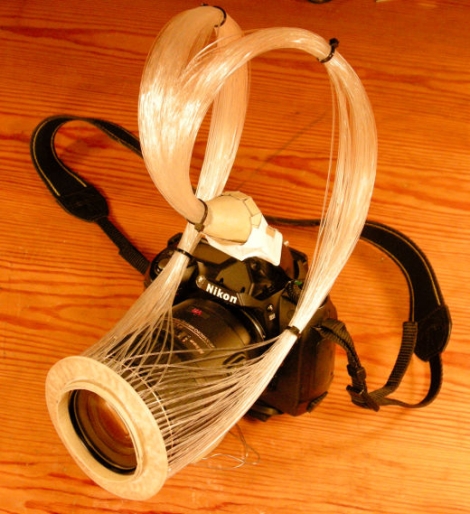
DIY ring light setups for DSLR cameras are nothing new around here. While most of them rely on an array of LEDs or a mirror-based light tube, [Wolf] had a different idea. He figured that since optical fibers are made specifically for transmitting light from one place to another, they would make a perfect medium for constructing a ring light.

Since he was using the camera’s built-in flash to power the ring light, he was able to provide a function that few other DIY ring lights do: proper flash compensation. Typically, a self-made ring light flashes at one set brightness, regardless of how much light is actually required to compose the image.

The construction was relatively simple, albeit time consuming. He procured a set of fiber optic cables that had been melted together into 150 small bundles, which he then glued to an acrylic ring that he fabricated. The end result isn’t the most aesthetically pleasing ring light we’ve ever seen, but it’s the pictures that matter at the end of the day. As you can see on his site, they speak for themselves.

Looking to build your own ring light? Check out a couple of other projects we have featured in the past.

Xbox 360 Controller Mod For A Friend In Need

xbox_controller_external_button_mod

[Adrian] has a friend that, due to an accident, can no longer play Xbox games in the standard fashion. His friend is unfortunately unable to hold the game pad properly, and no longer has the manual dexterity to reach the shoulder buttons and triggers on the top side of his Xbox 360 controller. Being the good guy that he is, he set out to see what he could do in order to bring the joy of playing Xbox back into his friend’s life.

Inspired by the many different gaming mods he has seen [Ben Heck] construct, he pulled apart an Xbox 360 wireless controller and began to investigate how the four top buttons were activated. In no time, he had four large buttons wired to the PCB where the triggers and shoulder buttons once connected.

[Adrian] mentions that his modification isn’t quite complete, as he is going to mount the buttons into a board which can easily be laid on his friend’s lap or a table. The only thing we are left wondering is whether or not he was able to replicate the analog functionality of the triggers, or if they are treated as simple on/off switches. Either way, we are sure his friend will be thrilled!

Self-balancing Robot Keeps Things On The Straight And Narrow

self_balancing_robot

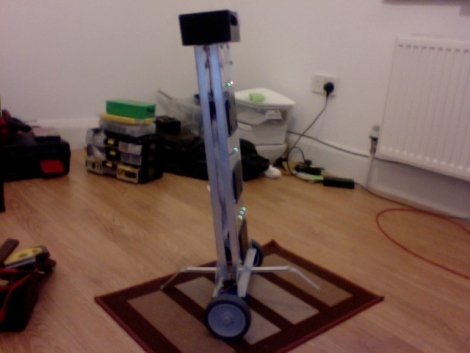
[James] designed a digital controller in MatLab, but he really wanted to see if it would work in a real-world application. To test out his linear quadratic regulator design, he decided to build a self-balancing robot. His goal was to built a robot that can keep its balance even when external forces are applied, all while staying in the same place.

Balancing on a pair of wheels is not all that simple, so his LQR controller allows him to weight the bot’s priorities towards keeping balance, focusing on returning to its starting position once equilibrium has been achieved. The results are pretty impressive as you can see in the videos below.  The robot is easily able to attain its balance once powered on, and it has no problem remaining stable even when pushed or when objects are placed on top of it.

[James] has plans for several enhancements in the near future, including remote control via Xbee modules as well as autonomous navigation utilizing sonar or possibly a camera. We’d totally love to see it sporting a Kinect sensor in a future revision, but that’s just us!

Keep reading for a couple of demo videos he put together.

[Thanks, Nicholas]

Continue reading “Self-balancing Robot Keeps Things On The Straight And Narrow”

LED Artwork Disappears Right Before Your Eyes

take_a_picture_demo

If you walked into an art gallery and saw nothing but blank canvases lining the wall, you might be compelled to demand your money back, or assume that you had discovered the world’s laziest artist. If this gallery happened to be displaying work by [Brad Blucher and Kyle Clements] however, you would be mistaken.

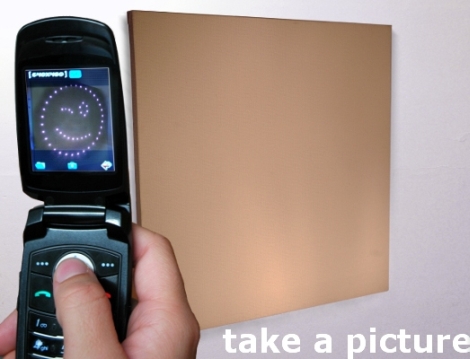
These two artists have collaborated to create a series of works titled, “Take a Picture“. Each picture they have built is constructed to look like an empty canvas when viewed with the naked eye. If you were to take a picture of the canvas with your cell phone or digital camera however, a whole new world would open up in front of your eyes. Their artwork is constructed using infrared LEDs, which cannot be seen with the naked eye, but are visible to nearly any CMOS or CCD sensor on the market. The images range from simple smiley faces and objects to abstract geometric shapes.

It’s a very simple, yet novel approach, and we happen to think it’s pretty cool. The artists have not said what they have planned for this project in the future, but we’d love to see it expanded using larger LED arrays to display higher-resolution images, or even short movies.

Keep reading to see how they went about creating these works of art as well as a promo video demonstrating the effect.

Continue reading “LED Artwork Disappears Right Before Your Eyes”

Remote Operated Security Gate Lets You Phone It In

ring_detection_circuit

[Itay] has a friend who works in a rented office where the parking lot is secured by a remote-controlled gate. Unfortunately, while his friend shares an office with several people, they only received a single remote. To help his friends out, he built a small device that triggers the remote control whenever a phone call is received.

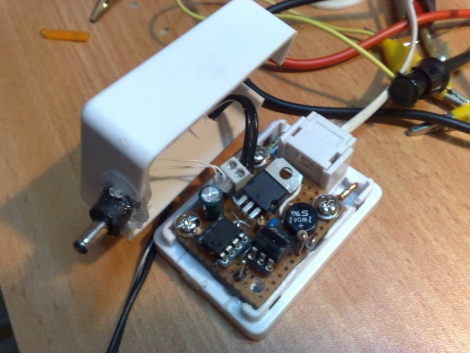
The remote modification was rather straightforward. He simply opened the device, adding a single wire to each button terminal. Rather than connect to the remote using wires, he decided to fit it with what looks like a scavenged DC power jack. The ring detector circuitry was constructed and stuffed in a small phone box, which is connected to the remote using a DC power plug. It’s a great solution to the problem, but let’s just hope no one gets a hold of the phone number they used for the trigger!

There are plenty of pictures on his site, as well as video of the ring detector being tested. Unfortunately [Itay] lost the original schematics for the circuit, so you will have to flesh that part out on your own if you wish to build a similar device.

Keep reading to see a few videos of the remote in testing and in use.

Continue reading “Remote Operated Security Gate Lets You Phone It In”

Pint-sized Nixie Display Fits Neatly In Your Pocket

[Brett] has had Nixie tubes on the brain ever since being introduced to them by a good friend of his. He decided that building a Nixie-based key chain would be the best way to familiarize himself with the technology, while also giving him a project to enter in the 555 Design Contest. He dug up the smallest Nixie tube he could find that displayed digits, and got down to business.

The biggest obstacle he ran into was figuring out how he would provide the high voltage required to light the Nixie tube. He eventually built a transformer circuit driven by a 555 timer, using a small 12v battery as his power source. Once everything was up and running on a breadboard, he designed and etched some PCBs, then soldered everything together.

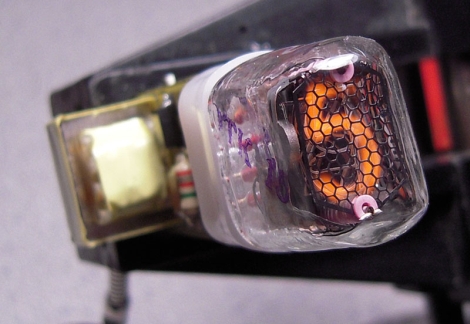
The end result is a nifty little key chain that flashes the number 5 when a button is pressed – pretty appropriate for the 555 contest. It’s a great looking project, though we’re still not 100% sure what we think about a naked high voltage circuit residing in our pocket.

Keep reading for a pair of videos documenting the key chain’s construction and operation.

Continue reading “Pint-sized Nixie Display Fits Neatly In Your Pocket”

mirror_hud

Bathroom Mirror HUD Displays Time And Weather

By and large, the standard household mirror is one item that has not made much real progress over the years. They hang on the wall reflecting light, and that’s about it.

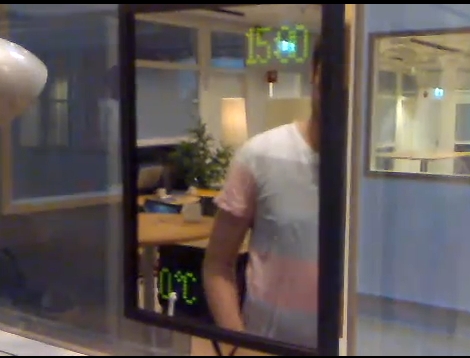
A few years back, some students studying in the Department of Interaction Design at Chalmers University sought to enhance their morning routine with an interactive mirror. Their project was constructed using a two-way mirror with several Arduino-driven LED displays embedded behind the glass. Once a hand is swiped past the pair of embedded light dependent resistors, the display is activated. Subsequent hand swipes trigger the mirror to toggle between the different modes, providing the user with the current time, weather information as well as a toothbrush timer.

The project writeup is quite thorough, including plenty of source code and information on some of the components they used. You can take a look at their work here (PDF).

Check out the interactive mirror we featured that served as inspiration for their project.

[Thanks Emil]

Continue reading “Bathroom Mirror HUD Displays Time And Weather”