MIDI Air Drums Let You Play Anywhere

[Maayan Migdal] wrote in to share a really cool drum kit he constructed that has one special twist – no drums at all. Using a simple MIDI device and an Arduino, his “Air Drums” look pretty sweet.

The hack makes use of a pair of garden rakes, which serve as his drum sticks. The rakes were cut down and modified to allow the addition of accelerometers and some USB cables. The left stick contains a single accelerometer for registering hi-hat hits, while the right stick is armed with a pair of the modules, which are used to trigger snare and crash symbol strikes. He modified a pair of sandals to fit better while drumming before adding a sensor to each shoe. The left sandal contains an accelerometer to register bass drum hits, while the right shoe uses a light sensor to simulate the use of a hi-hat pedal.

We think that the results are awesome, but feel free to check out the video below to see what we mean. If Guitar Hero wasn’t dead in the water on hiatus, we think this sort of setup would make a great replacement for the flimsy drum set that comes with the game.


Continue reading “MIDI Air Drums Let You Play Anywhere”

Sleek, Disc-less GameCube Handheld

sd_card_gamecube_handheld

Console hacker [techknott] has a skill set that is quite possibly second to none. We do love [Ben Heck] and think that his portable consoles are beyond awesome, but you’ve got to check out this portable GameCube [techknott] put together.

While the construction details are pretty sparse, the video below shows off the bulk of the portable ‘Cube’s best features. Far smaller than his Flip-Top GameCube or Dreamcast portables we’ve featured in the past, his new handheld sports a wider screen and is completely disc-less. While the legality of booting backup copies of games from an SD card is something we won’t delve into, we do like the concept.

The console itself is probably only about one and a half times the width of a standard GameCube controller, and while it doesn’t sport an internal battery pack, we wouldn’t turn one down. Besides, who wants to play GameCube outside? With one of these in hand, we are more than happy to keep our pasty selves indoors, thank you very much.

The only complaint we have here is the lack of build details. [techknott’s] handheld consoles are pretty amazing – we just wish that we could see how the magic was made!

Be sure to check out the video below to see the console in action.

[Thanks, Dave]

Continue reading “Sleek, Disc-less GameCube Handheld”

NTSC Video Out With The Papilio One

video_out_with_the_papilio_one

[Ben Leperchey] is working on building a Sega Master System clone using the Papilio One FPGA board, and although his ultimate goal has yet to be reached, he’s bringing some great stuff to the table in the meantime.

One component that is necessary for any sort of game system clone is NTSC/PAL video output, naturally. Since no one had constructed a TV output “Wing” (The Papilio One’s version of a shield or breakout board), [Ben] went and did it on his own. Using only 14 resistors and a low-pass audio filter, he was able to get the video output he was looking for with relatively little trouble. His VHDL code running on the Papilio does all the hard work of creating the video signal, while the wing he designed mostly handles the connectivity.

This is one of the first few projects/components we’ve seen come out of the Papilio camp, and it looks like things are off to a good start. We can’t wait to see the Master System implementation once it has been wrapped up!

Continue reading to see a quick video demonstration of the Papilio One and [Ben’s] TV output wing.

Continue reading “NTSC Video Out With The Papilio One”

Creating Halftone Pictures With A CNC Machine

cnc_halftone_images

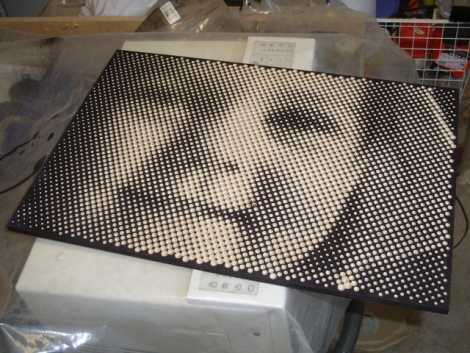
[Metalfusion], built himself a nice looking CNC machine and has been experimenting with some out of the box uses for his new tool. One novel use he is particularly fond of is creating pictures with his machine (Google Translation). While you might imagine that he is simply using the CNC as an engraver, literally drawing images on the surface of his workpiece, what he is doing is far more interesting.

He developed a small application that takes an image (jpeg, gif, or png) and converts it to a set of pixels, which can then be tweaked and skewed to his liking. The application exports the halftone image to a DXF file which can be fed into the CAD application that he uses to control his CNC machine. The CNC does the rest, using a v-shaped router bit to cut holes into his workpiece, generating a physical halftone picture from his digital image.

Thought the process does take some time to complete, the resulting images are well worth it. If you are interested in trying this at home using your own CNC machine, the DXF Halftone application is available on his site for free.

Continue reading to see his halftone generating CNC in action.

[via HackedGadgets]

Continue reading “Creating Halftone Pictures With A CNC Machine”

Microcontroller Communications Using Flashing Lights

phototransistor_pc_microcontroller_communications

[Scott] was driving in the pouring rain behind a car with its blinkers on when inspiration struck. He had previously created a simple communications system using his sound card that allowed him to send data to a microcontroller from his PC, but he thought that doing the same thing with light would be an interesting exercise.

He decided that the best way to go about building such a system would be to use a phototransistor along with his computer monitor to send data to his microcontroller. While he couldn’t really think of any practical application for the project, that didn’t stop him from putting it together just for grins.

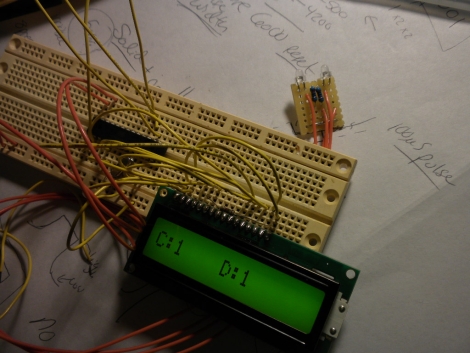
[Scott] says the circuit is dead-simple, and includes a pair of phototransistors along with their required resistors. The receiver was tied into the ADC of his microcontroller, where he was easily able to pick up some simple light patterns. His ultimate goal is to put together a javascript application that sends data to his microcontroller, though he’s looking for a bit of assistance on the programming side of things – any takers?

While [Scott] couldn’t come up with any applications off the top of his head, we know of at least one. Anyone familiar with the Bloomberg financial application will likely have come across their “B-Unit”. This piece of hardware is about the size of a credit card, but thicker. Armed with a fingerprint scanner and a photodiode, it reads a series of flashing lights from your computer screen in order to ‘synchronize’ the unit for each login session that is not initiated with an official Bloomberg keyboard. So there’s one for you!

Continue reading to see a video of the system in action.

Continue reading “Microcontroller Communications Using Flashing Lights”

Automated Water Distiller Gets An Overhaul

automated_water_distiller_stillduino_v2

One thing we love about the hacking community is the drive that most people have to revamp and rework their “finished” projects. A few weeks ago, we wrote about a water distilling rig that [Kyle] hacked together, which allowed him to automate his distillation process. He took his project back into the workshop and tweaked a few things, giving us the heads up when he was finished.

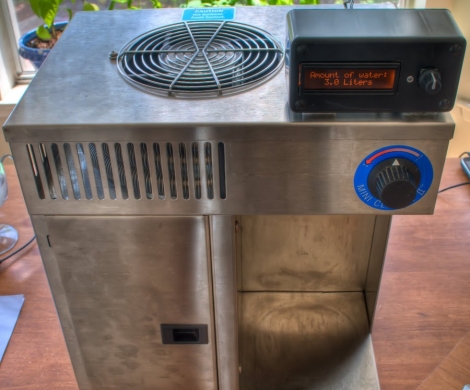
He got his hands on a new distillation unit and decided that he wanted to transfer over his automation setup. He cleaned things up by ditching most of the components from his first distiller, including the toy clock tower dial (which we happened to think was pretty fun). The same relays and Arduino were used in the second version of the still, but he reworked all of his code to make use of his new control interface.

The new model sports an LCD panel that allows the user to interact with the machine via a push button rotary encoder. Now he can easily navigate through a series of menus that enable him to set the distillation quantity and start time, leaving the distiller to do the hard work. The still also does a quick safety check each time it starts up, to ensure that things are in good working order before firing up the heating element.

[Kyle] says he will continue to tweak the distiller, though we think it looks great already.

Continue reading to see a quick video of his Stillduino v2 in action.

Continue reading “Automated Water Distiller Gets An Overhaul”

scout_diy_quadcopter

How To Build Your Own Quadcopter, Step By Step

DIY-er [Russell] wanted a quadcopter, and like many people out there, he knew the satisfaction that would come from building it himself. Rather than purchase a kit or follow a set of online instructions, he spent a lot of time researching quadcopters, and eventually put together a thorough tutorial himself.

His Arduino-based quadcopter is named Scout and runs about $1,000 to $1,200 depending on which parts you choose to buy. [Russell] has a complete parts list available on his site, including plenty of alternate component choices for builders on a budget.

He covers the construction process in great detail, discussing frame fabrication and component placement as well as how to program the Arduino for the copter’s first flight. He also takes the time to break down his component list item by item to explain how each piece is part of the greater puzzle, which is great for first time builders.

We love seeing this level of detail when discussing a build process, and as you can see by the video embedded below, his quadcopter looks great!

[Thanks, Willow]

Continue reading “How To Build Your Own Quadcopter, Step By Step”