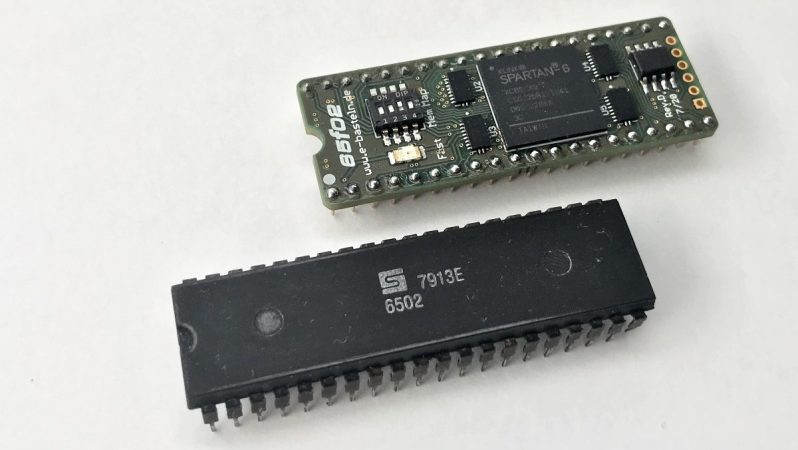
A 65f02 and 65c02

65F02 Is An FPGA 6502 With A Need For Speed

Does the in 65F02 “F” stand for “fast” or “FPGA”? [Jurgen] doesn’t know, but his drop-in replacement board for the 6502 and 65c02 is out there and open source, whatever you want it to stand for.

The “f” could easily be both, since at 100 MHz, the 65f02 is blazing fast by 6502 standards–literally 100 times the speed of the first chips from MOS. That speed comes from the use of a Spartan 6 FPGA core to implement the 6502 logic; making the “f” stand for “FPGA” makes sense, given that the CMOS version of the chip was dubbed the 65c02. The 65f02 is a tiny PCB containing the FPGA and all associated hardware that shares the footprint of a DIP-40 package, making it a drop-in replacement. A really fast drop-in replacement.

You might be thinking that that’s insane, and that (for example) the memory on an Apple ][ could never run at 100 MHz and so you won’t get the gains. This is both true, and accounted for: the 65F02 has an internal RAM “cache” that it mirrors to external memory at a rate the bus can handle. When memory addresses known to interact with peripherals change, the 65f02 slows down to match for “real time” operations.

The USB adapter board for programming is a great touch.

Because of this the memory map of the external machine matters; [Jurgen] has tested the Commodore PET and Apple ][, along with a plethora of German chess computers, but, alas, this chip is not currently compatible with the Commodore 64, Atari 400/800 or BBC Micro (or at least not tested). The project is open source, however, so you might be able to help [Jurgen] change that.

We admit this project isn’t totally new– indeed, it looks like [Jurgen]’s last update was in 2024– but a fast 6502 is just as obsolete today as it was when [Jurgen] started work in 2020. That’s why when [Stephen Walters] sent us the tip (via electronics-lab), we just had to cover it, especially considering the 6502’s golden jubilee.

We also recently featured a 32-bit version of the venerable chip that may be of interest, also on FPGA.
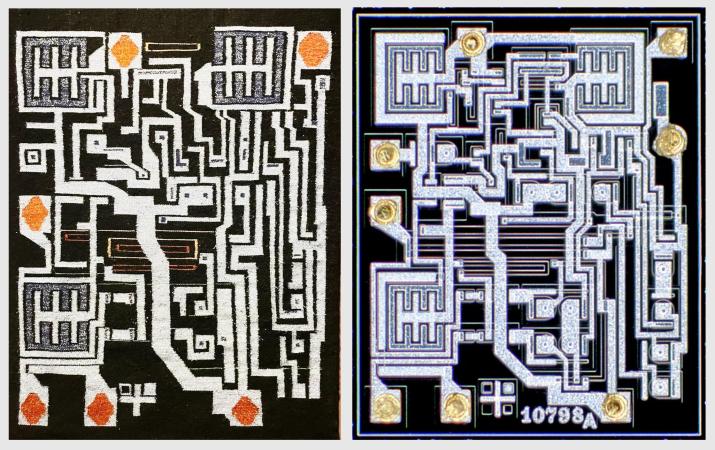
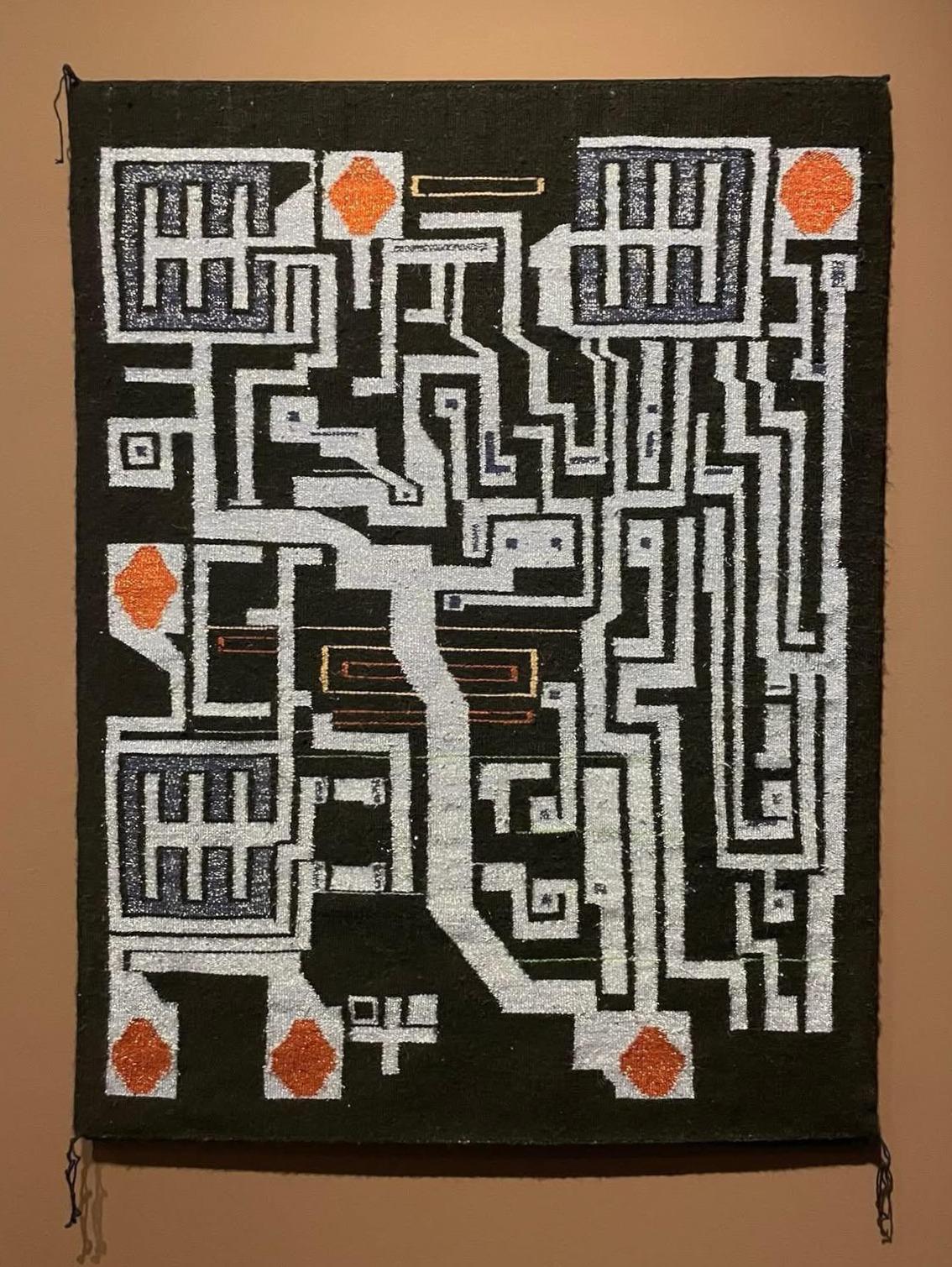
The weaving is on the left, a microphoto of the chip die is on the right.

The 555 As You’ve Never Seen It: In Textile!

The Diné (aka Navajo) people have been using their weaving as trade goods at least since European contact, and probably long before. They’ve never shied from adopting innovation: churro sheep from the Spanish in the 17th century, aniline dies in the 19th, and in the 20th and 21st… integrated circuits? At least one Navajo Weaver, [Marilou Schultz] thinks they’re a good match for the traditional geometric forms. Her latest creation is a woven depiction of the venerable 555 timer.

“Popular Chip” by Marilou Schultz. Photo courtesy of First American Art Magazine, via righto.com

This isn’t the first time [Marilou] has turned an IC into a Navajo rug; she’s been weaving chip rugs since 1994– including a Pentium rug commissioned by Intel that hangs in USA’s National Gallery of Art–but it’s somehow flown below the Hackaday radar until now. The closest thing we’ve seen on these pages was a beaded bracelet embedding a QR code, inspired by traditional Native American forms.

That’s why we’re so thankful to [VivCocoa] for the tip. It’s a wild and wonderful world out there, and we can’t cover all of it without you. Are there any other fusions of tradition and high-tech we’ve been missing out on? Send us a tip.

Rackintosh Plus Is The Form Factor Nobody Has Been Waiting For

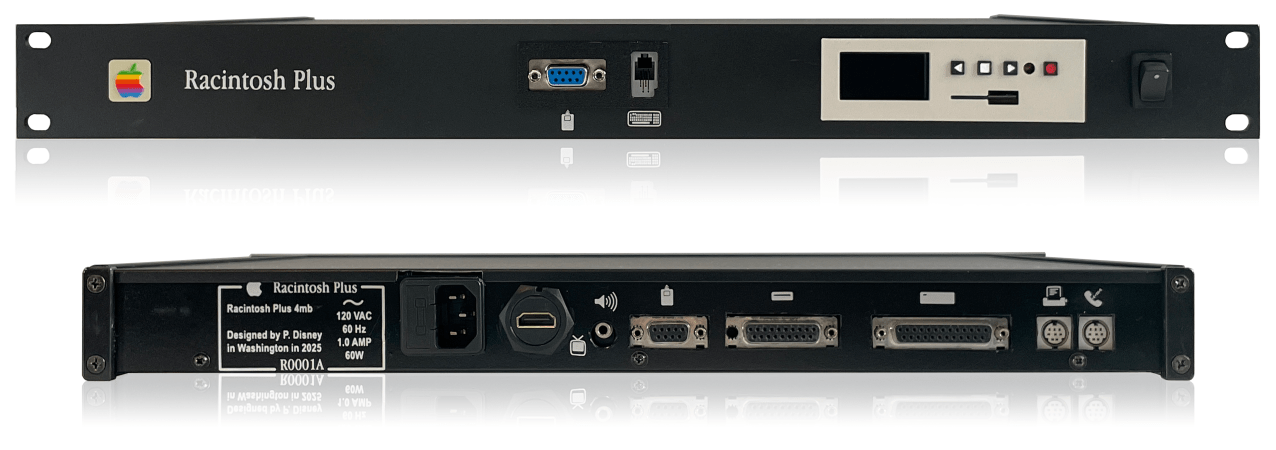
For all its friendly countenance and award-winning industrial design, there’s one thing the venerable Macintosh Plus can’t do: fit into a 1U rack space. OK, if we’re being honest with ourselves, there are a lot of things a Mac from 1986 can’t do, but the rack space is what [identity4] was focused on when they built the 2025 Rackintosh Plus.

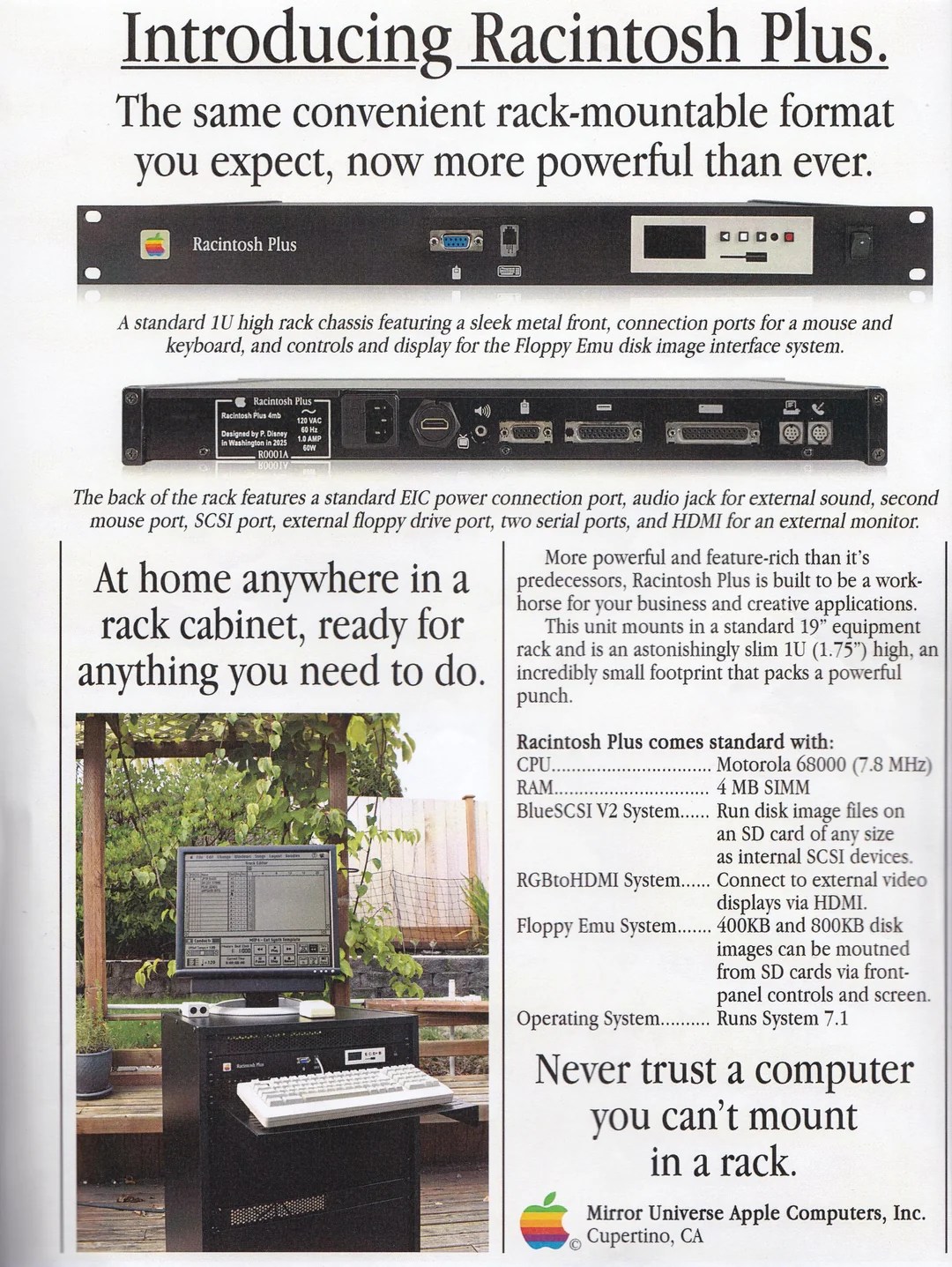
Some folks may have been fooled by this ad to think this was an actual product.

For those of you already sharpening your pitchforks, worry not: [identity4]’s beloved vintage Mac was not disassembled for this project. This rack mount has instead become the home for a spare logic board they had acquired Why? They wanted to use a classic Mac in their studio, and for any more equipment to fit the space, it needed to go into the existing racks. It’s more practical than the motivation we see for a lot of hacks; it’s almost surprising it hasn’t happened before. (We’ve seen Mac Minis in racks, but not the classic hardware.)

Aside from the genuine Apple logic board, the thin rack also contains a BlueSCSI hard drive emulator, a Floppy Emu for SD-card floppy emulator, an RGB-to-HDMI converter to allow System 7 to shine on modern monitors, and of course a Mean Well power supply to keep everything running.The Floppy Emu required a little light surgery to move the screen so it would fit inside the low-profile rack. [identity4] also broke out the keyboard and mouse connectors to the front of the rack, but all other connectors stayed on the logic board at the rear.

Sound is handled by a single 8-ohm speaker that lives inside the rack mount, because even if the Rackintosh can now fit into a 1U space, it still can’t do stereo sound…or anything else a Macintosh Plus with 4 MB of RAM couldn’t do. Still, it’s a lovely hack. and the vintage-style advertisement was an excellent touch.

Now they just need the right monochrome display.

Was Action! The Best 8-Bit Language?

Most people’s memories of programming in the 8-bit era revolve around BASIC, and not without reason. Most of the time, it was all we had. On the other hand, there were other options if you sought them out, and [Paul Lefebvre] makes the case that Goto10Retro that Action! was the best of them.

The limits of BASIC as an interpreted language are well-enough known that we needn’t go over them here. C and Pascal were available for some home computers in the 1980s, and programs written in those languages ran well, but compiling them? That was by no means guaranteed.

The text editor. Unusual for Atari at the time, it allowed scrolling along a line of greater than 40 char.

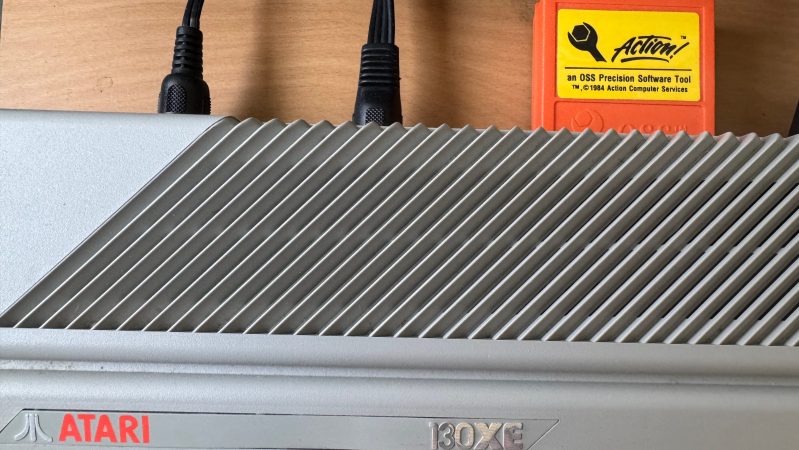
For those who lived on the Atari side of the fence, the Action! language provided a powerful alternative. Released by Optimized Systems Software in 1983, Action! was heavily optimized for the 6502, to the point that compiling and running simple programs with “C” and “R” felt “hardly slower” than typing RUN in BASIC. That’s what [Paul] writes, anyway, but it’s a claim that almost has to be seen to be believed.

You didn’t just get a compiler for your money when you bought Action!, though. The cartridge came with a capable text editor, simple shell, and even a primitive debugger. (Plus, of course, a hefty manual.) It’s the closest thing you’d find to an IDE on a computer of that class in that era, and it all fit on a 16 kB cartridge. There was apparently also a disk release, since the disk image is available online.

Unfortunately for those of us in Camp Commodore, the planned C-64 port never materialized, so we missed out on this language.  Luckily our 64-bit supercomputers can easily emulate Atari 8-bit hardware and we can see what all the fuss was about. Heck, even our microcontrollers can do it. 


O Brother, What Art Thou?

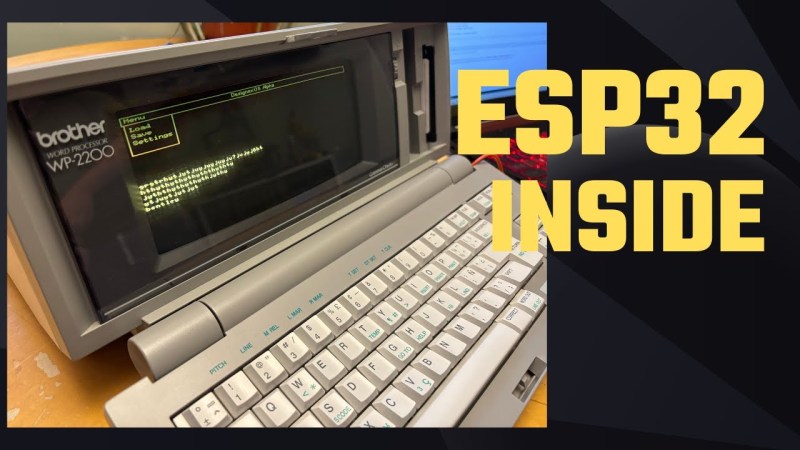
Dedicated word processors are not something we see much of anymore. They were in a weird space: computerized, but not really what you could call a computer, even in those days. More like a fancy typewriter, with a screen and floppy disks. Brother made some very nice ones, and [Chad Boughton] got his hands on one for a modernization project.

The word processor in question, a Brother WP-2200, was chosen primarily because of its beautiful widescreen, yellow-phosphor CRT display. Yes, you read that correctly — yellow phosphor, not amber. Widescreen CRTs are rare enough, but that’s just different. As built, the WP-2200 had a luggable form-factor, with a floppy drive, ̶m̶e̶c̶h̶a̶n̶i̶c̶a̶l̶ clacky keyboard, and dot-matrix printer in the back. Continue reading “O Brother, What Art Thou?” →

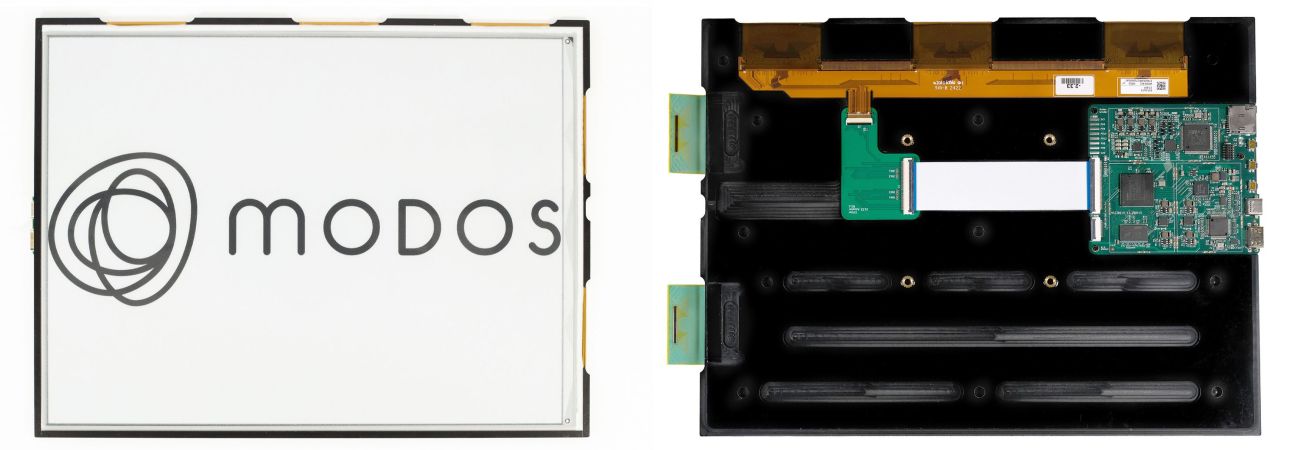
Front and back view of the 13.7" monitor kit

Modos Is Open Hardware, Easy On The Eyes

Since e-ink first hit the market a couple decades back, there’s always murmurs of “that’d be great as a second monitor”— but very, very few monitors have ever been made. When the commecial world is delivering very few options, it leaves room for open source hardware projects, like the Modos Glider and Paper Monitor, projects now seeking funding on Crowd Supply.

As far as PC monitors go, the Modos isn’t going to win many awards on specs alone. The screen is only 13.3″ across, and its resolution maxes out at 1600 x 1200. The refresh rate would be totally unremarkable for a budget LCD, at 75 Hz. This Paper Monitor isn’t an LCD, budget or otherwise, and for e-ink, 75 Hz is a blazing fast refresh rate. Continue reading “Modos Is Open Hardware, Easy On The Eyes” →

Ore Formation Processes, Part Two: Hydrothermal Boogaloo

There’s a saying in mine country, the kind that sometimes shows up on bumper stickers: “If it can’t be grown, it has to be mined.” Before mining can ever start, though, there has to be ore in the ground. In the last edition of this series, we learned what counts as ore (anything that can be economically mined) and talked about the ways magma can form ore bodies. The so-called magmatic processes are responsible for only a minority of the mines working today. Much more important, from an economic point of view, are the so-called “hydrothermal” processes.

Come back in a few million years, and Yellowstone will be a great mining province.
Image: “Gyser Yellowstone” by amanderson2, CC BY 2.0

When you hear the word “hydrothermal” you probably think of hot water; in the context of geology, that might conjure images of Yellowstone and regions like it : Old Faithful geysers and steaming hot springs. Those hot springs might have a role to play in certain processes, but most of the time when a geologist talks about a “hydrothermal fluid” it’s a lot hotter than that.

Is there a point on the phase diagram that we stop calling it water? We’re edging into supercritical fluid territory, here. The fluids in question can be hundreds of degrees centigrade, and can carry things like silica (SiO2) and a metal more famous for not dissolving: gold. Perhaps that’s why we prefer to talk about a “fluid” instead of “water”. It certainly would not behave like water on surface; on the surface it would be superheated steam. Pressure is a wonderful thing.

Let’s return to where we left off last time, into a magma chamber deep underground. Magma isn’t just molten rock– it also contains small amounts of dissolved gasses, like CO2 and H2O. If magma cools quickly, the water gets trapped inside the matrix of the new rock, or even inside the crystal structure of certain minerals. If it cools slowly, however? You can get a hydrothermal fluid within the magma chamber.

Continue reading “Ore Formation Processes, Part Two: Hydrothermal Boogaloo” →