Jointly Is A Typeface Designed For CNC Joinery

If you have a CNC router, you know you can engrave just about any text with the right tool, but Jointly is a typeface that isn’t meant to be engraved. That would be too easy for [CobyUnger]. His typeface “Jointly” is the first we’ve seen that’s meant to be used as joinery.
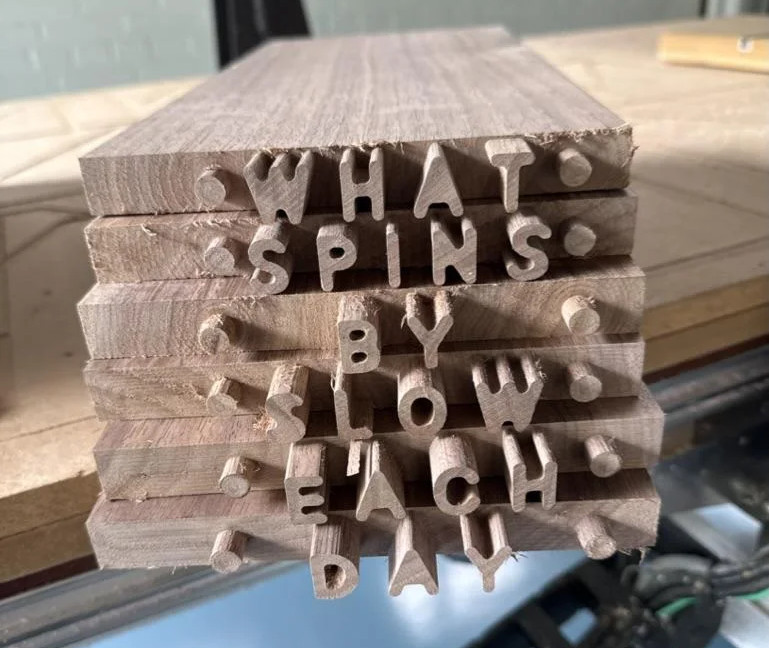
The idea is simple: carve mortises that take the shape of letters in one piece, and carve matching letter-tenons into the end of another. Push them together, and voila: a joint! To get this concept to work reliably, the font did have to be specially designed — both the inner and outer contours need to be accessible to a rotary cutting tool. Cutting tools get harder to use the smaller they go (or more fragile, at any rate) so with Jointly, the design spec was that any letters over 3/4″ (19.05 mm) tall needed to be handled with a 1/8″ (3.175 mm) rotary cutter.

This gives the font a friendly curved appearance we find quite fetching. Of course if you’re going to be cutting tenons into the end of a board, you’re going to need either some serious z-depth or an interesting jig to get the end of the board under the cutting head. It looks like [CobyUnger] has both, but he mentions the possibility of using a handheld CNC router as the cheaper option.

Speaking of routing out type, do you know the story of Gorton? You can’t make joinery with that typeface, but you’ve almost certainly seen it.


Off To The Races With ESP32 And EInk

Off to the races? Formula One races, that is. This project by [mazur8888] uses an ESP32 to keep track of the sport, and display a “live” dashboard on a 2.9″ tri-color LCD.

“Live” is in scare quotes because updates are fetched only every 30 minutes; letting the ESP32 sleep the rest of the time gives the tiny desk gadget a smaller energy footprint. Usually that’s to increase battery life, but this version of the project does not appear to be battery-powered. Here the data being fetched is about overall team rankings, upcoming races, and during a race the current occupant of the pole-position.

There’s more than just the eInk display running on the ESP32; as with many projects these days, micro-controller is being pressed into service as a web server to host a full dashboard that gives extra information as well as settings and OTA updates. The screen and dev board sit inside a conventional 3D-printed case.

Normally when talking Formula One, we’re looking into the hacks race teams make. This hack might not do anything revolutionary to track the racers, but it does show a nice use for a small e-ink module that isn’t another weather display. The project is open source under a GPL3.0 license with code and STLs available on GitHub.

Thanks to [mazur8888]. If you’ve got something on the go with an e-ink display (or anything else) send your electrophoretic hacks in to our tips line; we’d love to hear from you.

E-Waste And Waste Oil Combine To Make Silver

As the saying goes, “if it can’t be grown, it has to be mined”– but what about all the metals that have already been wrested from the bosom of the Earth? Once used, they can be recycled– or as this paper charmingly puts it, become ore for “urban mining” techniques. The technique under discussion in the Chemical Engineering Journal is one that extracts metallic silver from e-waste using fatty acids and hydrogen peroxide.

This “graphical abstract” gives the rough idea.

Right now, recycling makes up about 17% of the global silver supply. As rich sources of ore dry up, and the world moves to more sustainable footing, that number can only go up. Recycling e-waste already happens, of course, but in messy, dangerous processes that are generally banned in the developed world. (Like open burning, of plastic, gross.)

This paper describes a “green” process that even the most fervant granola-munching NIMBY wouldn’t mind have in their neighborhood: hot fatty acids (AKA oil) are used as an organic solvent to dissolve metals from PCB and wire. The paper mentions sourcing the solvent from waste sunflower, safflower or canola oil. As you might imagine, most metals, silver included, are not terribly soluble in sunflower oil, but a little refining and the addition of 30% hydrogen peroxide changes that equation.

More than just Ag is picked up in this process, but the oils do select for silver over other metals. The paper presents a way to then selectively precipitate out the silver as silver oleate using ethanol and flourescent light. The oleate compound can then be easily washed and burnt to produce pure silver.

The authors of the paper take the time to demonstrate the process on a silver-plated keyboard connector, so there is proof of concept on real e-waste. Selecting for silver means leaving behind gold, however, so we’re not sure how the economics of this method will stack up.

Of course, when Hackaday talks about recycling e-waste, it’s usually more on the “reuse” part of “reduce, reuse, recycle”.  After all, one man’s e-waste is another man’s parts bin–or priceless historical artifact.

Thanks to [Brian] for the tip.Your tips can be easily recycled into Hackaday posts through an environmentally-friendly process via our tipsline. 

Aussie Researchers Say They Can Bring The Iron Age To Mars

It’s not martian regolith, bu it’s the closest chemical match available to the dirt in Gale Crater. (Image: Swinburne University)

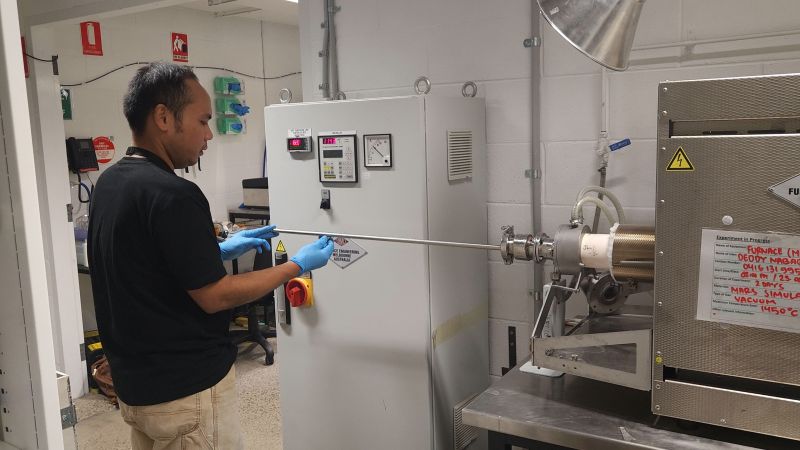
Every school child can tell you these days that Mars is red because it’s rusty. The silicate rock of the martian crust and regolith is very rich in iron oxide. Now Australian researchers at CSIRO and Swinburn University claim they know how to break that iron loose.

In-situ Resource Utilization (IRSU) is a big deal in space exploration, with good reason. Every kilogram of resources you get on site is one you don’t have to fight the tyranny of the rocket equation for. Iron might not be something you’d ever be able to haul from Earth to the next planet over, but when you can make it on site? You can build like a Victoria is still queen and it’s time to flex on the French.

The key to the process seems to be simple pyrolysis: they describe putting dirt that is geochemically analogous to martian regolith into a furnace, and heating to 1000 °C under Martian atmospheric conditions to get iron metal. At 1400 °C, they were getting iron-silicon alloys– likely the stuff steelmakers call ferrosilicon, which isn’t something you’d build a crystal palace with.

It’s not clear how economical piling red dust into a thousand-degree furnace would be on Mars– that’s certainly not going to cut it on Earth– but compared to launch costs from Earth, it’s not unimaginable that martian dirt could be considered ore.

ESP32 Hosts Functional Minecraft Server

If you haven’t heard of Minecraft, well, we hope you enjoyed your rip-van-winkle nap this past decade or so. For everyone else, you probably at least know that this is a multiplayer, open world game, you may have heard that running a Minecraft server is a good job for maxing out a spare a Raspberry Pi. Which is why we’re hugely impressed that [PortalRunner] managed to squeeze an open world onto an ESP32-C3.

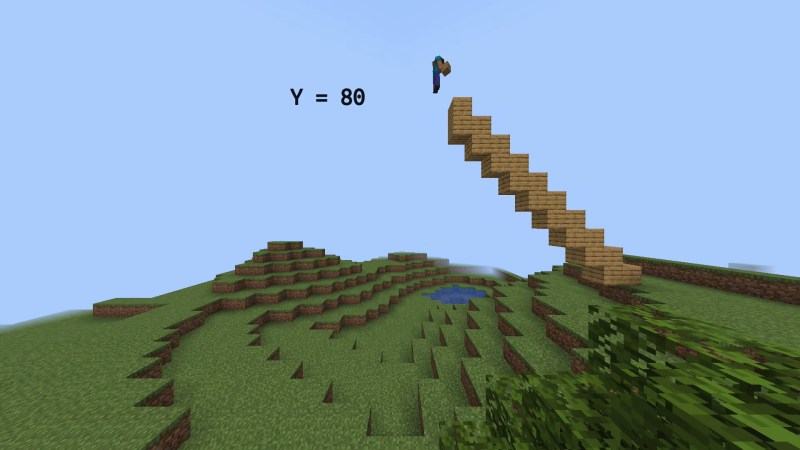
Of course, the trick here is that the MCU isn’t actually running the game — it’s running bareiron, [PortalRunner]’s own C-based Minecraft server implementation. Rewriting the server code in C allows it to be optimized for the ESP32’s hardware, but it also let [PortalRunner] strip his server down to the bare essentials, and tweak everything for performance. For example, instead of the multiple octaves of Perlin noise for terrain generation, with every chunk going into RAM, he’s using the x and z of the corners as seeds for the psudorandom rand() function, and interpolating between them. Instead of caves being generated by a separate algorithm, and stored in memory, in bareiron the underground is just a mirror-image of the world above. Biomes are just tiled, and sit separately from one another.

So yes, what you get from bareiron is simpler than a traditional Minecraft world — items are simplified, crafting is simplified, everything is simplified, but it’s also running on an ESP32, so you’ve got to give it a pass. With 200 ms to load each chunk, it’s playable, but the World’s Smallest Minecraft Server is a bit like a dancing bear: it’s not about how well it dances, but that it dances at all.

This isn’t the first time we’ve seen Minecraft’s server code re-written: some masochist did it in COBOL, but at least that ran on an actual computer, not a microcontroller. Speaking of low performance, you can’t play Minecraft on an SNES, but you can hide the game inside a cartridge, which is almost as good.

Thanks to [CodeAsm] for the tip. Please refer any other dancing bears spotted in the wild to our tips line.

Continue reading “ESP32 Hosts Functional Minecraft Server” →

Musical Motors, BLDC Edition

This should count as a hack: making music from a thing that should not sing. In this case, [SIROJU] is tickling the ivories with a Brushless DC motor, or BLDC. 

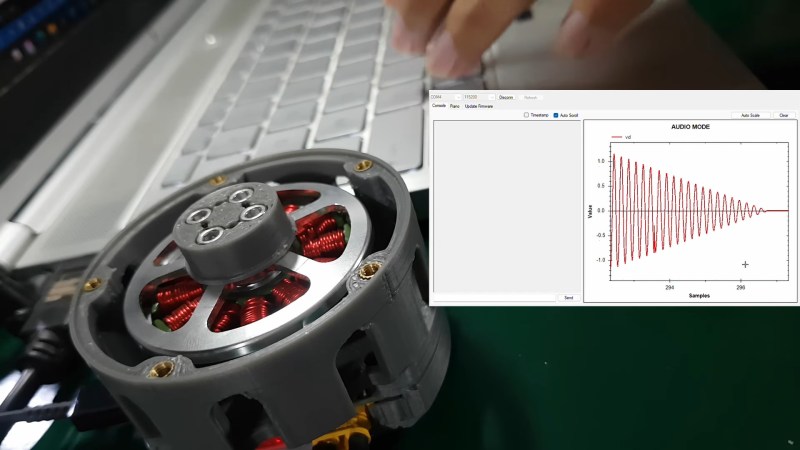
To listen to a performance, jump to 6:27 in the embedded video. This BLDC has a distinctly chip-tune like sound, not entirely unlike other projects that make music with stepper motors. Unlike most stepper-based instruments we’ve seen [SIROJU]’s BLDC isn’t turning as it sings. He’s just got it vibrating by manipulating the space vector modulation that drives the motor — he gets a response of about 10 kHz that way. Not CD-quality, no, but plenty for electronic music. He can even play chords of up to 7 notes at a time.

There’s no obvious reason he couldn’t embed the music into a proper motor-drive signal, and thus allow a drone to hum it’s own theme song as it hovers along. He’s certainly got the chops for it; if you haven’t seen [SIROJU]’s videos on BLDC drivers on YouTube, you should check out his channel. He’s got a lot of deep content about running these ubiquitous motors. Sure, we could have just linked to him showing you how to do FOC on an STM32, but “making it sing” is an expression for mastery in English, and a lot more fun besides.

There are other ways to make music with motors. If you know of any others, don’t hesitate to send us a tip.

Continue reading “Musical Motors, BLDC Edition” →

Old Phone Upcycled Into Pico Projector, ASMR

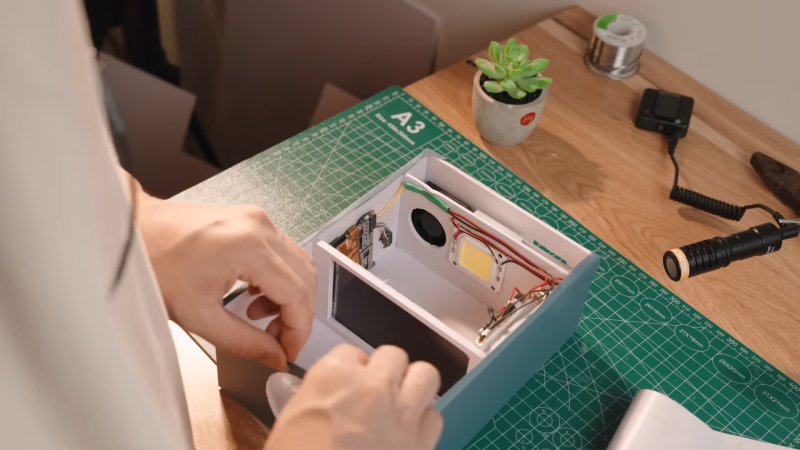
To update an old saying for the modern day, one man’s e-waste is another man’s bill of materials. Upcycling has always been in the hacker’s toolkit, and cellphones provide a wealth of resources for those bold enough to seize them. [Huy Vector] was bold enough, and transformed an old smartphone into a portable pico projector and an ASMR-style video. That’s what we call efficiency!

Kidding aside, the speech-free video embedded below absolutely gives enough info to copy along with [Huy Vector] even though he doesn’t say a word the whole time. You’ll need deft hands and a phone you really don’t care about, because one of the early steps is pulling the LCD apart to remove the back layers to shine an LED through. You’ll absolutely need an old phone for that, since that trick doesn’t apply to the OLED displays that most flagships have been rocking the past few years.

Continue reading “Old Phone Upcycled Into Pico Projector, ASMR” →