Unlocking The Mystery Of An Aircraft ADI

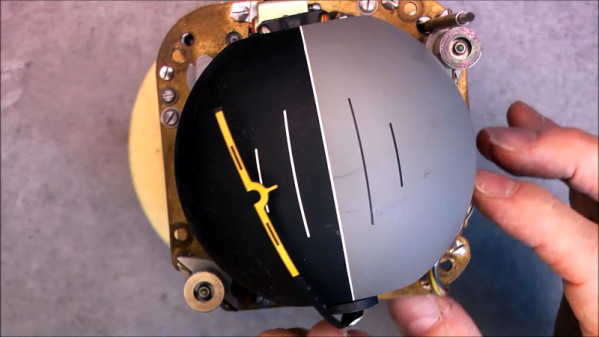
If you’ve ever seen the cockpit of an airplane, you’ve probably noticed the round ball that shows your attitude, and if you are like us, you’ve wondered exactly how the Attitude Direction Indicator (ADI) works. Well, [msylvain59] is tearing one apart in the video below, so you can satisfy your curiosity in less than 30 minutes.

Like most things on an airplane, it is built solidly and compactly. With the lid open, it reminded us of a tiny CRT oscilloscope, except the CRT is really the ball display. It also has gears, which is something we don’t expect to see in a scope.

Continue reading “Unlocking The Mystery Of An Aircraft ADI”

Korean Multifunction Counter Teardown

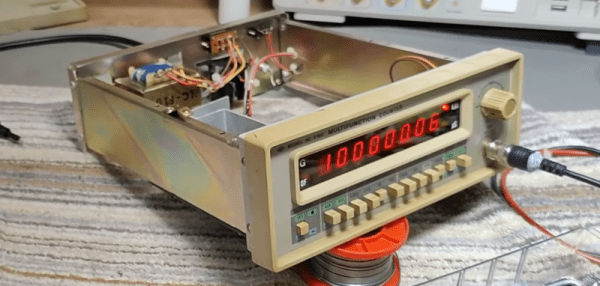
[Thomas Scherrer] likes to tear down old test equipment, and often, we remember the devices he opens up or — at least — we’ve heard of them. However, this time, he’s got a Hung Chang HC-F100 multifunction counter, which is a vintage 1986 instrument that can reach 100 MHz.

Inside, the product is clearly a child of its time period. There’s a transformer for the linear supply, through-hole components, and an Intersil frequency counter on a chip. Everything is easy to get to and large enough to see.

Continue reading “Korean Multifunction Counter Teardown”

New Battery Has No Anode

Conventional batteries have anodes and cathodes, but a new design from the University of Chicago and the University of California San Diego lacks an anode. While this has been done before, according to the University, this is the first time a solid-state sodium battery has successfully used this architecture.

Sodium is abundant compared to lithium, so batteries that use sodium are attractive. According to the University of Chicago’s news release:

Anode-free batteries remove the anode and store the ions on an electrochemical deposition of alkali metal directly on the current collector. This approach enables higher cell voltage, lower cell cost, and increased energy density…

Continue reading “New Battery Has No Anode”

Hacking A Brother Label Maker: Is Your CUPS Half Empty Or Half Full?

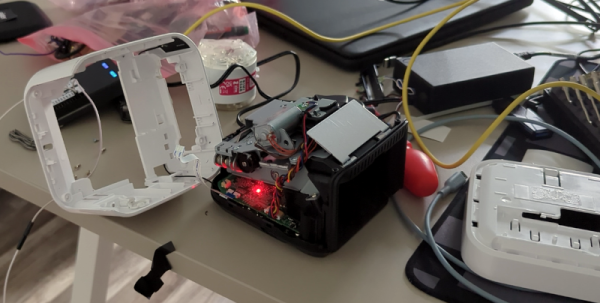
On the one hand, we were impressed that a tiny Brother label maker actually uses CUPS to support printing. Like [Sdomi], we were less than impressed at how old a copy it was using – – 1.6.1. Of course, [Sdomi] managed to gain access to the OS and set things up the right way, and we get an over-the-shoulder view.

It wasn’t just the old copy of CUPS, either. The setup page was very dated and while that’s just cosmetic, it still strikes a nerve. The Linux kernel in use was also super old. Luckily, the URLs looked like good candidates for command injection.

Continue reading “Hacking A Brother Label Maker: Is Your CUPS Half Empty Or Half Full?”

New Solar Spheres Claim To Be Better Than Solar Panels

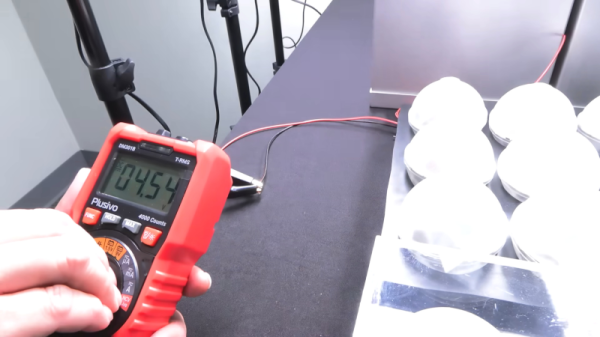
When you think of solar energy, you probably think of flat plates on rooftops. A company called WAVJA wants you to think of spheres. The little spheres, ranging from one to four inches across, can convert light into electricity, and the company claims they have 7.5 times the output of traditional solar panels and could later produce even more. Unfortunately, the video below doesn’t have a great deal of detail to back up the claims.

Some scenes in the video are clearly forward-looking. However, the so-called photon energy system appears to be powering a variety of real devices. It’s difficult to assess some of the claims. For example, the video claims 60 times the output of a similar-sized panel. But you’d hardly expect much from a tiny 4-inch solar panel.

Continue reading “New Solar Spheres Claim To Be Better Than Solar Panels”

Dad? Where Did Printed Circuit Boards Come From?

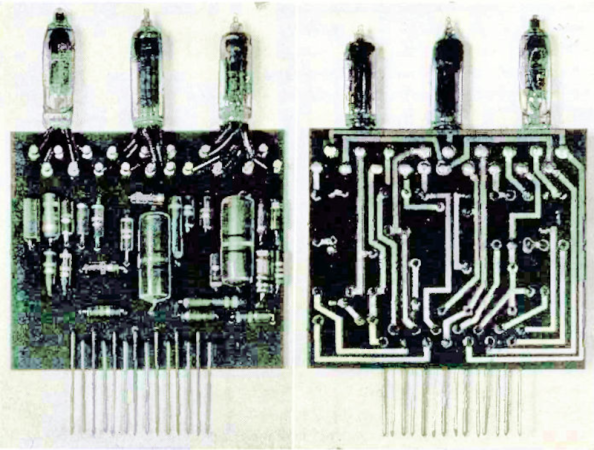
These days, it is hard to imagine electronics without printed circuit boards. They are literally in everything. While making PCBs at home used to be a chore, these days, you design on a computer, click a button, and they show up in the mail. But if you go back far enough, there were no PC boards. Where did they come from? That’s the question posed by [Steven Leibson] who did some investigating into the topic.

There were many false starts at building things like PCBs using wires glued to substrates or conductive inks.  However, it wasn’t until World War II that mass production of PC boards became common. In particular, they were the perfect solution for proximity fuzes in artillery shells.

Continue reading “Dad? Where Did Printed Circuit Boards Come From?”

A Trip Down Electronic Toy Memory Lane

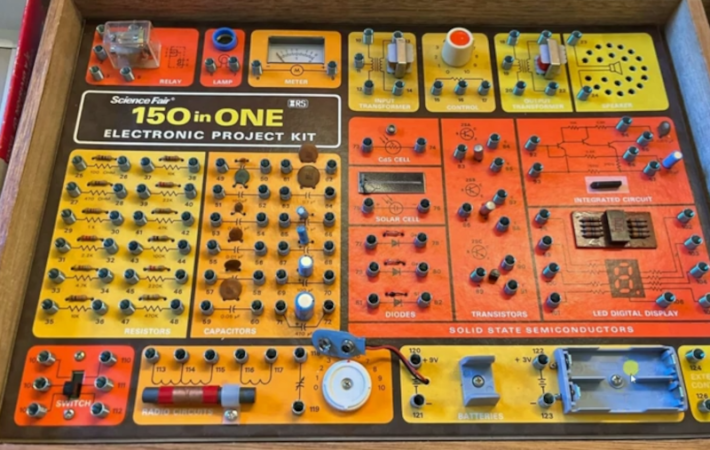
Like many of us, [MIKROWAVE1] had a lot of electronic toys growing up. In a video you can watch below, he asks the question: “Did electronic toys influence your path?” Certainly, for us, the answer was yes.

The CB “base station” looked familiar although ours was marked “General Electric.” Some of us certainly had things similar to the 150-in-one kit and versions of the REMCO broadcast system. There were many versions of crystal radio kits, although a kit for that always seemed a little like cheating.

Continue reading “A Trip Down Electronic Toy Memory Lane”