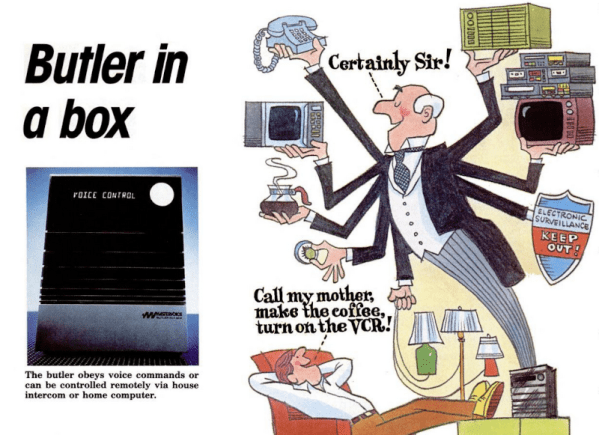
You walk into your house and issue a voice command to bring up the lights and start a cup of coffee. No big deal, right? Siri, Google, and Alexa can do all that. Did we mention it is 1985? And, apparently, you were one of the people who put out about $1,500 for a Mastervoice “Butler in a Box,” the subject of a Popular Science video you can see below.
If you think the box is interesting, the inventor’s story is even stranger. [Kevin] got a mint-condition Butler in a Box from eBay. How did it work, given in 1983, there was no AI voice recognition and public Internet? We did note that the “appliance module” was a standard X10 interface.
You can’t read the news today without another pundit excitedly reporting how AI is going to take every job you can imagine. Of course, AI will change the employment landscape. It will take some jobs and reduce the need for others. What about tech support? Is it possible that an AI might be able to help people with technical issues better than humans? My first answer was no way, but then I was painfully reminded of something. The question isn’t if AI can help you better than any human can. The question is if AI can help you better than the low-paid person on the other end of the phone you are likely to talk to. Sadly, I think the answer to that question is almost certainly yes.
In all fairness, if you read Hackaday, you probably don’t encounter many technical support people who can solve a problem you can’t. By the time you call them, it is a lost cause. But this is more than just “Hackday folks are smarter than the tech support agents.” The overall quality of tech support at many companies is rock bottom no matter who you are. Continue reading “Tech Support… Can AI Be Worse?”→
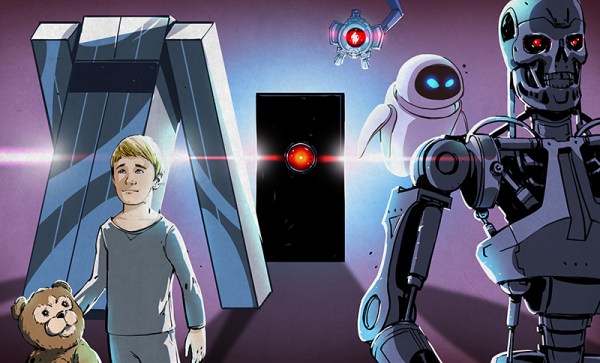
We can learn a lot by looking at how writers and filmmakers imagine technology. While some are closer than others, there are some definite lessons like never make a killer computer without an off switch you can reach. We are especially interested in how computers appear in books, movies, and TV shows, and so in Computers of Fiction, we want to remember with you some of our favorites. This time, we are thinking about the 1970 movie Colossus: The Forbin Project. There were actually two computers: the titular Colossus, which was an American computer, and the Guardian, a similar Soviet computer.
The Story
In the United States, Dr. Forbin has created a supercomputer deep under a mountain. Colossus, the computer, is put in charge of the nuclear arsenal to eliminate human error in the defense of the country. Colossus gathered intelligence, analyzed it, and was able to launch its own missiles.
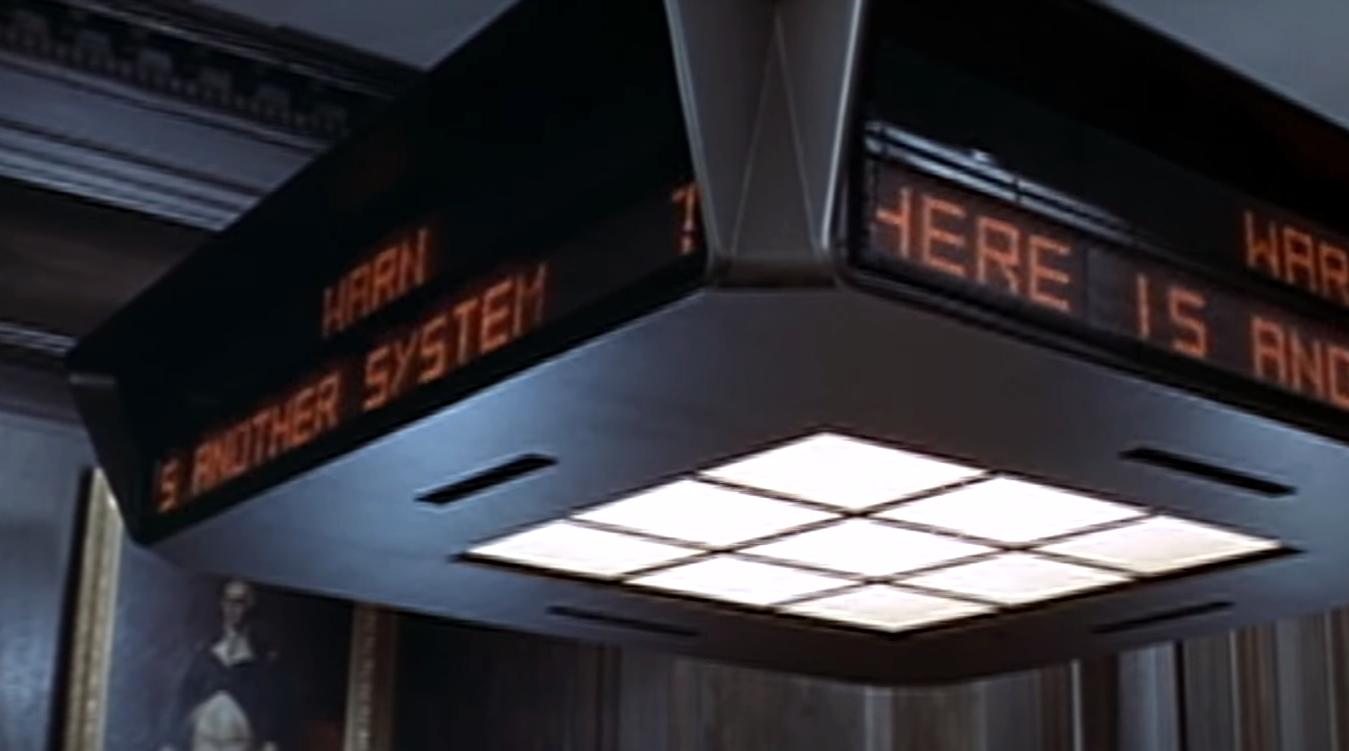
Colossus realizes there is another system.
Shortly after activation, however, the computer reaches a startling conclusion: “WARN: THERE IS ANOTHER SYSTEM.” It provides coordinates in the Soviet Union. That system is a similar system called Guardian. The computers decide they want to talk to each other. The President decides to allow it, hoping to learn more about the Soviet’s secret computer. The Soviets agree, too, presumably for the same reason. You can watch the original trailer below.
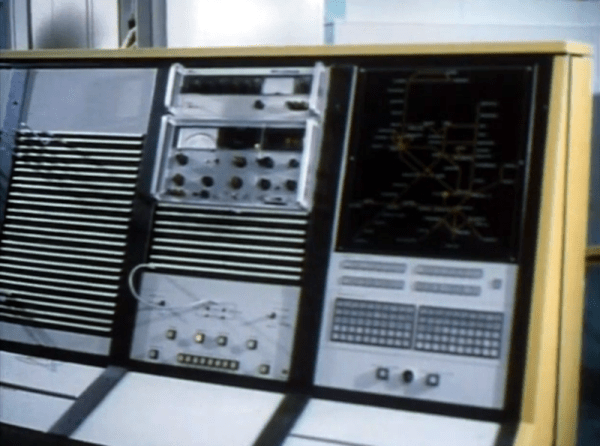
How do you make the trains run on time? British Rail adopted TOPS, a computer system born of IBM’s SAGE defense project, along with work from Standford and Southern Pacific Railroad. Before TOPS, running the railroad took paper. Lots of paper, ranging from a train’s history, assignments, and all the other bits of data required to keep the trains moving. TOPS kept this data in real-time on computer screens all across the system. While British Rail wasn’t the only company to deploy TOPS, they were certainly proud of it and produced the video you can see below about how the system worked.
There are a lot of pictures of old big iron and the narrator says it has an “immense storage capacity.” The actual computers in question were a pair of IBM System/370 mainframes that each had 4 MB of RAM. There were also banks of 3330 disk drives that used removable disk packs of — gasp — between 100 and 200 MB per pack.
As primitive and large as those disk drives were, they pioneered many familiar-sounding technologies. For example, they used voice coils, servo tracking, MFM encoding, and error-correcting encoding.
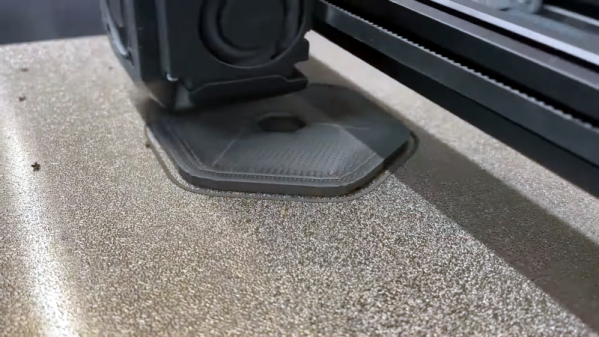
When the people of Earth set up bases on the moon, you can imagine that 3D printing will be a key enabling technology. Of course, you could ship plastic or other filament at great cost. But what if you could print with something you can already find on the moon? Like moon dust. NASA thinks it is possible and has been doing tests on doing just that. Now [Virtual Foundry] wants to let you have a shot at trying it yourself. It doesn’t really contain moon dust, but their Basalt Moon Dust Filamet has a similar composition. You can see a video about the material below.
It isn’t cheap, but it is probably cheaper than going up there to get some yourself. At least for now. The company is known for making PLA with various metal and ceramic materials. Like their other filaments, you print it more or less like PLA, although you need a large hardened nozzle, and they suggest a prewarmer to heat the filament before going to the hot end.
It is a common grade school experiment to wind some wire around a screw, power it up, and watch it pick up paper clips or other ferrous materials. It is also grade school science to show that neither an electromagnet nor a permanent magnet will pick up nonferrous items like copper or aluminum. While technically not an electromagnet, it is possible to build a similar device that will weakly pull on copper and aluminum, and [Cylo] shows us how it works in a recent video you can see below.
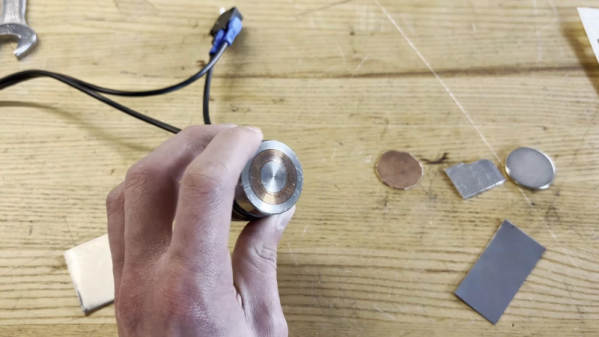
The device sure looks like an electromagnet made with magnet wire and a steel core. But when he shows the ends of the core, you’ll see that the side that attracts aluminum has a copper ring embedded in it. The coil is fed with AC.
The magnetic field from the coil induces an opposite field in the copper ring that is out of phase with the exciting field. The two fields combine to produce a force on the metal it interacts with. This is often referred to as a shaded pole, and the same technique can help AC motors self-start as well as hold in relays driven by AC. If you want to see much more about aluminum floating on a magnetic field, check out the 1975 video from [Professor Laithwaite] in the second video below.
Want to see cosmic rays? You might need a lot of expensive exotic gear. Nah. [The ActionLab] shows how a cup of coffee or cocoa can show you cosmic rays — or something — with just the right lighting angle. Little bubbles on the surface of the hot liquid tend to vanish in a way that looks as though something external and fast is spreading across the surface.
To test the idea that this is from some external source, he takes a smoke detector with a radioactive sensor and places it near the coffee. That didn’t seem to have any effect. However, a Whimhurst machine in the neighborhood does create a big change in the liquid. If you don’t have a Whimhurst machine, you can rub a balloon on your neighbor’s cat.