The Long Strange Trip To US Color TV

We are always fascinated when someone can take something and extend it in a clever way without changing the original thing. In the computer world, that’s old hat. New computers improve, but can usually run old software. In the real world, the addition of stereo to phonograph records and color to photography come to mind.

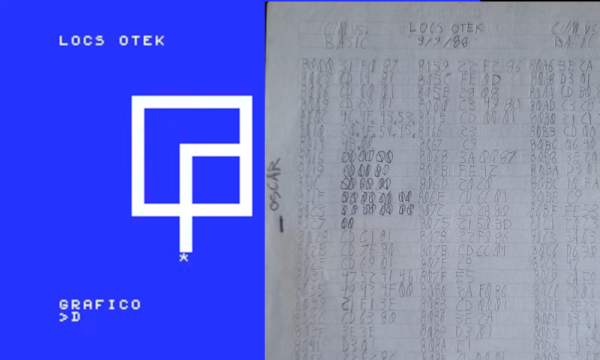
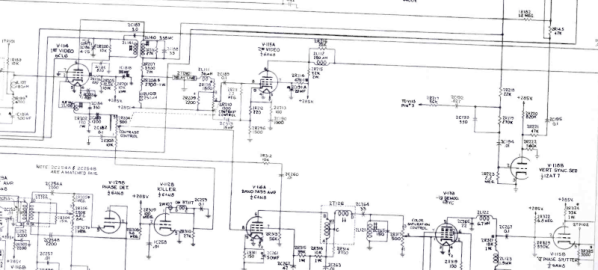
But there are few stories as strange or wide-ranging as the path to provide color TV. And it had to be done in a way that a color set could still get a black and white picture and black and white sets could still watch a color signal without color. You’d think there would be a “big bang” moment where color TV burst on the scene — no pun involving color burst intended. But there wasn’t. Instead, there was a long, twisted path with many competing interests and ideas to go from a world in black and white to one tinted with color phosphor.

Background
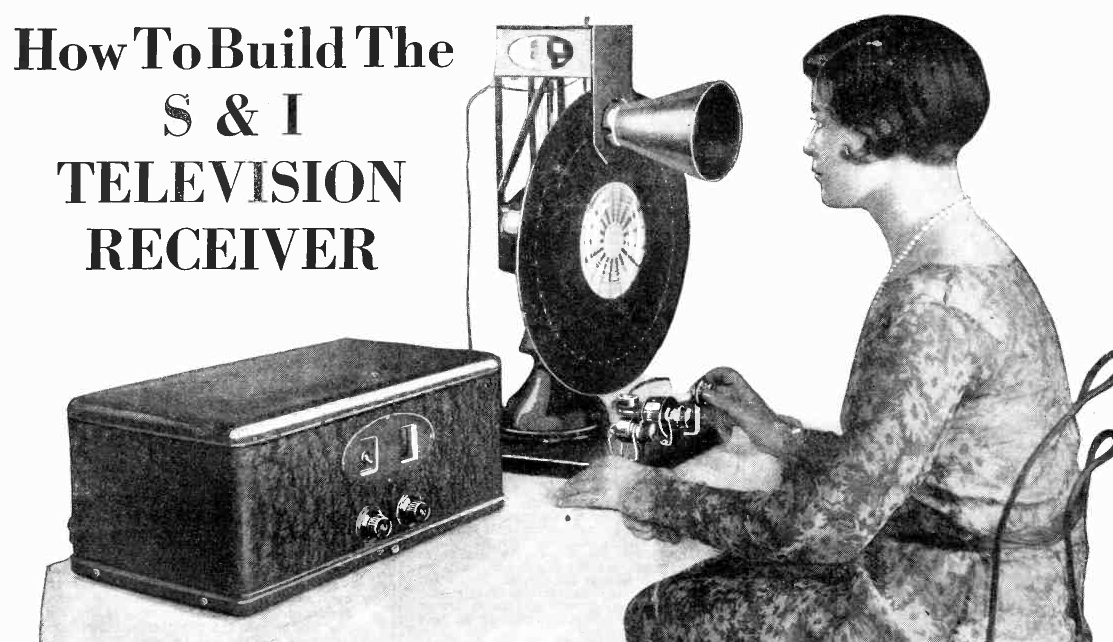
In 1928, Science and Invention magazine had plans for building a mechanical TV (although not color)

It is hard to imagine, but John Logie Baird transmitted color images as early as 1928 using a mechanical scanner. Bell Labs had a demonstration system, also mechanical, in 1929. Baird broadcast using his system in 1938. Even earlier, around 1900, there were attempts to create mechanical color image systems. Those systems were fickle or impractical, though.

Electronic scanning was the answer, but World War II froze most consumer electronics development. Baird showed an electronic color system in late 1944. However, it would be 1953 before NTSC (the National Television System Committee) adopted the standard color TV signal for the United States. It would be almost 20 years later before SECAM and PAL were standardized in other parts of the world.

Of course, these are all analog standards. The world’s gone digital now, but for nearly 50 years, analog color TV was the way people consumed TV in their homes. By 1941, NTSC produced a standard in the United States, but not for color TV. TV adoption didn’t really take off until after the war. But by 1950, the US had some 6 million TV sets.

This was both a plus — a large market — and a negative. No one wanted to obsolete those 6 million sets. Well, at least, the government regulators and consumers didn’t. But most color systems would be incompatible with those existing black and white sets. Continue reading “The Long Strange Trip To US Color TV”
Repairing A Gear With A Candle (and Some Epoxy)

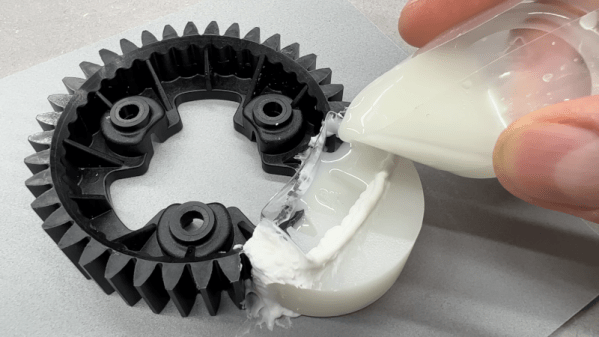
You have a broken gear you need to fix, but there’s no equivalent part available. That’s the issue [Well Done Tips] faced with a plastic gear from a lawnmower. While we’d be tempted to scan the gear, repair the damage in CAD and then 3D print a new one, we enjoyed hearing about his low-tech solution. In addition to the write up, there’s a video showing the process you can watch below.

The idea is pretty simple. Using a piece of pipe and melted candle wax, he prepared a mold of an undamaged section of the gear. Then he cast epoxy resin in place to recreate the missing pieces. There are a few tricks, like putting holes in the remaining part of the gear so the epoxy flows into the existing part. Depending on the gear’s purpose and original material, you might be able to just use it as-is. However, you could also use the repaired gear as a template to create another mold and then cast an entire gear from resin or even metal if you can cast metal.

You can argue whether resin is better or worse than PLA, but of course, it depends on the kind of resin—photopolymers are different from epoxy resins you’d use for this sort of thing. If you think you might like to make your new gear out of aluminum, you might find some inspiration in a previous post.

Continue reading “Repairing A Gear With A Candle (and Some Epoxy)”

Breadboard SDR Doesn’t Need Much

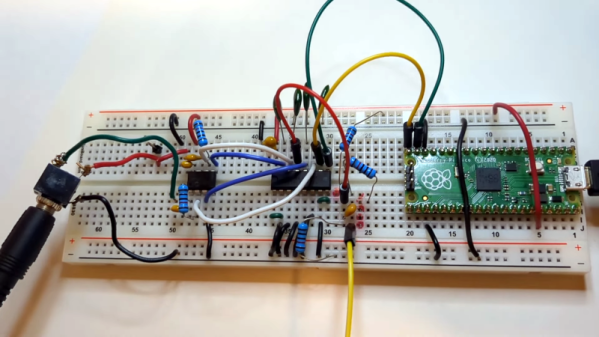
[Grug Huhler] built a simple Tayloe mixer and detector on a breadboard. He decided to extend it a bit to be a full-blown software defined radio (SDR). He then used WSJT-X to monitor FT8 signals and found that he could pick up signals from all over the world with the little breadboard system.

A Raspberry Pi Pico generates a quadrature clock that acts as the local oscillator for the radio. All the processing of the input signal to a quadrature signal is done with a 74LV4052A, which is nothing more than an analog multiplexer. In principle, the device takes a binary number from zero to three and uses it to connect a common signal to one of four channels. There are two common lines and two sets of four channels. In this case, only half of the chip is in use.

An antenna network (two resistors and a capacitor) couples the antenna to one of the common pins, and the Pi generates two square waves, 90 degrees out of phase with each other. This produces select signals in binary of 00, 01, 11, and 10. An op amp and a handful of passive components couple the resulting signals to a PC soundcard, where the software processes the data. The Pi can create clocks up to about 15 or 20 MHz easily using the PIO.

The antenna is a 20-meter-long wire outside, and that accounts for some of the radio’s success. There are several programs than can work with soundcard input like this and [Grug] shows Quisk as a general-purpose receiver. If you missed the first video explaining the Tayloe mixer design, you can catch it below the first video.

This isn’t the first breadboard SDR we’ve seen, but they all use different parts. We’ve even seen a one-bit SDR with three components total (not including the microcontroller). Seriously.

Continue reading “Breadboard SDR Doesn’t Need Much”

Learn AI Via Spreadsheet

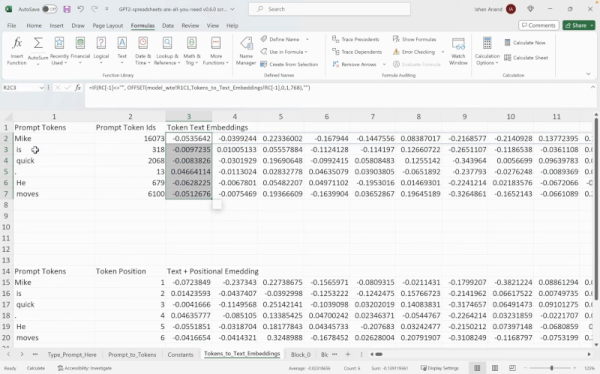
While we’ve been known to use and abuse spreadsheets in the past, we haven’t taken it to the level of [Spreadsheets Are All You Need]. The site provides a spreadsheet version of an “AI” system much like ChatGPT 2. Sure, that’s old tech, but the fundamentals are the same as the current crop of AI programs. There are several “lesson” videos that explain it all, with the promise of more to come. You can also, of course, grab the actual spreadsheet.

The spreadsheet is big, and there are certain compromises. For one thing, you have to enter tokens separately. There are 768 numbers representing each token in the input. That’s a lot for a spreadsheet, but a modern GPT uses many more.

Continue reading “Learn AI Via Spreadsheet”

Do We Need A New Hardware Description Language?

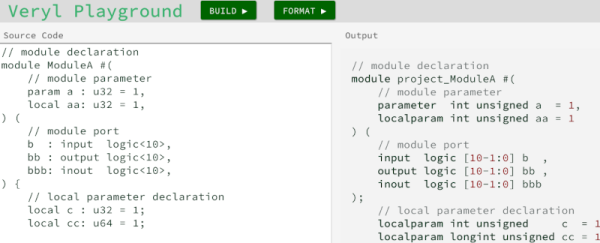
When you think about hardware description languages, you probably think of Verilog or VHDL. There are others, of course, but those are the two elephants in the room. Do we need another one? [Veryl-lang] thinks so. The Veryl language is sort of Verilog meets Rust. What makes Veryl interesting is that it transpiles to normal SystemVerilog, so it will — probably — work with your existing tool chains.

That means you can define your logic Veryl, have it output SystemVerilog, and then use that Verilog in your vendor’s (or an open source) Verilog tool. The output is supposed to be human-readable Verilog, too, so you don’t have to transport opaque blocks of gibberish.

Continue reading “Do We Need A New Hardware Description Language?”

Folding Solar Panel Is Underpowered

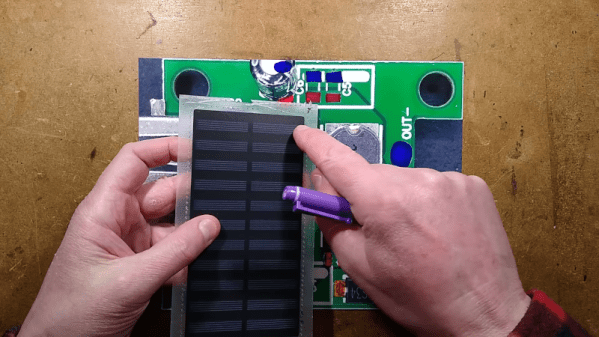
If you hang out on certain kinds of sites, you can find huge-capacity USB drives and high-power yet tiny solar panels, all at shockingly low prices. Of course, the USB drives just think they are huge, and the solar panels don’t deliver the kind of power they claim. That seems to be the case with [Big Clive’s] latest folding solar panel purchase. The nice thing about the Internet is you can satisfy your urge to tear things open to see what’s inside of them vicariously instead of having to buy a lot of junk yourself. Thanks [Clive]!

The picture on the website didn’t match the actual product, which was the first sign, of course. The panel’s output in full sun was around 2.5 watts instead of the claimed 10 watts. He’s also seen sellers claim they are between 20 and 80-watt panels. But the interesting bits are when [Clive] decides to rip the panel into pieces and analyze the controller board.

Continue reading “Folding Solar Panel Is Underpowered”