Heat Pump Dryer Explained

Historically, having a washer and a dryer in your house requires “a hookup.” You need hot and cold water for the washer as well as a drain for wastewater. For the dryer, you need either gas or — in the US — a special 220 V outlet because the heating elements require a lot of wattage, and doubling the voltage keeps the current levels manageable. You also need a bulky hose to vent hot moist air out of the house. But a relatively new technology is changing that. Instead of using a heater, these new dryers use a heat pump, and [Matt Ferrell] shows us his dryer and discusses the pros and cons in a video you can below. We liked it because it did get into a bit of detail about the principle of operation.

These dryers are attractive because they use less power and don’t require gas or a 220 V outlet. They also don’t need a vent hose which means they can sit much closer to the wall and take up less space. Heat pumps don’t convert electrical energy into heat like a normal heating element. Instead, it uses a compressor to move heat from one place to another. In this case, the dryer heats the air using the heat pump. That causes water in the clothes to evaporate into the air. The heat pump dryer then uses a second loop to cool the air, condensing the water out so the it can reheat the air and start the whole cycle over again.

Continue reading “Heat Pump Dryer Explained”

Mystery Signal! Are You Ready For Your Mystery Signal?

Like many people [Dan Greenall] spent a lot of time in the 1970s listening to shortwave radio. While you often think of that as a hobby involving listening to broadcast stations, some people like to listen to other communications such as airliners, ships, military, and even spy stations. These days, if you hear a strange signal you are probably only one internet search away from identifying what it is. But back then, you had to depend on word-of-mouth or magazines to figure things like that out. [Dan] found a recording of a mysterious military-like signal he made in 1971 on 14.85 MHz. He decided that maybe now, all these years later, he could finally identify it.

The operator in the recording is counting and mentions “Midway Island,” famous for a World War II battle and part of the Leeward Islands in the Pacific. Thanks to the internet and the law of six degrees of separation, [Dan] found [Chuck Kinzer] who was a Midway Navy vet.

Continue reading “Mystery Signal! Are You Ready For Your Mystery Signal?”

DIY Smart Washing Machine Redesign

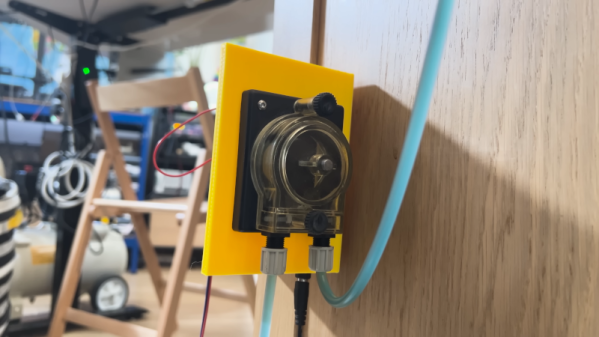
[Mellow Labs] wanted a smart washer and built a simple controller. However, he found out after a few weeks it wasn’t working how he wanted. The detergent quit flowing, and he washed clothes with no soap for a week! So, a redesign was in order. You can follow the process and the result in the video below.

A bit of 3D printing, a larger pump, and proper voltage made a big difference. We didn’t see the print files, but unless you have the exact same setup, you’d probably have to customize it anyway. There is a real-time hand-drawn schematic, and the software is probably not hard to pull off the video screen (it is only 18 lines).

Continue reading “DIY Smart Washing Machine Redesign”

Life Imitates ART (ART-13, That Is)

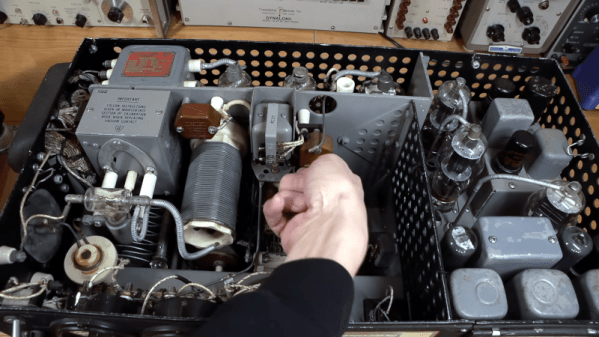
[Mr. Carlson] has been restoring vintage military radios, and as part of his quest, he received an ART-13 transmitter. Before he opened the shipping box, he turned on the camera, and we get to watch from the very start in the video below. These transmitters were originally made by Collins for the Navy with an Army Air Corps variant made by Stewart-Warner. Even the Russians made a copy, presumably by studying salvaged units from crashed B-29s.

The transmitter puts out 100 watts at frequencies up to 18.1 MHz. The tubes needed a plate supply, and so, like many radios of the era, this one used a dynamotor. Think of it as a motor running at one voltage and turning a generator that produces a (usually) higher voltage. If you ever used a radio with one, you know you didn’t need an “on the air” sign — the whine of the thing spinning would let everyone know you had the key or microphone button pushed down. It’s an interesting piece of bygone tech that we’ve looked into previously.

The transmitter wasn’t in perfect shape, but we’ve seen worse. When the lid comes off, you can practically smell the old radio odor. There are tubes, coils, and even a vacuum relay, presumably for transmit/receive switching of the antenna. [Carlson] also tears open the dynamotor which is something you don’t see every day.

Continue reading “Life Imitates ART (ART-13, That Is)”

Linux Fu: Easy Kernel Debugging

It used to be that building the Linux kernel was not easy. Testing and debugging were even worse. Nowadays, it is reasonably easy to build a custom kernel and test or debug it using virtualization. But if you still find it daunting, try [deepseagirl’s] script to download, configure, build, and debug the kernel.

The Python program takes command line arguments so you can select a kernel version and different operations. The script can download the source, patch the configuration, build the kernel, and then package it into a Debian package you can boot under qemu. From there, you can test and even debug with gdb. No risk of hosing your everyday system and no need to understand how to configure everything to run.

Continue reading “Linux Fu: Easy Kernel Debugging”

Computer Gear With — Um — Gears

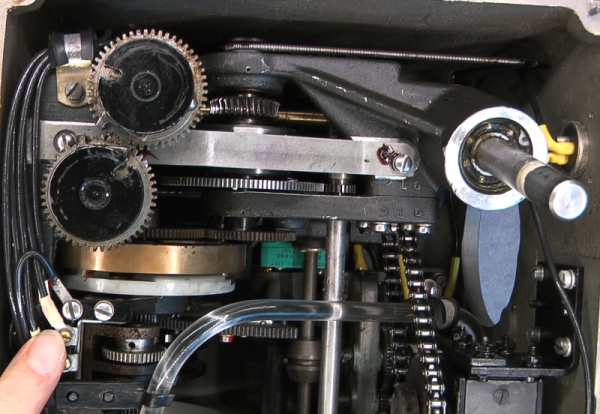
Analog computers have been around in some form for a very long time. One very obvious place they were used was in military vehicles. While submarine fire computers and the Norden bombsight get all the press, [msylvain59] has a lesser-known example: an M13A1 ballistic computer from an M48 tank that he tears down for us in the video below.

The M48, known as a Patton, saw service from 1952 to 1987. Just looking at the mechanical linkage to the tank’s systems is impressive. But inside, it is clear this is a genuinely analog computer. The thing is built — quite literally — like a tank. What was the last computer you opened that needed a hammer? And inside, you’ll find gears, bearings, and a chain!

We don’t pretend to understand all the workings. These devices often used gears and synchros (or selsyns, if you prefer) to track the position of some external thing. But we are guessing there was a lot more to it than that. It’s probably an exciting process to see something like that designed from scratch.

We did think of the Norden when we saw this. Hard to imagine, but there were “general purpose” analog computers.

Continue reading “Computer Gear With — Um — Gears”

How To Talk To Your Scope

It used to be only high-end test equipment that had some sort of remote control port. These days, though, they are quite common. Historically, test gear used IEEE-488 (also known as GPIB or, from the originator, HPIB). But today, your device will likely talk over a USB port, a serial port, or a LAN connection. You’d think that every instrument had unique quirks, and controlling it would be nothing like controlling another piece of gear, especially one from another company. That would be half right. Each vendor and even model indeed has its unique command language. There has been a significant effort to standardize some aspects of test instrument control, and you can quickly write code to control things on any platform using many different programming languages. In a few posts, I will show you just how easy it can be.

The key is to use VISA. This protocol is defined by the IVI Foundation that lets you talk to instruments regardless of how they communicate. You do have to build an address that tells the VISA library how to find your device. For example: “TCPIP::192.168.1.92::INSTR.” But once you have that, it is easy to talk to any instrument anywhere.

I say that thinking it is a problem is half right because talking to the box is one task of the two you need to complete. The other is what to say to the box and what it will say back to you. There are a few standards in this area, but this is where you get into problems. Continue reading “How To Talk To Your Scope”