Old Style 1802 Computer Has MMU

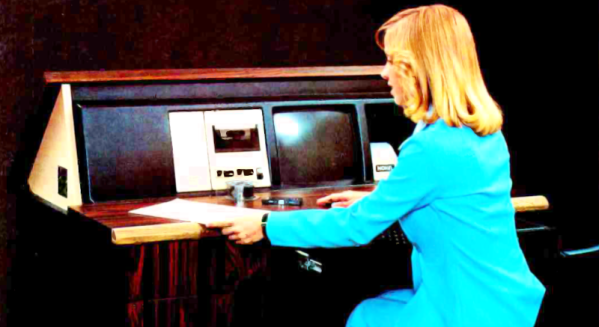
When you think of an MMU — a memory management unit — you probably think of a modern 32-bit computer. But [Jeff Truck] has a surprise. His new RCA 1802 computer has bank switching, allowing the plucky little processor to address 256K of RAM. This isn’t just the usual bank-switching design, either.

The machine has several unique features. For example, an Arduino onboard can control the CPU so that you can remotely control the bus. It does not, apparently, stand in for any of the microprocessor support chips. It also doesn’t add additional memory or control its access.

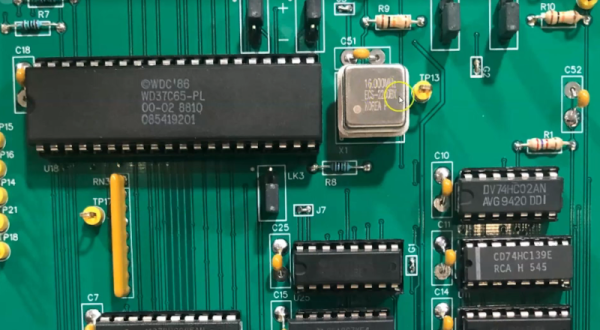
The 256K of memory is under the control of the MMU board. This board generates two extra address bits by snooping the executing instruction and figures out what register is involved in any memory access. Memory in the MMU stores a table that lets you set different memory pages for each register. This works even if the register is not explicit and also for the machine’s DMA and instruction fetch cycles. If you know about the RCA “standard call and return technique,” which also needed a little patching for the MMU. [Jeff] covers that at the end of the video below.

This is a very simple version of a modern MMU and is an impressive trick for a 50-something-year-old CPU. We were surprised to hear — no offense to [Jeff] — that the design worked the first time. Impressive! There’s also some 3D printing and other tips to pick up along the way. But we were super impressed with the MMU. You might never have to do this yourself (although you could), but you can still marvel that it can be done at all.

We have a soft spot for the 1802s, real or emulated. The original ELF was great, but 256K is a lot better than the original 256 bytes!

Continue reading “Old Style 1802 Computer Has MMU”

TV Typewriter Remembered

With the recent passing of Don Lancaster, I took a minute to reflect on how far things have come in a pretty short period of time. If you somehow acquired a computer in the early 1970s, it was probably some discarded DEC, HP, or Data General machine. A few people built their own, but that was a stout project with no microprocessor chips readily available. When machines like the Mark-8 and, more famously, the Altair appeared, the number of people with a “home computer” swelled — relatively speaking — and it left a major problem: What kind of input/output device could you use?

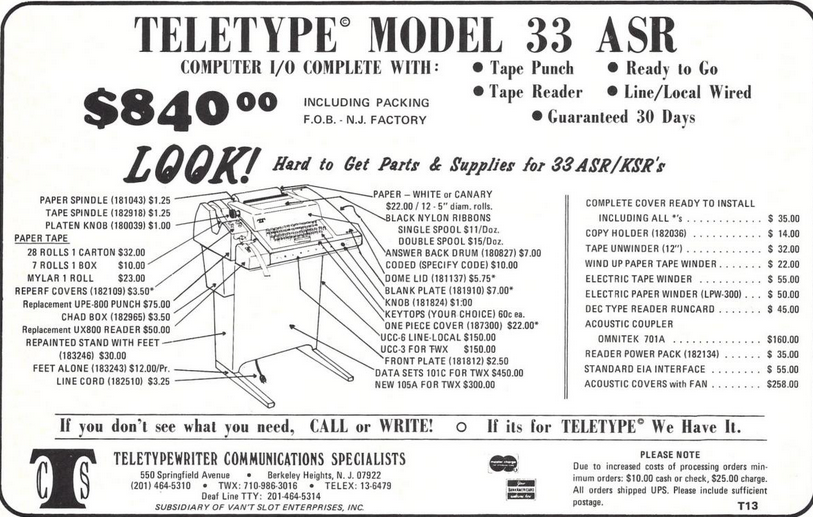
An ad from Kilobaud offered you a ready-to-go, surely refurbished, ASR33 for $840

At work, you might have TeleType. Most of those were leased, and the price tag of a new one was somewhere around $1,000. Remember, too, that $1,000 in 1975 was a small fortune. Really lucky people had video terminals, but those were often well over $1,500, although Lear Siegler introduced one at the $1,000 price, and it became wildly successful. Snagging a used terminal was not very likely, and surplus TeleType equipment was likely of the 5-bit Baudot variety — not unusable, but not the terminal you really wanted.

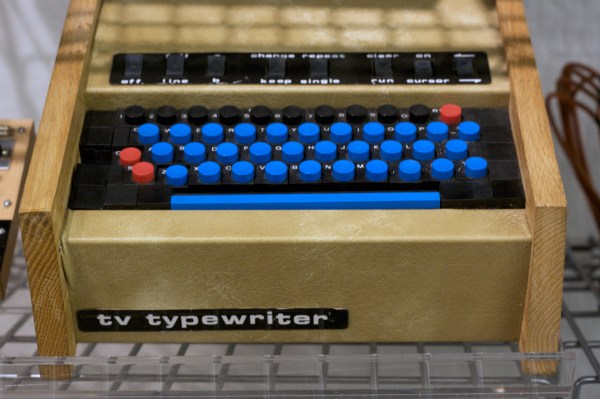
A lot of the cost of a video terminal was the screen. Yet nearly everyone had a TV, and used TVs have always been fairly cheap, too. That’s where Don Lancaster came in. His TV Typewriter Cookbook was the bible for homebrew video displays. The design influenced the Apple 1 computer and spawned a successful kit for a company known as Southwest Technical Products. For around $300 or so, you could have a terminal that uses your TV for output. Continue reading “TV Typewriter Remembered”

Vintage Digital Frequency Meter Teardown

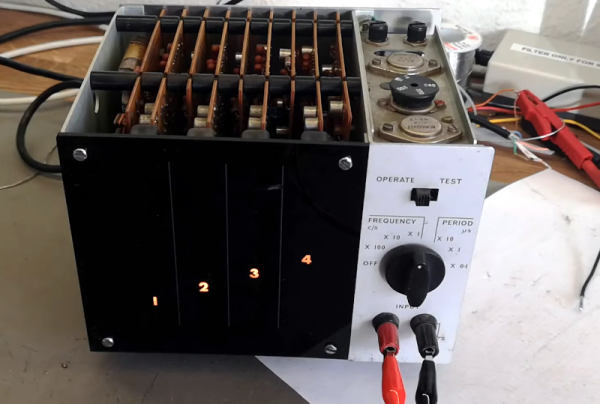
You think of digital displays as modern, but the idea isn’t that new. We had clocks, for example, with wheels and flip digits for years. The Racal frequency counter that [Thomas Scherrer] is playing with in the video below has columns of digits with lamps behind them. You just need the right plastic and ten lightbulbs per digit, and you are in business. Easy enough to accomplish in 1962.

Inside the box was surprising. The stack of PC boards looks more like a minicomputer than a piece of test gear. There were a few novel items inside, too, ranging from a glass-encapsulated crystal to an interesting method of selecting the line voltage.

Continue reading “Vintage Digital Frequency Meter Teardown”

Shake, Rattle, Roll, With Your Own Seismograph

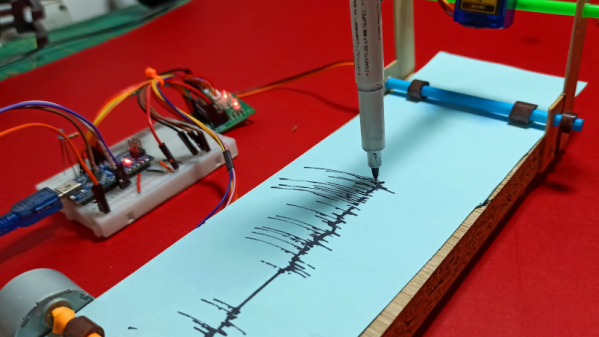
We always love to see projects where you can build your own lab equipment so [CompactDIY’s] homemade seismograph caught our eye. The design uses an Arduino with an accelerometer and builds on one of their earlier projects. You can see a video of the device below.

The principle is simple. A hobby servo controls a pen and a stepper motor rolls paper, creating a makeshift strip recorder. Its software uses the Visuino system, which is a flowchart-like system, but it outputs Arduino code. Honestly, we would probably have just plotted the data on a PC, but there’s a certain charm to the strip recorder and the idea would work for other types of data recording projects, too. We thought if you rearranged the stepper motor and cut a paper disk out, you could also have a circular chart recorder easily, which wouldn’t need to friction transport the paper. A clock motor would make it even less dependent on software, too.

If this project interests you, try a Raspberry shake, which isn’t as delicious as it sounds. Or, keep an eye on the entire globe, if you prefer.

Continue reading “Shake, Rattle, Roll, With Your Own Seismograph”

Digital Microscope With An On-Screen Multimeter

Some things go together, like chocolate and peanut butter. Others are more odd pairings, like bananas and bacon. We aren’t sure which category to put [IMSAI Guy]’s latest find in. He has a microscope with a built-in digital multimeter. You can see the video of the device in operation below.

The microscope itself is one of those unremarkable ten-inch LCD screens with some lights and a USB camera. But it also has jacks for test probes, and the display shows up in the corner of the screen. It is a normal enough digital meter except for the fact that its display is on the screen.

If you had to document test results, this might be just the ticket. If you are probing tiny little SMD parts under the scope, you may find it useful, too, so you don’t have to look away from what you are working on when you want to take a measurement. Although for that, you could probably just have a normal display in the bezel, and it would be just as useful.

At about $180 USD, it’s not exactly an impulse buy. We wonder if we’ll someday see an oscilloscope microscope. That might be something. These cheap microscopes are often just webcams with additional optics. You can do the same thing with your phone. If you don’t need the microscope, but you like the idea, can we interest you in a heads-up meter?

Continue reading “Digital Microscope With An On-Screen Multimeter”

Tesla Door Phone Decoded (Not That Tesla)

[Danman] has digital door phones manufactured by Tesla — or at least, a Tesla, as they’re not to be confused with the carmaker, though. The problem is if someone comes to the door when no one’s home, there’s no remote indicator. The answer? Reverse engineer the protocol and fix it.

A quick dump on a storage scope showed the data clearly, but it wasn’t obvious what protocol it was using. After a little analysis, it proved the datastream used 4 PWM pulses as symbols with three symbols: one, zero, and stuffing sequence.

Once you can read the bits, it is easy to determine that each frame consists of a 16-bit destination and source address, along with a command byte and a checksum byte. Each station can have an ID from 000 to 999 although you can only dial up to number 323. Some nodes are special, and there are ways to address particular units.

Connecting to the hardware took a transformer for isolation. Honestly, unless you have this exact hardware, this isn’t likely to be something you can directly use. However, it is a great example of how you can figure out a specialized device and bend it to your will.

We love reverse engineering projects. In some cases, it is easier if you have a CT scan.

Practical Inductors In LTSpice

LTSpice and the underlying Spice engine does a great job of simulating ideal components. But it is also capable — if you know how — of handling models of real-world devices. Inductors, for example, are one of the most imperfect components. Their constituent wire has resistance, and there is parasitic capacitance between the windings. If there is a core, it also will have many imperfections and losses. [Sam Ben-Yaakov] has a lecture about modeling real inductors in LTSpice, and he covers how you can capture some of these imperfections in the video below.

There is a bit of math in the presentation, but we liked that it relates back to datasheets for actual components. Being able to understand what the parameters on a datasheet mean is crucial, and if you ever wondered what some of these entries mean, you’ll get a lot from this video.

The main feature of the model is the flux equation. The tanh (hyperbolic tangent) function is similar to the curve you want for the flux equation, so it plays a major part. Of course, there are other parts of the inductor you may have to model, too, but this is one of the most difficult parts.

You can also model transformers using LTSpice. You can also create custom components.

Continue reading “Practical Inductors In LTSpice”