Electroplated 3D Printed Sword: Shiny!

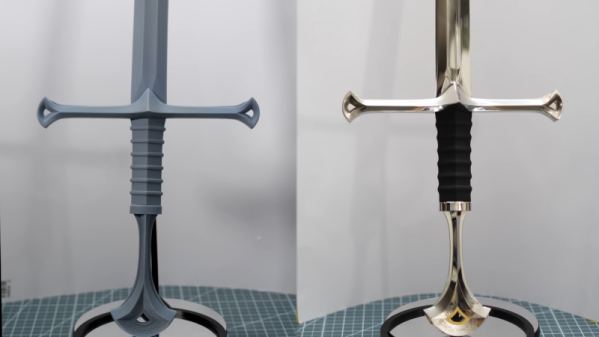
We all want to 3D print metals, but the equipment to do that is still beyond most home workshops. However, [HEN3DRIK] takes resin 3D-printed items and electroplates them. Might not be as good as printing in metal, but it sure looks metallic. As you can see in the video below, the sword looks like it was crafted from highly-polished steel.

The sword comes out in four pieces. He repeats several times that sanding is the key because you must have flat surfaces. Using sandpaper and steel wool, he worked the parts to a fine finish. The parts assemble along an M8 threaded rod to form a whole. The next step was to electroplate with copper.

Continue reading “Electroplated 3D Printed Sword: Shiny!”

Don’t Believe Everything You Read: The Great Electric Toaster Hoax

We’ve all looked up things on Wikipedia and, generally, it is usually correct information. However, the fact that anyone can edit it leads to abuse and makes it somewhat unreliable. Case in point? The BBC’s [Marco Silva] has the story of the great online toaster hoax which erroneously identified the inventor of the toaster with great impact.

You should read the original story, but in case you want a synopsis, here goes: Until recently, the Wikipedia entry for toasters stated that a Scottish man named Alan MacMasters invented the electric toaster in the 1800s. Sounds plausible. Even more so because several books had picked it up along with the Scottish government’s Brand Scottland website. At least one school had a day memorializing the inventor and a TV show also honored him with a special dessert named for Alan MacMasters, the supposed inventor. Continue reading “Don’t Believe Everything You Read: The Great Electric Toaster Hoax”

The 13.5 Million Core Computer

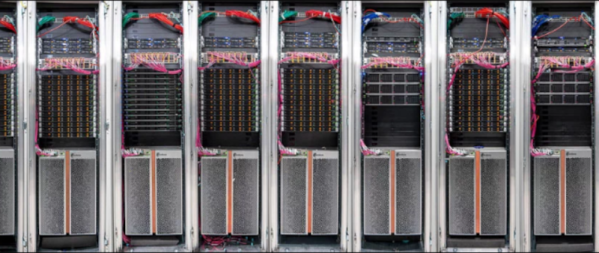
Having a dual- or quad-core CPU is not very exotic these days and CPUs with 12 or even 16 cores aren’t that rare. The Andromeda from Cerebras is a supercomputer with 13.5 million cores. The company claims it is one of the largest AI supercomputers ever built (but not the largest) and can perform 120 Petaflops of “dense compute.”

We aren’t sure about the methodology, but they also claim more than one exaflop of “AI computing.” The computer has a fabric backplane that can handle 96.8 terabits per second between nodes. According to a post on Extreme Tech, the core technology is a 3-plane wafer processor, WSE-2. One plane is for communications, one holds 40 GB of static RAM, and the math plane has 850,000 independent cores and 3.4 million floating point units.

The data is sent to the cores and collected by a bank of 64-core AMD EPYC 3 processors. Andromeda is optimized to handle sparse matrix computations. The company claims that the performance scales “almost linearly.” That is, as you double the number of cores used, you roughly half the total run time.

The machine is available for remote use and cost about $35 million to build. Since it uses 500 kW at peak run times, it isn’t free to operate, either. Extreme Tech notes that the Frontier computer at Oak Ridge National Labs is both larger and more precise, but it cost $600 million, so you’d expect it to be more capable.

Most homebrew “supercomputers” we see are more for learning how to work with clusters than trying to hit this sort of performance. Of course, if you have a modern graphics card, OpenCL and CUDA will let you do some of this, too, but at a much lesser scale.

Fuel Cell Catalyst: Less Is More

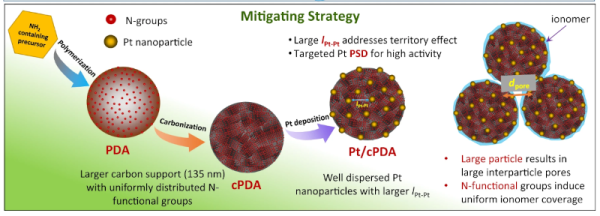
A fuel cell is almost like a battery that has replenishable fuel. Instead of charging a battery with an electric current, you recharge a fuel cell with something like hydrogen or you simply consume it from a tank much as an internal combustion engine consumes gasoline. However, fuel cells usually use a catalyst — it isn’t consumed in the reaction, but it is necessary and many fuel cells use platinum as a catalyst which is expensive. But what if you could use less catalyst and get a better result? That’s what researchers in Canada and the US are claiming in a recent paper. The key isn’t how much catalyst they are using, but rather the shape of the catalyst.

Of course, everyone wants to use less of the expensive catalyst but polymer electrolyte fuel cells have had a particular problem where reducing the amount of catalyst used causes a disproportionate drop in cell performance. This new approach uses spherical catalyst support that improves the distribution and utilization of the catalyst.

Continue reading “Fuel Cell Catalyst: Less Is More”

New Metric Prefixes Get Bigger And Smaller

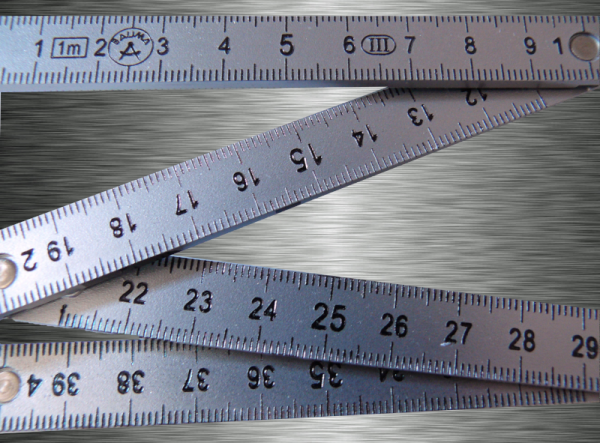
It always fascinates us that every single thing that is made had to be designed by someone. Even something as simple as a bag and box that holds cereal. Someone had to work out the dimensions, the materials, the printing on it, and assign it a UPC code. Those people aren’t always engineers, but someone has to think it out no matter how mundane it is before it can be made. But what about the terms we use to express things? Someone has to work those out, too. In the case of metric prefixes like kilo, mega, and pico, it is apparently the General Conference on Weights and Measures that recently had its 27th session. As a result of that, we have four more metric prefixes to learn: ronna, quetta, ronto, and quecto.

Apparently, the new prefixes are to accommodate “big data” which is rapidly producing more data than there are atoms in the Universe. There were actually proposed earlier in a slightly different form but accepted at the conference. Apparently quecca is too close to a Portuguese swear word. So what do these actually mean? A QB (quettabyte) would be 1030 bytes while an RB (ronnabyte) is only 1027.  So 1 QB would be 1,000,000 yottabytes (YB) the previous top of the scale.

Continue reading “New Metric Prefixes Get Bigger And Smaller”

How To Repair? The Death Of Schematics

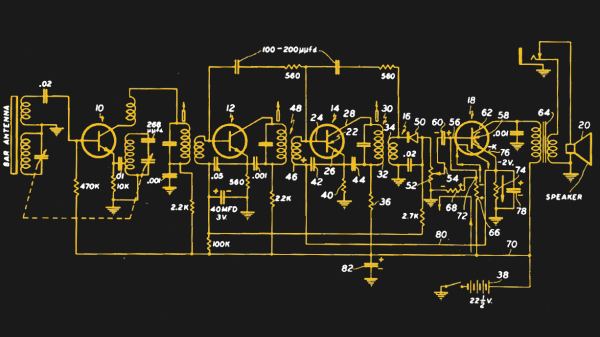
There was a time when, if you were handy with a soldering iron, you could pretty easily open up a radio or TV repair business. You might not get rich, but you could make a good living. And if you had enough business savvy to do sales too, you could do well. These days there aren’t many repair shops and it isn’t any wonder. The price of labor is up and the price of things like TVs drops every day. What’s worse is today’s TV is not only cheaper than last year’s model, but probably also better. Besides that, TVs are full of custom parts you can’t get and jam-packed into smaller and smaller cases.

Case in point, I saw a “black Friday” ad for a 40-inch 1080p flatscreen with a streaming controller for $98. Granted, that’s not huge by today’s standards and I’m sure it isn’t a perfect picture. But for $98? Even a giant high-quality TV these days might cost a bit more than $1,000 and you can get something pretty great for well under $500.

Looking back, a Sears ad showed a great deal on a 19″ color TV in 1980. The price? $399. That doesn’t sound too bad until you realize that today that would be about $1,400. So with a ratio of about 3.5 to 1, a $30/hour service call would be, today, $105. So for an hour’s service call with no parts, I could just buy that 40″ TV. Add even one simple part or another hour and I’m getting close to the big league TVs.

Did you ever wonder how TV repair technicians knew what to do? Well, for one thing, most of the time you didn’t have to. A surprising number of calls would be something simple like a frayed line cord or a dirty tuner. Antenna wires destroyed by critters was common enough. In the tube days, you could pretty easily swap tubes to fix the bulk of actual problems.

Continue reading “How To Repair? The Death Of Schematics”

At A Loss For Words? Try A Teleprompter

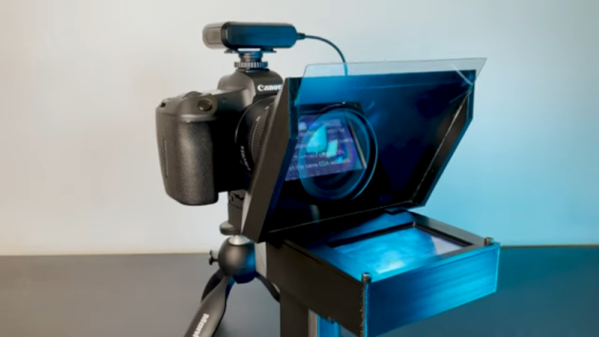
With everyone doing videos these days, you might want to up your narration game with a teleprompter. [Modern Hobbyist] can help. Since he does videos — like the one about the teleprompter below — we assume he built it out of his own need for the device. Actually, this is his second teleprompter. The first one was larger and not battery-powered, so this new version offers more portability. The camera shoots through the teleprompter screen so you can look right at the camera and still stay on script.

The project reuses some of the original teleprompter code, showing a text file via a Raspberry Pi. There’s also a control keyboard that lets you remotely control the scrolling speed. The real key to this project though is the 3D printed housing. Well, that and the reflective glass screen. Given that, you could do the actual text display in a number of ways.

Apparently, the portability of the build is limited somewhat by the weight of the camera. You could, of course, use something lighter or perhaps add some weight opposite to at least balance it a bit. The 3D printing files are on Thingiverse and the rest is on GitHub, so you can easily make changes if you want.

You would think we would see more teleprompter projects, and we do see some. We’ve also seen a hack to let you look through your laptop screen on video conferences.

Continue reading “At A Loss For Words? Try A Teleprompter”