Active Signal Tracer Probe Has AGC

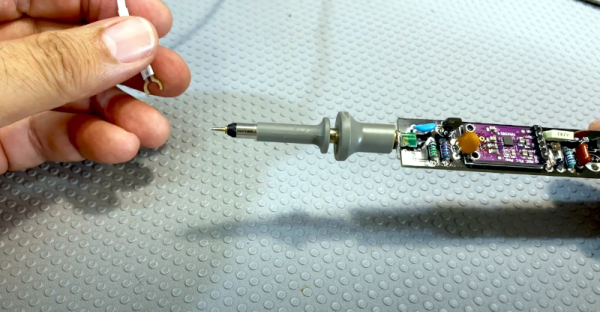
[Electronics Old and New] has a new version of one of his old projects. The original project was an active probe. He took what he learned building that probe and put it into a new probe design. He also added automatic gain control or AGC. You can see a video explanation of the design below. The probe is essentially a high-impedance input using a JFET that can amplify audio or demodulated RF signals, which is a handy device to have when troubleshooting radios.

The audio amplifier is a simple LM386 circuit. The real work is in the input stage and the new AGC circuit. Honestly, we’ve used the amplifier by itself for a similar function, although the raw input impedance of the chip is only about 50K and is less in many circuits that use a pot on the input. Having a JFET buffer and an RF demodulating diode is certainly handy. You’d think the AGC block would be in the audio stage. However, the design uses it ahead of the detector which is great as long as the amplifier can handle the RF frequency you are interested in. In this case, we think he’s mostly working on old tube AM radios, so the max signal is probably in the neighborhood of 1 MHz.
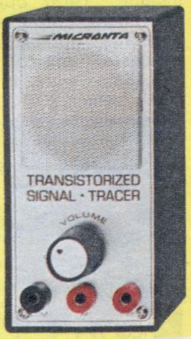
A similar device was a Radio Shack staple for many years

The module is made to amplify an electret microphone using a MAX9814 which has AGC. The module had a microphone that came off for this project. The datasheet doesn’t mention an upper frequency limit, but a similar Maxim part mentions its gain is greater than 5 at 600 kHz, so for the kind of signals this is probably used for, it should work well. We wondered if you could use the module and dispense with the JFET input. The chip probably has a pretty high input impedance, but the datasheet doesn’t give a great indication.

For years we used a signal tracer from Radio Shack which — if we could still find it — now has an LM386 inside of it after the original electronics failed decades ago. In those days, fixing an AM radio involved either using a device like this to find where you did and didn’t have a signal or injecting signals at different points in the radio. Two sides of the same coin. For example, if you could hear a signal at the volume control — that indicated the RF stages were good and you had a problem on the audio side. Conversely, if you injected a signal at the volume control, not hearing would mean the same thing. Once you knew if the problem was in the RF or AF side, you’d split that part roughly in half and repeat the operation until you were down to one bad stage. Of course, you could use signal generators and scopes, but in those days you weren’t as likely to have those.

Heathkit, of course, had their own version. It even had on of those amazing magic eye tubes.
Continue reading “Active Signal Tracer Probe Has AGC”

Around GPS In 100 Videos

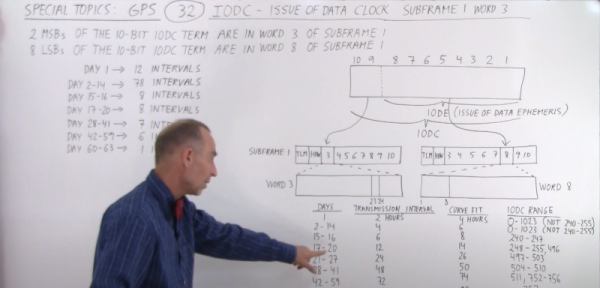
Do you know what the IODC word in GPS data means? If so, great! If not, head over to see the 32nd of [Michel van Biezen’s] 100-part video series on GPS. You probably want to watch the other 31 videos before he gets too much further ahead of you, too. [Michel] reminds you of that professor you had in college who knows a whole lot about something. In fact, scanning his YouTube channel, he knows a lot about many topics ranging from optics, chemistry, kalman filters, and lots of electronics.

There is a dedicated playlist for the GPS videos dating back to 2016. So 32 videos in about six years. So you might have a little time to catch up.  While the first video is pretty introductory as you might expect, by the time you get to video 7 the topics switch to things like the C/A code, BPSK, and gory details of all the frame data, including the IODC word.

Continue reading “Around GPS In 100 Videos”

Design Your Next Robot Hand In Minutes

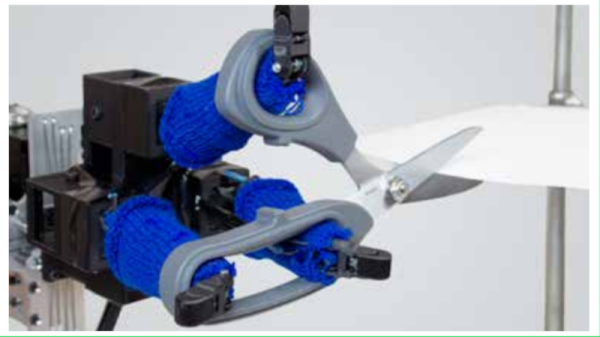
MIT complains that designing a robot hand is time-consuming and takes a lot of iterations. They want to improve that using a unique approach by giving a modular hand tactile sensors. They claim this can reduce the design time down to minutes for many practical applications. For example, cutting paper. You can see a video about the paper below as well as read the text itself.

Each style of manipulator has an associated graph. Predefined elements let you assemble a palm and specialized fingers. You deform the fingers to match the use of the hand. Then a sensor that looks like a mitten provides feedback fo the task.

Continue reading “Design Your Next Robot Hand In Minutes”

Linux Fu: Roll With The Checksums

We are often struck by how often we spend time trying to optimize something when we would be better off just picking a better algorithm. There is the old story about the mathematician Gauss who, when in school, was given busy work to add the integers from 1 to 100. While the other students laboriously added each number, Gauss realized that 100+1 is 101 and 99 + 2 is also 101. Guess what 98 + 3 is? Of course, 101. So you can easily find that there are 50 pairs that add up to 101 and know the answer is 5,050. No matter how fast you can add, you aren’t likely to beat someone who knows that algorithm. So here’s a question: You have a large body of text and you want to search for it. What’s the best way?

Continue reading “Linux Fu: Roll With The Checksums”

Plastic CPUs Will Bend To Your Will

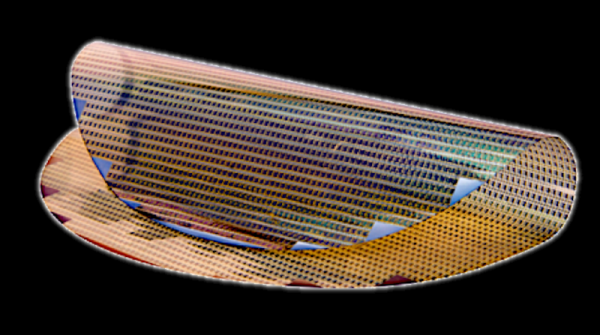
As microcontroller prices drop, they appear in more things. Today you will find microcontrollers in your car, your household appliances, and even kid’s toys. But you don’t see them often embedded in things that are either super cheap or have to flex, such as for example a bandage. Part of the reason is the cost of silicon chips and part of the reason is that silicon chips don’t appreciate bending. What if you could make CPUs for less than a penny out of flexible plastic? What applications would that open up? PragmatIC — a company working to make this possible — thinks it would open up a whole new world of smart items that would be unthinkable today. They worked with a team at the University of Illinois Urbana-Champaign to create prototype plastic CPUs with interesting results.

This is still the stuff of research and dreams, but a team of researchers did work to produce 4-bit and 8-bit processors using IGZO –indium gallium zinc oxide — semiconductor technology. This tech can be put on plastic and will work even if you bend it around a radius as small as a few millimeters.

Continue reading “Plastic CPUs Will Bend To Your Will”

Inside 3D Printing Shoes

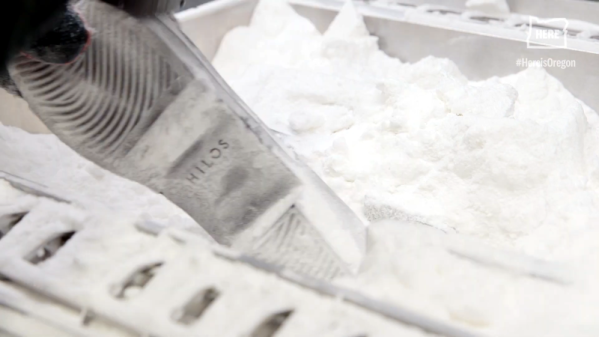
If you’ve ever thought about 3D printing shoes, you’ll enjoy watching the video below about a Portland-based company that creates shoes on demand using an HP MJF 5200 3D printer. Granted, this isn’t a printer you likely have in your basement. The one-ton printer costs up to a half-million dollars but watching it do its thing is pretty interesting.

The printer doesn’t create the entire shoe, but just a spongy foam-like TPU footbed and heel. They run the printer overnight and get about a dozen pairs out at once. There’s quite a bit of clean-up to get the piece ready. Of course, there’s also the assembly of the rest of the shoe to take into account.

Continue reading “Inside 3D Printing Shoes”

Linux Fu: Docking Made Easy

Most computer operating systems suffer from some version of “DLL hell” — a decidedly Windows term, but the concept applies across the board. Consider doing embedded development which usually takes a few specialized tools. You write your embedded system code, ship it off, and forget about it for a few years. Then, the end-user wants a change. Too bad the compiler you used requires some library that has changed so it no longer works. Oh, and the device programmer needs an older version of the USB library. The Python build tools use Python 2 but your system has moved on. If the tools you need aren’t on the computer anymore, you may have trouble finding the install media and getting it to work. Worse still if you don’t even have the right kind of computer for it anymore.

One way to address this is to encapsulate all of your development projects in a virtual machine. Then you can save the virtual machine and it includes an operating system, all the right libraries, and basically is a snapshot of how the project was that you can reconstitute at any time and on nearly any computer.

In theory, that’s great, but it is a lot of work and a lot of storage. You need to install an operating system and all the tools. Sure, you can get an appliance image, but if you work on many projects, you will have a bunch of copies of the very same thing cluttering things up. You’ll also need to keep all those copies up-to-date if you need to update things which — granted — is sort of what you are probably trying to avoid, but sometimes you must.

Docker is a bit lighter weight than a virtual machine. You still run your system’s normal kernel, but essentially you can have a virtual environment running in an instant on top of that kernel. What’s more, Docker only stores the differences between things. So if you have ten copies of an operating system, you’ll only store it once plus small differences for each instance.

The downside is that it is a bit tough to configure. You need to map storage and set up networking, among other things. I recently ran into a project called Dock that tries to make the common cases easier so you can quickly just spin up a docker instance to do some work without any real configuration. I made a few minor changes to it and forked the project, but, for now, the origin has synced up with my fork so you can stick with the original link.

Continue reading “Linux Fu: Docking Made Easy”