Geothermal System Is A Real Gold Mine

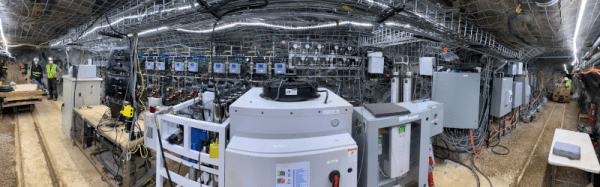
What do you get when Pacific Northwest National Laboratories takes over what was once the largest and deepest gold mine in North America? The answer might be enough energy to power 10,000,000 homes. The enhanced geothermal systems project includes the lab and several partners from academia and industry and aims to test sending fluids down boreholes so the Earth can heat them up. Hot fluids, of course, can easily create electricity.

At 4,100 feet underground, the old mine is not very convenient to get to. However, modern technology means that the equipment is largely automated so workers can carry out experiments from home using a computer or even a phone. The system itself is 7 feet long by 7 feet wide and 30 feet long. It was assembled above ground, tested, and then split into 4×4 sections for transportation deep below the surface.

Continue reading “Geothermal System Is A Real Gold Mine”

SWO: An ARM Printf By Any Other Name

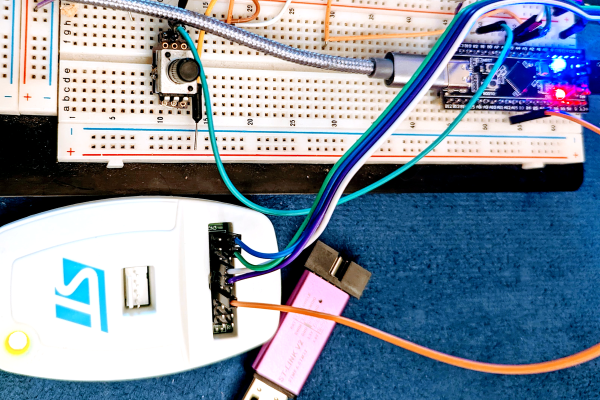
I’ll confess. Although printf-style debugging has a bad rep, I find myself turning to it on occasion. Sure, printf is expensive and brings in a lot of code, but if you have the space and time to use it while debugging you can always remove it before you are finished. However, what if you don’t have an output device or you are using it for something else? If you are using most modern ARM chips, you have another option — a dedicated output channel that is used for several things, including debugging output. I decided I wanted to try that on the Blackpill running mbed, and found out it isn’t as easy as you might think. But it is possible, and when you are done reading, you’ll be able to do it, too.

I’m writing this using the STM32-specific ST-LINK hardware. If you use other JTAG devices like the BlackMagic probe, you probably already have this set up for you.

What You Get

I’ll start backward with the end result, then talk about the software, so you’ll be good and motivated by the time you get to the hardware requirements. Spoiler alert: your existing hardware might need a quick hack to make it work, although you can buy something off the shelf if you prefer.

Here is a very simple test program:


SWO_Channel debugport;  // requires #include "SWO.h"
int main() 
  {
  unsigned count=0;
  debugport.printf("\r\nHello World from SWO\r\n");
  debugport.printf("CPU SystemCoreClock is %d Hz\r\n", SystemCoreClock);

  while (1) 
    {
    led = !led; // flip LED if output is true
    ThisThread::sleep_for(rate); // sleepy time
    if (count % 10) debugport.putc('*'); else debugport.printf("%d\r\n",count); 
    count++;
    }
}

Continue reading “SWO: An ARM Printf By Any Other Name”

Graphyne Finally Created

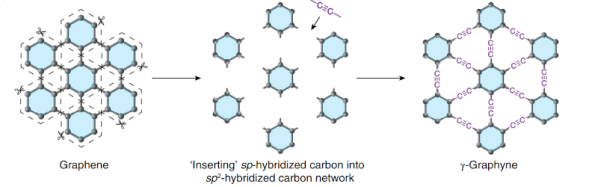
Before you jump down to the comments to chastise us for misspelling graphene, note that graphyne is similar to graphene but not the same. Like graphene, it is a two-dimensional structure of carbon. Unlike graphene, it contains double and triple bonds and does not always form hexagons. Scientists have postulated its existence for decades, but researchers at the University of Colorado Boulder have finally managed to pull it off. You can also download the paper if you want to wade through the details.

Carbon forms like fullerene and graphene are well-known and have many novel uses. Other allotropes of carbon include graphite and diamonds — certainly two things with wildly varying properties. Graphyne has conductivity similar to graphene but may also have other benefits.

Continue reading “Graphyne Finally Created”

Put Another Dime In The Jukebox

We don’t always acknowledge it, but most people have an innate need for music. Think of all the technology that brings us music. For decades, most of the consumer radio spectrum carried music. We went from records, to tape in various forms, to CDs, to pure digital. There are entire satellites that carry — mostly — music. Piracy aside, people are willing to pay for music, too. While it isn’t very common to see “jukeboxes” these days, there was a time when they were staples at any bar or restaurant or even laundrymat you happened to be in. For the cost of a dime, you can hear the music and share it with everyone around you.

Even before we could record music, there was something like a jukebox. Coin-operated machines, as you’ll recall, are actually very old. Prior to the 1890s, you might find coin-op player pianos or music boxes. These machines actually played the music they were set up to play using a paper roll with holes in it or metal disks or cylinders.

Early Days

That changed in 1890 when a pair of inventors connected a coin acceptor to an Edison phonograph. Patrons of San Francisco’s Palais Royale Saloon could put a hard-earned nickel in the slot and sound came out of four different tubes. Keep in mind there were no electronic amplifiers as we know them in 1890. Reportedly, the box earned $1,000 in six months.

Continue reading “Put Another Dime In The Jukebox”

Lotus 123 For Linux Is Like A Digital Treasure Hunt

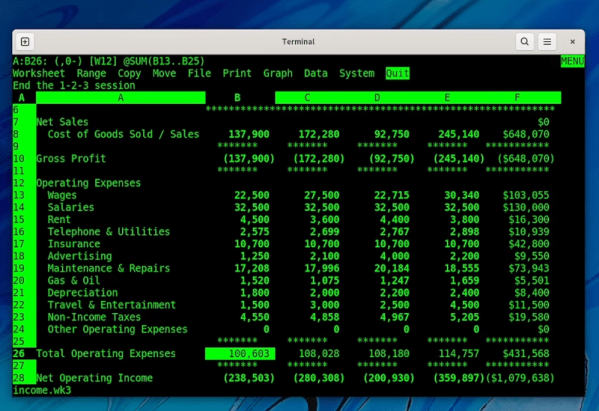
Ever hear of Lotus 123? It is an old spreadsheet program that dominated the early PC market, taking the crown from incumbent Visicalc. [Tavis Ormandy] has managed to get the old software running natively under Linux — quite a feat for software that is around 40 years old and was meant for a different operating system. You can see the results in glorious green text on a black screen in the video below.

If you are a recent convert to Linux, you might not remember what a pain it was “in the old days” to install software. But in this case, it is even worse since the software isn’t even for Linux. The whole adventure started with [Tavis] wanting to find the API kit used to add plugins to Lotus. In theory, you could use it to add modern features to the venerable spreadsheet program.

The $395 software development kit wasn’t very common and there was also a Unix version of Lotus 123, but no one seemed to have a copy of that. [Tavis] eventually found someone who ran a circa-1990 BBS and had the data on tape. Turned out there was a hot copy of the SDK that he was able to use. But he noticed something else in the BBS’s list of files: the long-lost Unix version of Lotus!

An investigation found the installer used TD0 files which took some research. Luckily, a utility exists that can convert these to raw disk images. Inside was a very large object file. Apparently, in the days without dynamic loading, that object would be linked with plug in modules to install them.

The object file had all of its debugging information intact which shed a lot of light on the program’s internal operations. The old executables used COFF format but it is possible to relink it to an ELF file. Of course, it isn’t just that easy. [Tavis] wrote a small program to remove the old-style Unix system calls so they could be rerouted to Linux system calls. Some calls just pass through, but others need some translation due to differences in things like structure layout, sizes, and alignment.

In the end, it all worked but didn’t have a valid license. However, [Tavis] felt like since he did have a license and the software is abandoned, he was within his rights to crack the license check.

We are well-known abusers of spreadsheets around here. Of course, we aren’t the only ones.

Continue reading Lotus 123 For Linux Is Like A Digital Treasure Hunt”

Truly Giant Telescope Could Image Exoplanets

Have you ever wished we could peek at all these exoplanets that have been recently discovered? We aren’t likely to visit anytime soon, but it would be possible to build a truly giant telescope that could take a look at something like that. At least according to [SciShow Space] in a recent video you can see below.

The idea put forth in a recent scientific paper is to deliberately create the conditions that naturally form gravitational lenses. If you recall, scientists have used these naturally-occurring lenses to image the oldest star ever observed. These natural super-telescopes have paid off many times, but you can’t pick what you want to look at. It is all a function of the distance to the star creating the lens and the direction a line between us points.

But what if you could create your own gravity lens? Granted, we probably aren’t going to do that in our garages. However, a recent paper talks about launching an optical detector that you could maneuver so that it was on a line that would pass through the object you want to see and our own sun. We clearly have the technology to do this. After all, we have several nice space telescopes, and several probes operating far away from the sun.

That is one of the biggest catches, though. This new telescope will need to be some 550 AU from the sun to get good results. For the record, the Earth is 1 AU (about 8 light minutes) out. Pluto — maybe not a planet anymore, but still a signpost on the way out of the solar system — is a scant 39 AU out. Voyager I, which has been racing away from the sun since 1977 is only about 156 AU out.

Because the craft would be so far out, it would be practically a one-shot mission. You also have to have something reliable enough to go the 17 years it would take with today’s technology to get in place. You also need a way to get the data back over that distance. All doable, but non-trivial.

The paper simulates what the Earth would look like using this technique from a nearby star. The images are shockingly good, especially after a bit of post-processing. Meanwhile, we may have to settle for more modest images. You might not see detail, but it is possible to find exoplanets with reasonably modest equipment.

Continue reading “Truly Giant Telescope Could Image Exoplanets”

Expedient Jig Lets You Crank Out Chain Link Fence

After the zombie apocalypse or whatever is coming, folks like us will be in high demand as the people who know how to fix things, generate electricity, and scavenge parts. But keeping out marauding zombies and neighbors requires fencing. Can you make your own chain link fence? If you watch [Diamleon]’s recent video, you might be able to. Admittedly, the bulk of the video is about fabricating the jig and you should expect to do some welding and cutting.

However, you might be able to make a similar jig with a little less work. The jig is essential a spool on a shaft with a crosswise cut to guide the wire. The whole thing is powered by an electric drill turning a sprocket much like a bicycle.

One pass through the machine makes a nice twisty wire. Once you’ve run off a few lengths of twisty wire it is relatively easy to interlace them into fencing panels. It is one of those things that is hard to visualize until you see it. We were impressed with the drill drive and immediately thought about modifying the design to wind large coils. There are probably many other uses for such a thing. So even if you don’t want to build a fence, you might want to check it out.

As for us, we’ll probably just make our fence out of wood. Or do something electric. Oddly enough, we saw a hand-crank version of this same type of machine last year.

Continue reading “Expedient Jig Lets You Crank Out Chain Link Fence”