Forget Radio! Transmitting With Neutrons

Throughout history, people have devised ways to send information across long distances. For centuries we relied on smoke signals, semaphores, and similar physical devices. Electricity changed everything. First the telegraph and then radio transformed communications. Now researchers at the University of Lancaster have demonstrated another way to send wireless data without using electromagnetic radiation. They’ve harnessed fast neutrons from californium-252 and modulated them with information with 100% success.

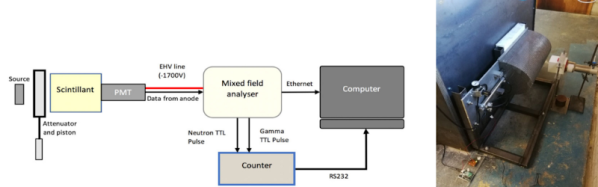
The setup was interesting. The radioactive material was encased in a cubic meter steel tank filled with water. A pneumatic system can move the material to one edge of the tank which allows fast neutrons to escape. A scintillating detector can pick up the increased neutron activity. It seems like it is akin to using what hams call CW and college professors call OOK (on off keying). You can do that with just about anything you can detect. A flashlight, knocking on wood, or — we suppose — neutrons.

We wondered what the practical application of this might be. The paper suggests that the technique could send data through metal containment structures like those of a nuclear reactor or, perhaps, a spacecraft where you don’t want anything unnecessarily breaching the containment. After all, neutrons cut through things that would stop a conventional radio wave cold.

It seems like you only have to prove you can detect something to make this work — it really doesn’t matter what it is you are detecting. It seems like it would be much harder to do more advanced types of modulation using neutrons. Maybe this is why we don’t hear aliens. They are all Morse code operators with neutron-based telegraphs.

Build Your Own HV Capacitors

Finding high voltage capacitors can be tricky. Sure, you can buy these capacitors, but they are often expensive and hard to find exactly what you want. [RachelAnne] needed some low-value variable capacitors that would work at 100 kV. So she made some.

Instead of fabricating the plates directly, these capacitors use laminations from a scrap power transformer. These usually have two types of plates, one of which looks like a letter “E” and the other just like a straight bar. For dielectric, the capacitors use common transparency film.

Continue reading “Build Your Own HV Capacitors”

Quantum computer

Scientific Honesty And Quantum Computing’s Latest Theoretical Hurdle

Quantum computers are really in their infancy. If you created a few logic gates with tubes back in the 1930s, it would be difficult to predict all the ways we would use computers today. However, you could probably guess where at least some of the problems would lie in the future. One of the things we are pretty sure will limit quantum computer development is error correction.

As far as we know, every quantum qubit we’ve come up with so far is very fragile and prone to random errors. That’s why every practical design today incorporates some sort of QEC — quantum error correction. Of course, error correction isn’t news. We use it all the time on unreliable storage media or communication channels and high-reliability memory. The problem is, you can’t directly clone a qubit (a quantum bit), so it is hard to use traditional error correction techniques with qubits.

After all, the whole point to a qubit is we don’t measure it until the end of the computation which, like Schrödinger’s cat, seals its fate. So if you were to “read” a bunch of qubits to form a checksum or a CRC, you’d destroy their quantum nature in the process making your computer not very useful. You can’t even copy a bit to use something like triple redundancy, either. There seems to be no way to practically duplicate a qubit.

Continue reading “Scientific Honesty And Quantum Computing’s Latest Theoretical Hurdle”

8″ Floppy On Your PC?

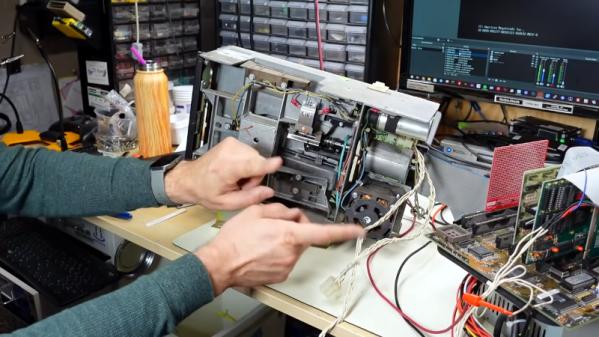
We should probably have a new metric for measuring mass storage performance: bytes per pound. An old IBM tape drive from the S/360 days, for example, could hold almost 6 megabytes of data. It also weighed more than a typical refrigerator. Today, a tiny postage-stamp-sized card can hold gigabytes of data and weighs — at most — a few ounces. Somewhere in the middle is the old 8 inch floppy drive. At its peak, you could cram about 1.2 megabytes on it, but even with the drive you could lift it all in one hand. These disks and their descendants ruled the computing world for a while. [Adrian asks the question: can you use an 8″ floppy drive on a PC? The answer is in the video below.

He didn’t do it on a lark. [Adrian] is getting ready to restore a TRS-80 Model II so he wanted to create some 8″test floppies. But how do you marry a 40-something-year-old drive to a modern computer? He had a few drives of unknown condition so there was nothing to do but try to get them working.

Continue reading “8″ Floppy On Your PC?”

Arduino Piano Tuner Is Pitch Perfect

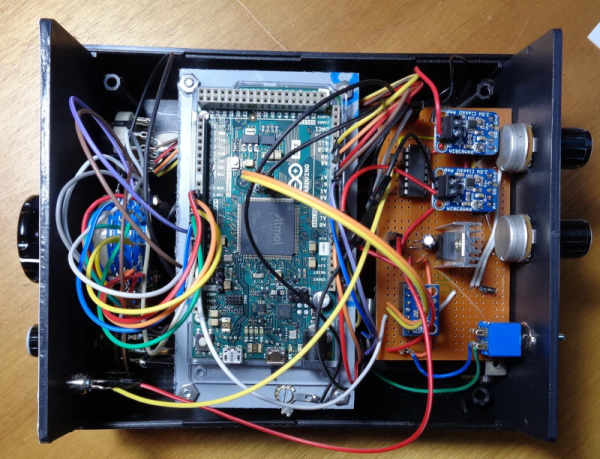
[JanHerman] knows that tuning musical instruments is all about precision and that precision is measured in a logarithmic unit called a cent. A cheap tuner unit might be accurate to 1.5 cents which sounds good until you look at one for ten times the price and find it is accurate to 0.1 cents. So you can spend $800 for precision or $60 for something less. [Jan] decided to build something better and cheaper using a 32-bit Arduino and a DDS frequency generator chip on a breakout board.

Oddly enough, the device doesn’t have a display. Instead, it generates a precise frequency and couples it to the piano using a transducer. You tune the string to the corresponding note. The post has a lot of detail about how piano tuning works.

Continue reading “Arduino Piano Tuner Is Pitch Perfect”

Faster IPA Recycling For Your Resin Print Workflow

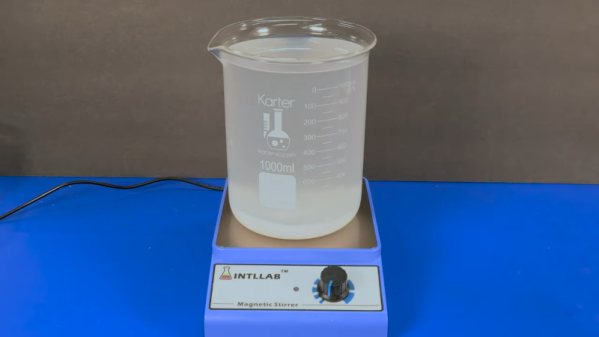
If you’ve printed with photopolymer resins, you know that you need alcohol. Lots of alcohol. It makes sense that people would like to reuse the alcohol both to be environmentally responsible and to save a little money. The problem is that the alcohol eventually becomes so dirty that you have to do something. Given time, the polymer residue will settle to the bottom and you can easily pour off most of the clean liquid. You can also use filters with some success. But [Makers Mashup] had a different idea. Borrowing inspiration from water treatment plants, he found a chemical that will hasten the settling process. You can see a video of his process below.

The experimentation started with fish tank clarifier, which is — apparently — mostly alum. Alum’s been used to treat wastewater for a long time. Even the ancient Romans used it for that purpose in the first century. Alum causes coagulation and flocculation so that particles in the water wind up sinking to the bottom.

Continue reading “Faster IPA Recycling For Your Resin Print Workflow”

Most FDM Printers Are Also Filament Dryers (with A Little Help)

If you’ve printed with an FDM printer, you probably know there are many interrelated factors to getting a good print. One key item is the dryness of the filament. When you first crack your plastic open, it should be dry. Most filament is packed in a sealed bag with desiccant in it. But if you have the filament out for a while, it soaks up moisture from the air and that causes lots of problems. [Design Prototype Test] has built and bought filament dryers before, but now he would like to point out that every FDM printer with a heated bed can act as a filament dryer. You can see the details in the video below.

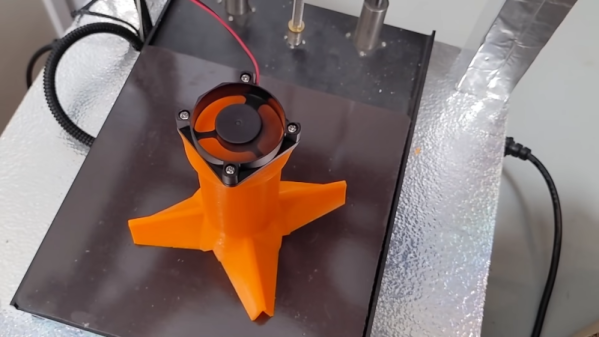
It turns out that the idea isn’t original, but it doesn’t seem to be one that has caught on. What the video shows though, is to take the idea and run with it. A 3D printed support sits on the bed and accepts a cheap PC fan. The whole affair gets boxed up with cardboard and can dry the filament.

Continue reading “Most FDM Printers Are Also Filament Dryers (with A Little Help)”