Tech In Plain Sight: Primitive Engineering Materials

It isn’t an uncommon science fiction trope for our hero to be in a situation where there is no technology. Maybe she’s back in the past or on a faraway planet. The Professor from Gilligan’s Island comes to mind, too. I’d bet the average Hacakday reader could do pretty well in that kind of situation, but there’s one thing that’s often overlooked: materials. Sure, you can build a radio. But can you make wire? Or metal plates for a capacitor? Or a speaker? We tend to overlook how many abstractions we use when we build. Even turning trees into lumber isn’t a totally obvious process.

People are by their very nature always looking for ways to use the things around them. Even 300,000 years ago, people would find rocks and use them as tools. It wasn’t long before they found that some rocks could shape other rocks to form useful shapes like axes. But the age of engineered materials is much younger. Whether clay, metal, glass, or more obviously plastics, these materials are significantly more useful than rocks tied to sticks, but making them in the first place is an engineering story all on its own.

Continue reading “Tech In Plain Sight: Primitive Engineering Materials” →

Linux For The Paranoid Does The Work For You

We all know that our activity on the Internet is not that hard to track. It just annoys some people more than others. If you are really hardcore, you’ll learn all the ins and outs of networking to help cover your tracks, but what if you don’t want to invest that kind of time? Maybe, as [TechRepublic] suggests, try Kodachi Linux.

You could, of course, start with your own live image. Then when you boot, you could take the following steps:

  • Randomize your MAC Address
  • Establish a TOR connection through a VPN
  • Route all internet traffic through TOR and use DNS encryption
  • Set up a scheduled task to scramble your MAC address periodically

But that’s what Kodachi does without any real effort on your part.

The distribution is based on Ubuntu, so all the familiar tools are there. There are also a few security and privacy tools included like KeePass, Tox, OnionShare, i2p, and more. The desktop shows a summary of secure network information

Do you need Kodachi? Probably not, if you are a Linux guru. Plus, most people aren’t doing anything that’s that interesting. But if you want to protect your privacy or you are up to something, give Kodachi a try. Then again, if you are that paranoid, maybe that’s just what THEY want you to do. Make your own decisions. You can also check out the video review from [eBuzz Central] below.

Looking for more conventional Linux? Why not Rocky Linux? If you just want a VPN, you can always just use ssh.

Continue reading “Linux For The Paranoid Does The Work For You” →

Shake With Your New Robot Hand

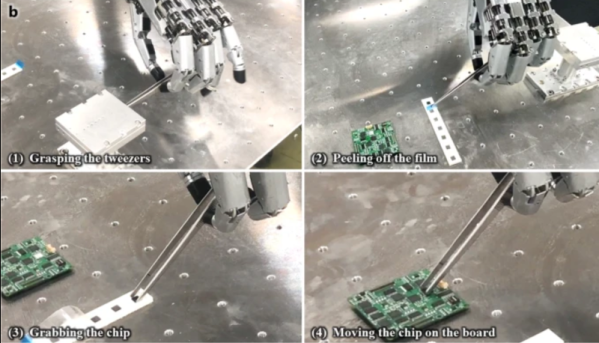
Korean researchers have created a very realistic and capable robot hand that looks very promising. It is strong (34N of grip strength) and reasonably lightweight (1.1 kg), too. There are several videos of the hand in action, of which you can see two of them below including one where the hand uses scissors to cut some paper. You can also read the full paper for details.

Continue reading “Shake With Your New Robot Hand” →

Laser Sees Through Keyhole

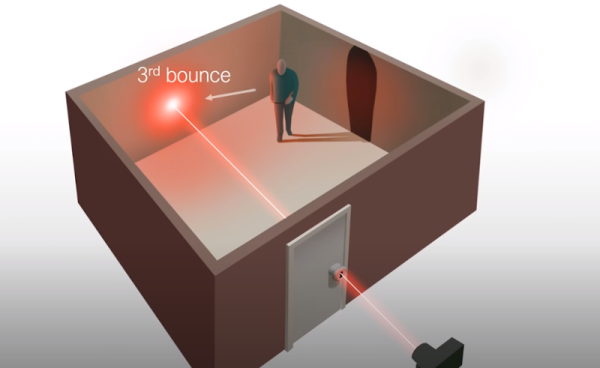
Those guys at Stanford must be watching a lot of James Bond movies. Their latest invention is a laser that can image an entire room through a keyhole. We imagine that will show up in a number of spy movies real soon now. You can see the code or watch the video below.

The technique is called NLOS or non-line-of-sight imaging. Previous approaches require scanning a large area to find indirect light from hidden objects. This new approach uses a laser to find objects that are moving. The indirect data changes based on the movement and an algorithm can reverse the measurements to determine the characteristics of the object.

Continue reading “Laser Sees Through Keyhole” →

Where The Rubber Meets The Computer

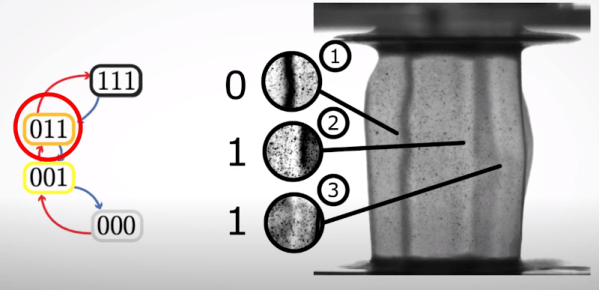
If you ever get a chance to go to Leiden, take it. It is a beautiful little city that hides some high-power university research. It also boasts the world’s first rubber computer. You won’t be running Crysis on it anytime soon, though. The fledgling computer has memory and can count to two — really more of a state machine. It is easier to watch the video below than try to fully explain it. Or you can read through the actual paper.

If you watch the video, you’ll see that deformation in the corrugated rubber structure is apparently repeatable and represent bits in the machine. Pressing and releasing pressure on the structure forms both input and clock and it is possible for the material to go from state A to B on compression, but when you release pressure, it reaches state C. The compression and the angle of the pressure allow for different input conditions. One example rubber state machine counts how many times you compress the piece of rubber.

What do you do with a piece of smart rubber? We don’t know. Maybe if you wanted shoes to count steps so you could transmit the count once a minute to save on battery? The researchers have admitted they don’t have any specific applications in mind either, but presume someone will want to use their work.

Of course, the video’s title: “The Rubber Computer” is a bit of hyperbole, but we can forgive it. Most people wouldn’t get “The Rubber Finite State Machine.” While mechanical computing might seem a bit passe, turns out at the molecular level it may become very important. Besides, you can make a computer out of cardboard (or simulate that computer in an FPGA or spreadsheet, if you prefer).

Continue reading “Where The Rubber Meets The Computer” →

Hydrogen Generation Made Easy

Even if you never want to generate hydrogen, [Maciej Nowak’s] video (embedded below) is interesting to watch because of the clever way the electrode is formed from stainless steel washers. You’ll need heat shrink tubing, but you ought to have that hanging around anyway. Building the electrode using the techniques in the video results in a lot of surface area which is important for an electrochemical reaction.

A standard rechargeable cell provides power for the generator which resides in a modified plastic bottle. The overall build looks good even though it is all repurposed material.

Continue reading “Hydrogen Generation Made Easy” →

Concrete With 3D Printed Foam Forms

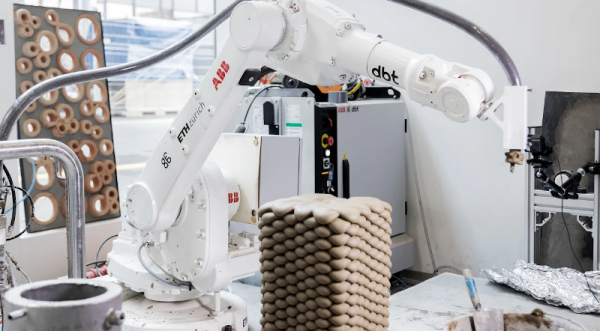
The latest 3D printing application?  Forming concrete. That’s according to a team at ETH Zurich who claims that construction with foam forms cuts concrete usage up to 70%. It also offers improved insulation properties. You can see a video about the process, below.

Typical concrete work relies on a form often made with wood, steel, or plastic. That’s easy to do, but hard to make complex shapes. However, if you can create complex shapes you can easily put material where it adds strength and omit material where it doesn’t carry load. Using a robotic-arm 3D print technique, the researchers can lay out prefabricated blocks of foam that create forms with highly complex shapes. Continue reading “Concrete With 3D Printed Foam Forms” →