Hacking An Air Assist For The Ortur Laser

Getting great results from a laser cutter takes a bit of effort to make sure all of the settings are just right. But even then, if the air between the material and the laser source is full of smoke and debris it will interfere with the laser beam and throw off the results. The solution is to add air assist which continuously clears that area.

Earlier this year I bought an Ortur laser engraver/cutter and have been hacking on it to improve the stock capabilities. last month I talked about putting a board under the machine and making the laser move up and down easily. But I still didn’t have an air assist. Since then I found a great way to add it that will work for many laser cutter setups.

I didn’t design any of these modifications, but I did alter them to fit my particular circumstances. You can find my very simple modifications to other designs on Thingiverse. You’ll also find links to the original designs and you’ll need them for extra parts and instructions, too. It is great to be able to start with work from talented people and build on each other’s ideas.

Continue reading “Hacking An Air Assist For The Ortur Laser” →
AI Makes Linux Do What You Mean, Not What You Say

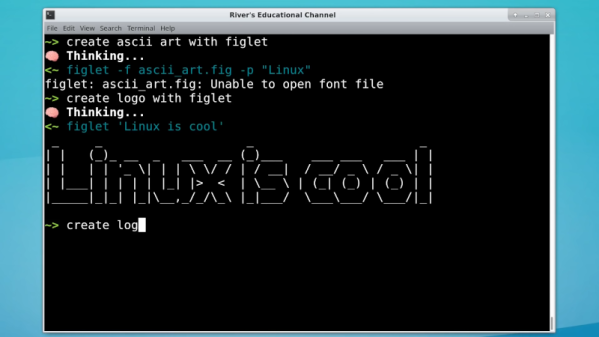
We are always envious of the Star Trek Enterprise computers. You can just sort of ask them a hazy question and they will — usually — figure out what you want. Even the automatic doors seemed to know the difference between someone walking into a turbolift versus someone being thrown into the door during a fight. [River] decided to try his new API keys for the private beta of an AI service to generate Linux commands based on a description. How does it work? Watch the video below and find out.

Some examples work fairly well. In response to “email the Rickroll video to Jeff Bezos,” the system produced a curl command and an e-mail to what we assume is the right place. “Find all files in the current directory bigger than 1 GB” works, too.

Continue reading “AI Makes Linux Do What You Mean, Not What You Say” →

Inside A DEC Hard Drive

A lot of technology from the not-so-distant past doesn’t resemble modern versions very much. For a case in point, look at the DEC RS08 disk drive meant to pair with a circa 1970 PDP-8. Paired with an RF08 controller, this was state of the art, holding 262K 12-bit words with a blistering access speed of almost 63K/second unless you were plugged into 50Hz AC when it was closer to 50K/second. [Uniservo] had the disk unit, but not the controller. Someone else had a controller, but no disk drive. So [Uniservo] is shipping the disk to its new owner in a move worthy of a Reeses’ Peanutbutter Cup. The problem? The disk is super fragile and shipping is risky, so he decided to remove the platter for separate packing. Good thing for us, because we get a peek inside.

The nickel-cobalt platter looks like a thick LP record with heads underneath. As you might guess from the data transfer specification, the motor was just a common AC motor that rotated the platter against the head.

Continue reading “Inside A DEC Hard Drive” →

Power Supply Uses Thin Form Factor

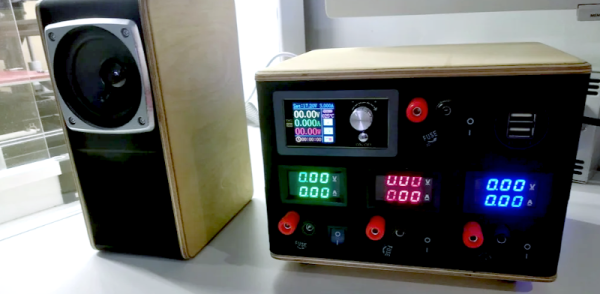
We’ve seen lots of power supply projects that start with an ATX PC power supply. Why not? They are cheap and readily available. Generally, they perform well and have a good deal of possible output. [Maco2229’s] design, though, looks a lot different. First, it is in a handsome 3D-printed enclosure. But besides that, it uses a TFX power supply — the kind of supply made for very small PCs as you’d find in a point of sale terminal or a set-top box.

Like normal PC supplies, these are inexpensive and plentiful. Unlike a regular supply, though, they are long and skinny. A typical supply will be about 85x65x175mm, although the depth (175mm) will often be a little shorter. Compare this to a standard ATX supply at  150x86x140mm, although many are shorter in depth. Volume-wise, that’s nearly 967 cubic centimeters versus over 1,800. That allows the project to be more compact than a similar one based on ATX.

Continue reading “Power Supply Uses Thin Form Factor” →

Exploring Op Amp Loading

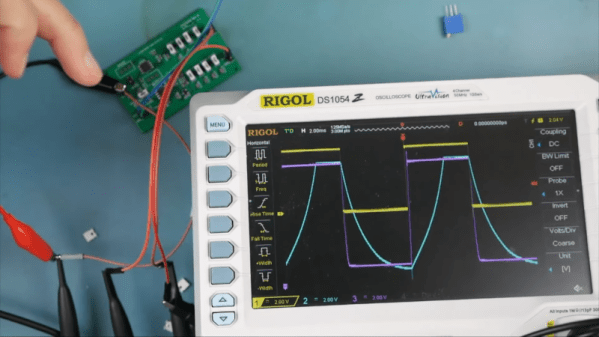
Op amps are generally pretty easy to apply, but there are some practical nonideal behaviors you have to keep in mind. [EEforEveryone] takes a test board with some 2X amplifiers on it and — after some fiddling around with the scope probes — demonstrates the effect of capacitive loading on the output of an op amp. (Video, embedded below.)

The op amp in question is the OP07. In fact, there are two identical opamps looking at the single input. The output of one op amp feeds directly to the scope probes. The second one passes through a bipolar transistor buffer consisting of an NPN and PNP transistor. Both outputs have optional capacitors that can be jumpered in or out of the circuit.

Continue reading “Exploring Op Amp Loading” →

Heads Up: Smart Glass Multimeter

Sometimes it is hard to probe a circuit and then look over at the meter. [Electronoobs] decided to fix that problem by making a Google Glass-like multimeter using an OLED screen and Bluetooth module.

The custom PCB doesn’t have many surprises. A small board has a controller, a battery charger, a display, and a Bluetooth module. One thing he did forget is a switch, though, so the board is always on unless you arrange an external switch.

Continue reading “Heads Up: Smart Glass Multimeter” →

The Imperfect Bipolar Transistor

We like to pretend that our circuit elements are perfect because, honestly, it makes life easier and it often doesn’t matter much in practice. For a normal design, the fact that a foot of wire has a tiny bit of resistance or that our capacitor value might be off by 10% doesn’t make much difference. One place that we really bury our heads in the sand, though, is when we use bipolar transistors as switches. A perfect switch would have 0 volts across it when it is actuated. A real switch won’t quite get there, but it will be doggone close. But a bipolar transistor in saturation won’t be really all the way on. [The Offset Volt] looks at how a bipolar transistor switches and why the voltage across it at saturation is a few tenths of a volt. You can see the video below.

To understand it, you’ll need a little bit of math and some understanding of the construction of transistors. The idea of using a transistor as a switch is that the transistor is saturated — that is, increasing base current doesn’t make much change in the collector current. While it isn’t perfect, it is good enough to switch a relay or do other common switching tasks.

Continue reading “The Imperfect Bipolar Transistor” →