Olaf Lets An ESP32 Listen To The Music

The joys of overengineering a simple gift. [Joren] wanted to create a dress for his daughter’s fourth birthday that would react with lights in sequence for a song from Frozen. The dress and an LED strip, along with a digital microphone and a battery were easy to procure. But how to make it all work? An ESP32 did the trick.

While the project’s name–Olaf–sounds like it was from Frozen, according to the GitHub page it actually means Overly Lightweight Acoustic Fingerprinting. Right. However, as the name implies, it can learn to identify any sound you want.


Continue reading “Olaf Lets An ESP32 Listen To The Music”

SDR Transmitting Gets The Power

Most hobby-grade software defined radio setups don’t transmit. Of the few that do, most of them put out anemic levels around one milliwatt or so. If you want to do something outside of the lab, you’ll need an amplifier and that’s what [Tech Minds] shows how to do in a recent video. (Embedded below.)

The video covers LimeSDR, HackRF, and the Pluto SDR, although the amplifiers should work with any transmitter. The SPF5189Z module is quite cheap and covers 50 MHz to 4 GHz, amplifying everything you throw at it. The downside is that it will amplify everything you throw at it, even parts of the signal you don’t want, such as spurs and harmonics.

Continue reading “SDR Transmitting Gets The Power”

Video Compression Explainer — Like We’re Five-Year-Olds

[Ottverse] has an interesting series in progress to demystify video compression. The latest installment promises to explain discrete cosine transforms as though you were five years old.

We’ll be honest. At five, we probably didn’t know how to interpret this sentence:

…the Discrete Cosine Transform takes a set of N correlated (similar) data-points and returns N de-correlated (dis-similar) data-points (coefficients) in such a way that the energy is compacted in only a few of the coefficients M where M << N.

Still, the explanation is pretty clear and we really liked the analogy with the spheres and the stars in a constellation.

Continue reading “Video Compression Explainer — Like We’re Five-Year-Olds”

A Tale Of Tutor Texts

Have you ever had one of those books that let you choose your own adventure? You know, the book will say “The bully tells you to hand over the secret message. If you want to run away, turn to page 48. If you want to fight him, turn to page 70.” While this is normally a staple of children’s literature, there were a series of training books known as Tutor Texts that used the format to teach technical topics.

In fact, one of these books was my first introduction to computer programming more years ago than I care to admit. But it wasn’t just computer programming. There were titles from the same publisher about trigonometry, slide rules, and even how to play bridge. I own four of these old books and it got me to thinking about how we deliver information on the web. Maybe these books were ahead of their time.

Continue reading “A Tale Of Tutor Texts”

Creating Kelvin Test Leads For Four-Wire Measurments

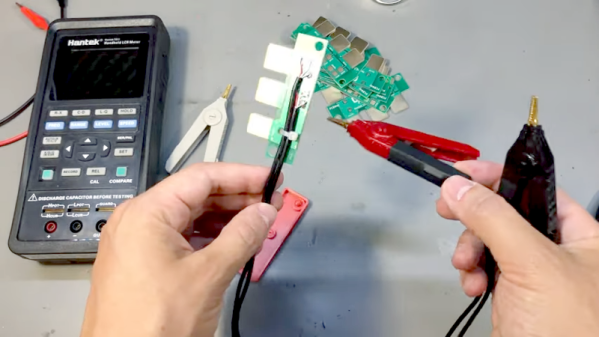
[VoltLog] has a cheap Hantek LCR meter, but it only has two probes. The best resistance and impedance measurements, though, use four wires to improve accuracy. The first order of business was a custom PCB to fit into the connector of the meter, along with a 3D-printed case.

Using a four-wire scheme requires unusual alligator clips that don’t electrical short the jaws together. The clips were hard to solder and even harder to strain relief. but [VoltLog] seemed to handle it with little problem.

Continue reading “Creating Kelvin Test Leads For Four-Wire Measurments”

Cold Tube Draws The Heat

If you live anywhere near the tropics, air conditioning isn’t a luxury but a necessity. The problem however is that humid climates can cause conventional air conditioners to draw more power to dehumidify the air than it requires to just cool it, which increases the power needed to run the unit. Back in 1963, there was a proposal to create a cooling system that didn’t foster condensation and couple it with different methods of removing humidity. Researchers in Singapore have now created such a system. It uses a membrane that is permeable to infrared radiation but prevents condensation around the cooling unit.

You can see a video of the apparatus in a pavilion in the Singapore heat in the video below. Chilled water runs through tubes behind a membrane that passes thermal radiation. Since the tubes are not exposed to the ambient atmosphere, condensation is minimal. But heat radiates from the warmer area to the much colder area of the tubes.

Continue reading “Cold Tube Draws The Heat”

This Geiger Counter Has Few Parts

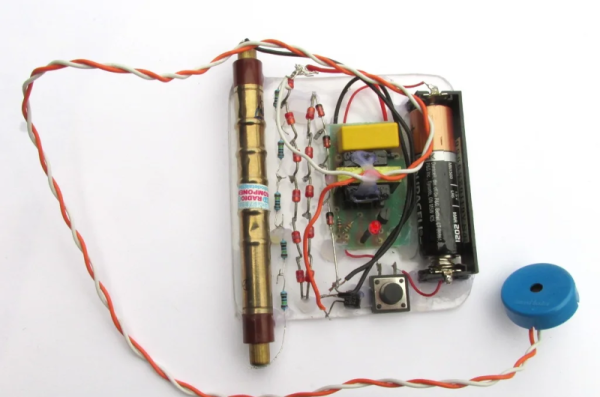
With all the focus on biological problems, we might forget that sometimes it’s handy to know about radiation hazards, too. [Ryan Harrington] shows us how to make a Geiger counter with very few parts, and you can see the results in the video below.

The glut of surplus Russian tubes has made this a common project, but we were amused to see the main part of the high-voltage supply was gutted from a cheap electronic flyswatter sourced from Harbor Freight. Even without a coupon, it only costs about $4.

There’s also a stack of zener diodes, a transistor, and some resistors. A battery, a piezo speaker, and a switch round out the bill of materials. Even then, the switch was upcycled from the flyswatter, so there’s not much to buy.

Continue reading “This Geiger Counter Has Few Parts”