Dipole Antenna Is Off Balance

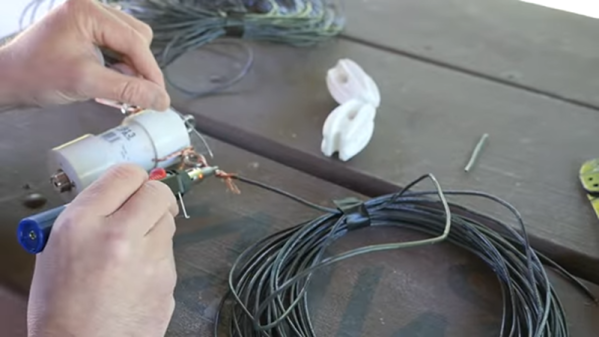
A dipole antenna is easy, right? Two wires, each a quarter wavelength long, emanate from a coax or other feedline. Unless it is an off-center dipole. The length is still the same, but you move the feed point to a different part. [KB9VBR] explains how this changes the antenna’s impedance from the nominal 70 ohms of a standard dipole.

Why would you want to do that? The trick is to find a feed point that has acceptable impedance on multiple ham radio bands. Most automatic tuners can handle a certain range of mismatch so using an antenna like this with a tuner can allow one antenna to serve multiple bands with no traps or switches.

Continue reading “Dipole Antenna Is Off Balance”

Learn Quantum Computing With Spaced Repetition

Everyone learns differently, but cognitive research shows that you tend to remember things better if you use spaced repetition. That is, you learn something, then after a period, you are tested. If you still remember, you get tested again later with a longer interval between tests. If you get it wrong, you get tested earlier. That’s the idea behind [Andy Matuschak ‘s]and [Michael Nielsen’s] quantum computing tutorial. You answer questions embedded in the text. You answer to yourself, so there’s no scoring. However, once you click to reveal the answer, you report if you got the answer correct or not, and the system schedules you for retest based on your report.

Does it work? We don’t know, but we have heard that spaced repetition is good for learning languages, among other things. We suspect that like most learning methods, it works better for some people than others.

Continue reading “Learn Quantum Computing With Spaced Repetition”

Loading Coils, The Heaviside Condition, And Pupin Coils

When we draw schematics, we have the luxury of pretending that wire is free. There are only a few cases where you have to account for the electrical characteristics of wire: when the wire is very long or the frequency on the wire is relatively high.

This became apparent after the first transatlantic cable went into service for telegraph communications. Even though the wire was linear, there was still distortion on the line so severe that dots and dashes would overlap each other. The temporary solution was to limit speeds so slow that operators had trouble sending and receiving at those speeds. How slow? An average character took two minutes to send! That’s not a typo. Two minutes per character. By custom, Morse code assumes a word is five characters, so you could send a word every 10 minutes.

The first transatlantic cable went into service in 1858 and was virtually the moon landing of its day. Frustrated with how slow the communications were, an electrician by the name of Whitehouse decided to crank up the voltage to over 1,000 volts which caused the cable to fail after only three weeks in service. Whoops. Later analysis showed the cable was probably going to fail quickly anyway, but Whitehouse took the public blame.

The wire back then wasn’t as good as what we have today, which led to some of the problems. The insulation was made from multiple coats of a natural latex, gutta percha, which is what dentists use to fill root canals. The jackets were made from tarred hemp and bound with iron wire. There was no way to build an underwater amplifier in 1858, so the cables were just tremendous wires laying on the ocean floor between Newfoundland and Ireland.

Continue reading “Loading Coils, The Heaviside Condition, And Pupin Coils”

Repairing A Workhorse Bench Meter

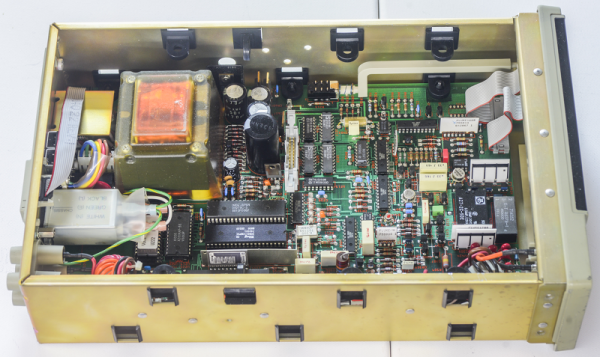
In today’s market, and expensive high-precision bench meter will have a host of features: graphs, alarms, averaging, and more. It will probably even use an operating system. However, old meters can still get the job done at a price that you can actually afford. A case in point is the Fluke 8842A, solid meters with 5.5 digits of resolution and the ability to do two or four wire resistance measurements.  They are built like tanks and are surprisingly affordable, especially if you consider what they went for when new. [Illya Tsemenko] recently updated a log about repairing such a meter, and there is a lot of good information about them if you own one or are thinking about one.

The biggest problem with repairing these meters is that there are several custom parts including the display that are essentially unavailable. For that reason, [Illya] took a meter with a broken display and used it to source parts for another meter.

Continue reading “Repairing A Workhorse Bench Meter”

Copy And Paste Deemed Insecure

Back when Windows NT was king, Microsoft was able to claim that it met the strict “Orange Book” C2 security certification. The catch? Don’t install networking and remove the floppy drives.  Turns out most of the things you want to do with your computer are the very things that are a security risk. Even copy and paste.

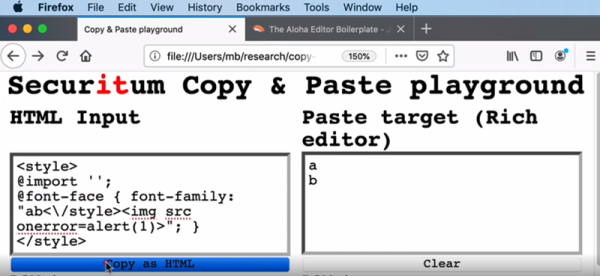
[Michal Benkowki] has a good summary of his research which boils down to the following attack scenario:

  1. Visit a malicious site.
  2. Copy something to the clipboard which allows the site to put in a dangerous payload.
  3. Visit another site with a browser-based visual editor (e.g., Gmail or WordPress)
  4. Paste the clipboard into the editor.

Continue reading “Copy And Paste Deemed Insecure”

Linux-Fu: Automation For Chrome And The Desktop By Matching Screenshots

I will be the first to admit it. This is almost not — at least not specifically — a Linux article. The subject? An automation tool for Chrome or Firefox. But before you hit the back button, hear me out. Sure, this Chrome plugin started out as a tool to automatically test web pages and automate repetitive tasks in the browser. However, it can extend that power to all programs on your computer. So, in theory, you can use it to graphically build macros that can interact with desktop applications in surprisingly sophisticated ways. In theory, anyway; there are a few problems.

The program has a few different names. Most documentation says UI Vision RPA, although there are some references to Kantu, which appears to be an older name. RPA is an acronym for Robotic Process Automation, which is an industry buzz word.

Let’s take it for a spin and see what it’s all about.

Continue reading “Linux-Fu: Automation For Chrome And The Desktop By Matching Screenshots”

Antique Army Surplus Receiver Restored

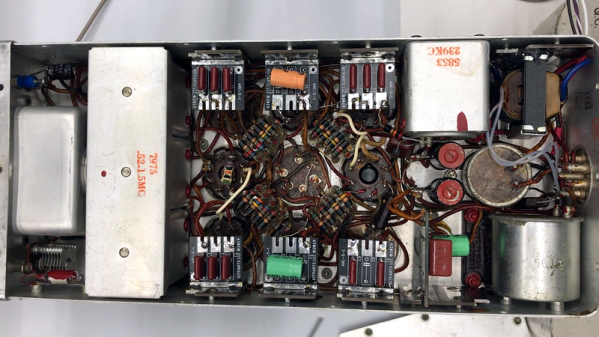
If you’ve ever been to a hamfest in the United States, you probably have at least seen an ARC 5 Command set. These were very rugged receivers and there were a ton of them made. Hams have been reworking them for years. In a recent video [Tom N3LLL] shared some of his tips for restoring them.

You might think these are just like a regular old radio, but there are some unique challenges, including capacitors filled with beeswax and strange threaded screws. [Tom] made several custom boards to replace the dynamotor with a solid-state inverter, replace odd capacitors, and provided a faceplate. He also 3D printed some replacement studs to replace the often decayed anti-vibration studs for the dynamotor.

The teardown at the end shows how rugged these things are. Tom’s restoration philosophy is to modernize the set while keeping the outward aesthetics. The receivers perform well, and as you might expect are built like tanks.

If you want to try your hand at restoration, these are not very expensive because there were so many of them made. Often the shipping is about the same price as the radio, but one in good shape can cost a bit more. We think the real fun is getting one that is not in such good shape and making it better.

Everyone has their own style and we know some restorers are more purists, but as a practical matter, [Tom’s] restorations look great, sound great, and preserve these great old radios so that someone might still be using them in another 75 years.

We’ve covered the ARC 5 before, unsurprisingly, and that restoration was a bit more traditional if you prefer it that way. If you need something to listen to on the AM band, try a matching transmitter.

Continue reading “Antique Army Surplus Receiver Restored”