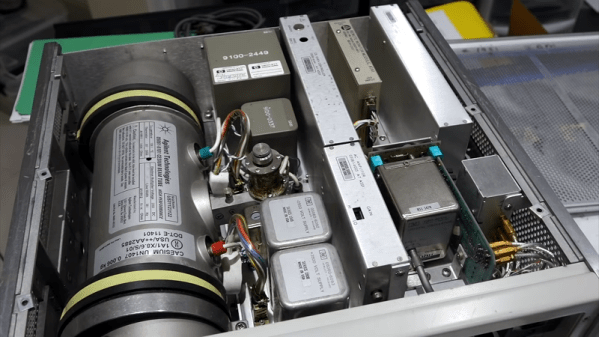
Cesium Clock Teardown, Or Quantum Physics Playground

Half the fun of getting vintage test equipment is getting to open it up. Maybe that’s even more than half of the fun. [CuriousMarc] got an HP 5061A Cesium clock, a somewhat famous instrument as the model that attempted to prove the theory of relativity. The reason? The clock was really the first that could easily be moved around, including being put on an airplane. You can watch the video below.

According to the video, you can simplify special relativity to saying that time slows down if you go fast — that is known as time dilation. General relativity indicates that time slows down with increasing gravity. Therefore, using airborne Cesium clocks, you could fly a clock in circles high up or fly at high speeds and check Einstein’s predictions.
Continue reading “Cesium Clock Teardown, Or Quantum Physics Playground”
Another PC Power Supply Project

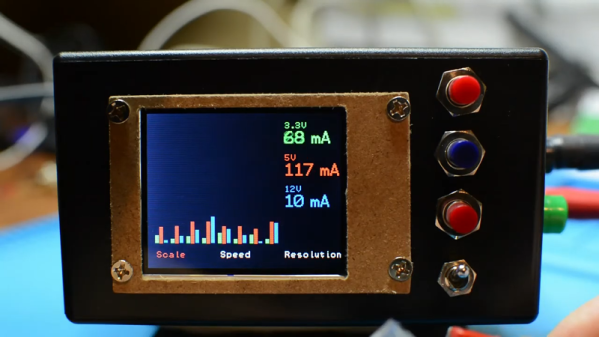
Economy of scale is a wonderful thing, take the switch-mode power supply as an example. Before the rise of the PC, a decent multi-voltage, high current power supply would be pretty expensive. But PCs have meant cheap supplies and sometimes even free as you gut old PCs found in the dumpster. [OneMarcFifty] decided to make a pretty setup for a PC supply that includes a very nice color display with bargraphs and other niceties. You can see the power supply in action in the video below.

The display is a nice TFT driven by an Arduino Nano. The project uses ACS712 current sensor modules, which are nice Hall effect devices that produce a linear output for current and have over 2 KV of voltage isolation.

Continue reading “Another PC Power Supply Project”

Quantum Sensor Receives From 0 Hz To 1000 GHz

Although it isn’t that uncommon to have broadband radio coverage in a single device, going from 0 Hz to 1000 GHz with one antenna and receiver is a bit much. But not for the US Army it seems, because they’ve developed a quantum sensor that can cover that range.

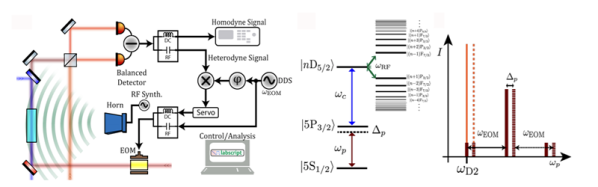
The technology uses Rydberg atoms, which are atoms with a highly excited valence electron. They’ve been used for a variety of sensing applications before, such as reading the cosmic microwave background radiation. However, until the Army’s work there has been no quantitative analysis of using them for wide-spectrum communications.

Continue reading “Quantum Sensor Receives From 0 Hz To 1000 GHz”

Another Blinky Light Project — With A COVID-19 Twist

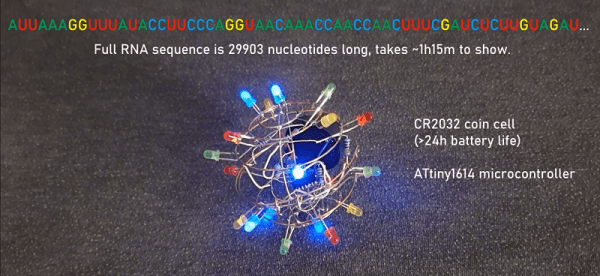
It seems all anyone is talking about right now is the virus scare that has most of us with a little extra time on our hands. [Paul Klinger] — a name we’ve seen before — built a blinking LED project to pass the time. So what? Well, the lights are made to look like a SARS-CoV-2 virus and the LEDs blink the virus RNA code. You can see the results in the video below.

This isn’t very surprising when you consider we’ve seen [Paul] make tiny things and even blink out his own DNA, so he’s clearly got some specific interests in this area.

Continue reading “Another Blinky Light Project — With A COVID-19 Twist”

MIT Ventilator Designed With Common Manual Resuscitator; Submitted For FDA Testing

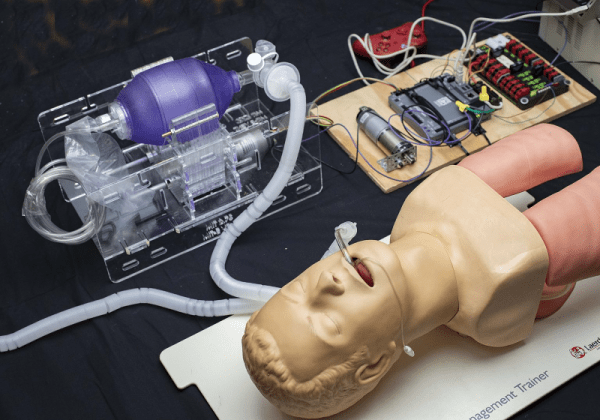
In many parts of the world the COVID-19 pandemic is causing shortages in hospital space, staff, medical supplies, and equipment. Severe cases may require breathing support, but there are only so many ventilators available. With that in mind, MIT is working on FDA approval of an emergency ventilator system (E-Vent). They have submitted the design to the FDA for fast track review. The project is open source, so once they have approval the team will release all the data needed to replicate it.

The design is actually made simple by using something that is very common: a manual resuscitator. You have doubtlessly seen these on your favorite medical show. It is the bag someone squeezes while the main character struggles valiantly to save their patient. Of course, having someone sit and squeeze the bag for days on end for thousands of people isn’t very practical and that’s where they’ve included an Arduino-controlled motor to automate the process.

Continue reading “MIT Ventilator Designed With Common Manual Resuscitator; Submitted For FDA Testing”

ESP32-S2 Samples Show Up

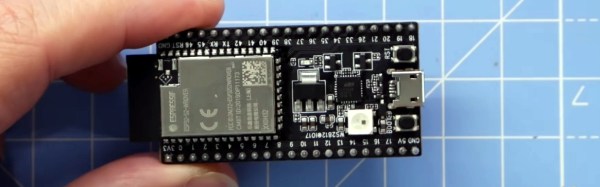
The ESP8266 is about six years old now and the ESP32 is getting more mainstream every day. Unsurprisingly, Espressif is developing even newer product and the ESP32-S2 was in the hands of some beta testers last year. Now it is finally landing as “final silicon” samples in people’s hands. [Unexpected Maker] got a few and a prototype development board for the chip and shared his findings in a recent video.

The ESP32-S2 has a single core LX7 running at 240 MHz along with a RISC-V-based coprocessor. Onboard is 320K of RAM and 128K of ROM. You might notice this is less than the ESP32. However, the device can support up to 128MB of external RAM and up to 1GB of external flash. It also supports USB, although the prototype module appears to have an external USB chip on it.

Continue reading “ESP32-S2 Samples Show Up”

Linux Fu: Mapping Files

If you use C or C++, you have probably learned how to open a file and read data from it. Usually, we read a character or a line at a time. At least, it seems that way. The reality is there are usually quite a number of buffers between you and the hard drive, so your request for a character might trigger a read for 2,048 characters and then your subsequent calls return from the buffer. There may even be layers of buffers feeding buffers.

A modern computer can do so much better than reading using things using old calls like fgetc. Given that your program has a huge virtual address space and that your computer has a perfectly good memory management unit within it, you can ask the operating system to simply map the file into your memory space. Then you can treat it like any other array of characters and let the OS do the rest.

The operating system doesn’t necessarily read the entire file in at one time, it just reserves space for you. Any time you hit a page that isn’t in memory, the operating system grabs it for you invisibly. Pages that you don’t use very often may be discarded and reloaded later. Behind the scenes, the OS does a lot so you can work on very large files with no real effort. The call that does it all is mmap.

Continue reading “Linux Fu: Mapping Files”