The ESP8266 is about six years old now and the ESP32 is getting more mainstream every day. Unsurprisingly, Espressif is developing even newer product and the ESP32-S2 was in the hands of some beta testers last year. Now it is finally landing as “final silicon” samples in people’s hands. [Unexpected Maker] got a few and a prototype development board for the chip and shared his findings in a recent video.
The ESP32-S2 has a single core LX7 running at 240 MHz along with a RISC-V-based coprocessor. Onboard is 320K of RAM and 128K of ROM. You might notice this is less than the ESP32. However, the device can support up to 128MB of external RAM and up to 1GB of external flash. It also supports USB, although the prototype module appears to have an external USB chip on it.
If you use C or C++, you have probably learned how to open a file and read data from it. Usually, we read a character or a line at a time. At least, it seems that way. The reality is there are usually quite a number of buffers between you and the hard drive, so your request for a character might trigger a read for 2,048 characters and then your subsequent calls return from the buffer. There may even be layers of buffers feeding buffers.
A modern computer can do so much better than reading using things using old calls like fgetc. Given that your program has a huge virtual address space and that your computer has a perfectly good memory management unit within it, you can ask the operating system to simply map the file into your memory space. Then you can treat it like any other array of characters and let the OS do the rest.
The operating system doesn’t necessarily read the entire file in at one time, it just reserves space for you. Any time you hit a page that isn’t in memory, the operating system grabs it for you invisibly. Pages that you don’t use very often may be discarded and reloaded later. Behind the scenes, the OS does a lot so you can work on very large files with no real effort. The call that does it all is mmap.
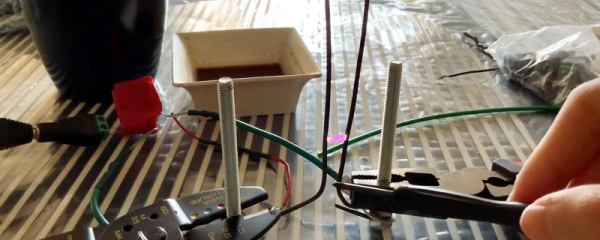
If you don’t have a ready source of high voltage, here’s an easy way to build one from the aptly-named [HVZapp]. The parts list is pretty simple to acquire, except for the transformer. For that, [HVZapp] raided a broken arc lighter. It took us a minute to realize that the MOSFETs are in parallel. The hand-drawn schematic shows a little “jump” from the drain lead to the source lead, but if you aren’t careful, it looks like the FETs are shorted out, which — of course — they aren’t.
The original arc lighter, of course, did a fine job of creating high voltage, although perhaps not as much as this circuit. Also, it would turn off every 10 seconds, which isn’t very useful if you want to use it as a power supply.
If you aren’t sure what to do with a high voltage, supply, there’s an associated quick and dirty Jacob’s Ladder in the video below. If you want your high voltage in a more natural way, consider harnessing lightning. There are many ways to generate high voltages.
It is hard to find anyone that does any kind of software development that doesn’t have some interaction with GitHub. Even if you don’t host your own projects there, there are so many things to study and borrow on the site, that it is nearly ubiquitous. However, when you’ve needed GitHub on the run, you’ve probably had to turn to your phone browser and had a reduced experience. GitHub for Mobile is now out of beta and promises a more fluid phone-based GitHub experience.
In addition to working with tasks and issues, you can also review and merge pull requests. The app sends your phone notifications, too, which can be handy. As you might expect, you can get the app for Android or iPhone in the respective stores.
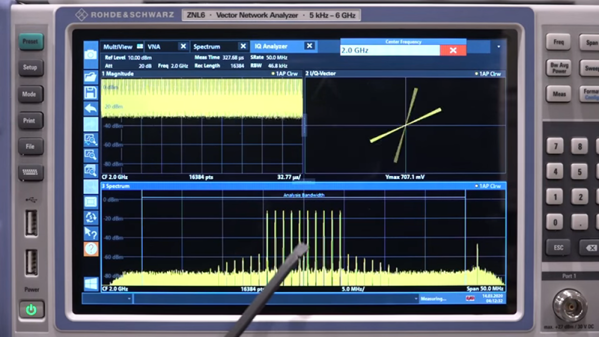
[The Signal Path] snagged a fancy Rohde & Schwarz vector signal generator that can go up to 3.2 GHz, but sadly it wasn’t in working order. It powered up and even put out a 1 GHz signal, but the amplitude output was very wrong. Interestingly relative changes to the output were correct, it was just that the absolute output amplitude was off by quite a bit and changed with frequency. That started a detective job which you can follow along in the video below.
The instrument is pretty high-end, and did not report any problems even during self-check. This implied that all the internals were probably good and whatever was wrong probably lay close to the output. The service manual’s block diagram wasn’t terribly useful, especially given that all the processing portions appear to work well.
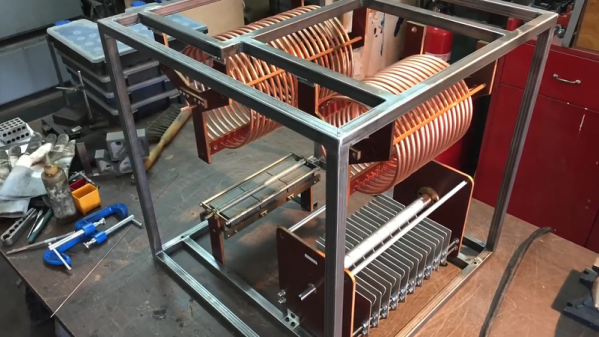
Remember “Wordless Workshop” in Popular Science? [Roy Doty] illustrated a household problem and the solution for it cobbled up in the main character’s garage workshop. We wonder what [Roy] would have done with YouTube? Maybe something like the video from [VE2TAE] and [VE2AEV] showing their link coupling antenna tuning build. You can watch the video after the break, and if you aren’t a fan of Jazz, you can mute the volume.
Like [Doty’s] cartoons, the video presumes you are going to have your own idea about dimensions and component values to fit your needs. But the construction is beautiful in its own right. The tubing wound into giant coils is impressive and brings back memories of the old days. However, the construction of the variable capacitors really got us excited. Big air variable caps may be hard to find, but the video makes them look easy to make.
A couple of nice looking knobs and panel meters make for a great looking tuner. With that spacing, we imagine it would handle full legal power without any difficulty at all. If you want to learn more about this type of tuner, [VK1OD] had a great page about it which seems to be defunct now. But the Internet Archive comes to our rescue, as usual.
The design is quite old, so even a 1934 copy of “Radio” can explain it (look on page 6). If you want to see a more wordy example of making variable capacitors — although they are smaller, the same principles apply — [N4DFP] has a good write up for that.
We can’t tell if the Eelume actually exists, or if it’s just a good CG and a design concept, but when we saw the video below, we wanted to start working on our version of it immediately. What’s an Eelume? A robotic eel that lives permanently under the ocean.
If you have to take care of something underwater — like a pipeline — this could be much more cost-effective than sending divers to the ocean floor. We liked the natural motion and we really liked the way the unit could switch batteries and tool heads.
We do have some questions, though. How do you get rid of one battery and pick up another? There would have to be some battery capacity that doesn’t exchange, but that’s not very efficient since the new battery would have to recharge the internal battery. Perhaps you can add batteries at either end. Some of the still pictures don’t clearly show how the batteries fit in, although they do show the flexible joints, sensors, cameras, and thrusters, which are all modular.
According to the web site, tools can go on either end and there’s a robot arm. The device can apparently shape itself like a U to bring both ends to bear on the same area. Generally, we like robots that mimic nature, but this is one of the best examples of that being practical we’ve seen.
There’s a video on the site of what appears to be real hardware tethered in a swimming pool, though we couldn’t tell how much of the device was subject to remote control and how much would be autonomous. Communicating underwater is finicky and usually requires either an antenna on the surface or a very low frequency (and, thus, not much bandwidth). While completely duplicating this would probably be a feat, it might inspire some hacker-friendly eels.