The Quadratic Equation Solution A Few Thousand Years In The Making

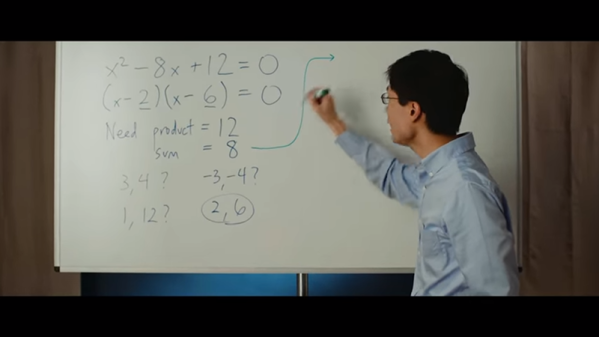
Everyone learns (and some readers maybe still remember) the quadratic formula. It’s a pillar of algebra and allows you to solve equations like Ax2+Bx+C=0. But just because you’ve used it doesn’t mean you know how to come up with the formula itself. It’s a bear to derive so the vast majority of us simply memorize the formula. A Carnegie Mellon mathematician named Po-Shen Loh didn’t expect to find a new way to derive the solution when he was reviewing math materials for middle school use to make them easier to understand. After all, people have been solving that equation for about 4,000 years. But that’s exactly what he did.

Before we look at the new solution, let’s talk about why you want to solve quadratic equations. They are used in many contexts. In ancient times you might use them to determine how much more crop to grow to cover pay tax payments without eating in to the crop you needed to subsist. In physics, it can describe motion. There’s seemingly no end to how many things you can describe with a quadratic equation.

Babylonians, in particular, would solve simultaneous equations to find the roots of a quadratic. Egyptians, Grecians, Indians, and Chinese peoples used graphical methods to solve the equations. The entire history is a bit much to get into, but still a great read. For this article, let’s dig into how the new derivation was discovered.

Continue reading “The Quadratic Equation Solution A Few Thousand Years In The Making”
Prolific Videos Show Altair 8800 Recreation

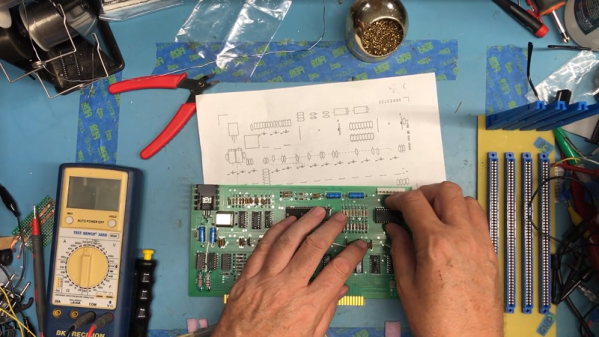
The January 1975 issue of Popular Electronics introduced the Altair 8800 and hit the newsstands in December of 1974, so it is only natural that around the New Year people start thinking about the old computer. [Shadowtron] did more than think about it. He ordered some replica PCBs and is building a new one. Even better, he’s posted an amazing number of videos (up to number 56 as I write this) detailing his progress. You can find part 1, below.

The boards are from Trailing Edge Technology. There’s a backplane board (about $100) as well as a few boards to fit it available for about $30 each — unpopulated, of course.

Continue reading “Prolific Videos Show Altair 8800 Recreation”

LC Oscillators, Animated

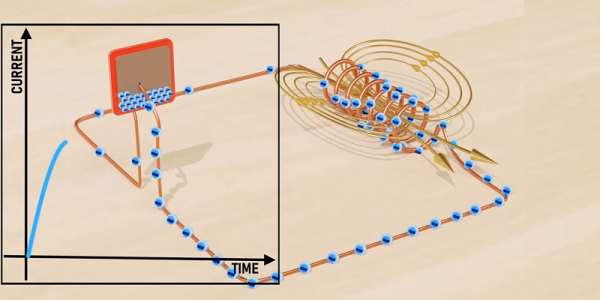
We wish that all the beautiful animations that are available today to understand math and electronics had been around when we were in school. Nonetheless, they are there for today’s students and [Learn Engineering] has another gorgeous one covering LC oscillation. Check it out, below.

If you are thoroughly grounded — no pun intended — in LC circuits, you probably won’t learn anything new. However, the animations are worth watching, just to admire them, if nothing else.

Continue reading “LC Oscillators, Animated”

Hacking An Arduino NFC Reader With WebUSB

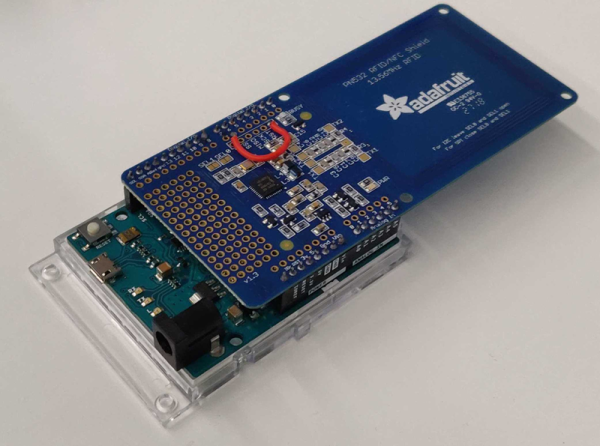
When [gdarchen] wanted to read some NFC tags, he went through several iterations. First, he tried an Electron application, and then a client-server architecture. But his final iteration was to make a standalone reader with an Arduino and use WebUSB to connect to the application on the PC.

This sounds easy, but there were quite a few tricks required to make it work. He had to hack the board to get the NFC reader’s interrupt connected correctly because he was using a Leonardo board. But the biggest problem was enabling WebUSB support. There’s a library, but you have to change over your Arduino to use USB 2.1. It turns out that’s not hard, but there’s a caveat: Once you make this change you will need the WebUSB library in all your programs or Windows will refuse to recognize the Arduino and you won’t be able to easily reprogram it.

Once you fix those things, the rest is pretty easy. The PC side uses node.js. If you back up a level in the GitHub repository, you can see the earlier non-Arduino versions of the code, as well.

If you want to understand all the logic that went into the design, the author also included a slide show that discusses the three versions and their pros and cons. He did mention that he wanted a short-range solution so barcodes and QR codes were out. He also decided against RFID but didn’t really say why.

NFC business cards are a thing. You can also use them to catch some public transportation.

Reverse Engineer PCBs With SprintLayout

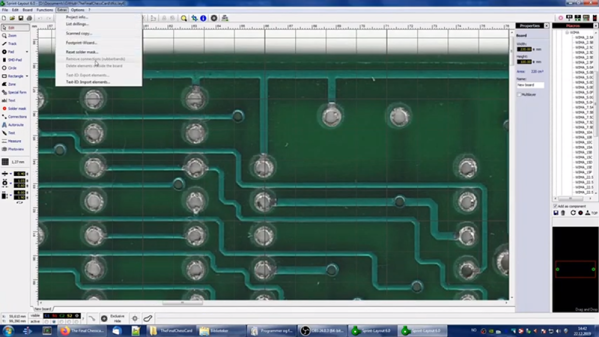
[Bwack] had some scanned pictures of an old Commodore card and wanted to recreate PC boards from it. It’s true that he could have just manually redrawn everything in a CAD package, but that’s tedious. Instead, he used SprintLayout 6.0 which allows you to import pictures and use them as a guide for recreating a PCB layout.

You can see the entire process including straightening the original scans. There are tools that make it very easy to place new structures over the original scanned images.

Continue reading “Reverse Engineer PCBs With SprintLayout”

Linux Fu: Leaning Down With Exec

Shell scripting is handy and with a shell like bash it is very capable, too. However, shell scripting isn’t always very efficient. Think about it. If you run grep or tr or sort to do some operation in a shell script, you are spawning a whole new process. That takes time and resources. But there are some answers to reducing — but not eliminating — the problem.

Have you ever written a program like this (in any language, but I’ll use C):

int foo(void)
{
  ...
  bar();

}

You hope the compiler doesn’t write assembly code like this:

_foo: 
....

      call _bar
      ret

Most optimizers should pick up on the fact that you can convert a call like this to a jump and let the ret statement in _bar return to foo’s caller. However, shell scripts are not that smart. If you have a shell script called MungeData and it calls another program or shell script called PostProcess on its last line, then you will have at one time three processes in play: your original shell, the shell running MungeData, and either the PostProcess program or a shell running the script. Not to mention, the processes to do things inside post process. So what do you do?

Continue reading “Linux Fu: Leaning Down With Exec”

FET Based Motor Driver Is Better Than L298N

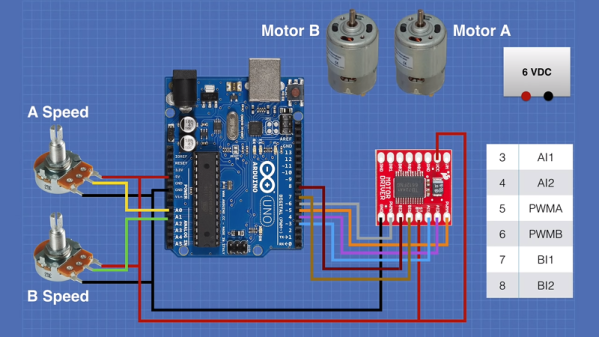
If you want to build a small robot with a motor, you are likely to reach for an L298N to interface your microcontroller to the motor, probably in an H-bridge configuration. [Dronebot] has used L298N chips like this many times. In the video below, he uses a TB6612FNG instead, taking advantage of the device’s use of MOSFETs. The TB6612 may be a little more expensive, but it’s clearly worth it.

You can get breakout boards for the tiny chips. [DroneBot] looks at several ready-to-go breakout boards. They are not drop-in compatible, though. For example, the L298N can operate motors from 4.5 to 46V while the TB6612 can go from 2.5 to 13.5V on the motor voltage. The L298N also handles more current. However, because of its relatively low efficiency, it needs a heat sink. The TB6612 boasts up to 95% efficiency and also has a low current standby mode. Of course, the TB6612 drops much less voltage which is great if you are using low voltage motor.

Continue reading “FET Based Motor Driver Is Better Than L298N”