Microphones Listen To Your… Monitor?

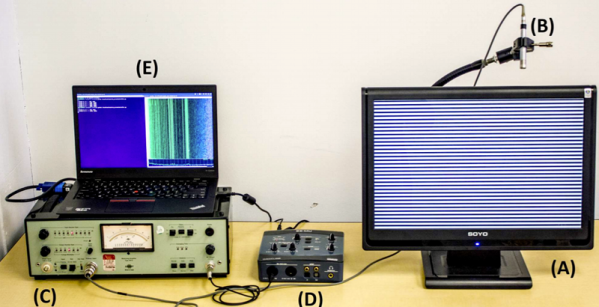
A song by Rockwell, “Somebody’s Watching Me” might be the anthem for the tin foil hat crowd. But a new paper reveals that it might be just as scary to have someone listening to you. Researchers have used common microphones to listen in on computer monitors. The demonstration includes analyzing audio to determine input from virtual keyboards and even a way to tell if people are surfing the web during a Google Hangout session.

Reading monitors based on electronic emissions is nothing new — ask Wim van Eck or read about TEMPEST. What makes this worrisome is that we constantly have live microphones around our computers. Webcams, phones, the latest smart assistant. Even some screens have built-in microphones. According to the paper, you could even pick up data from recorded audio. The paper has three main goals: extract display text, distinguish between different websites on screen, and extracting text entered with a virtual keyboard.

The analysis looked at 31 different screens. There were 12 distinct models from 6 different vendors. They did use a special VGA cable to tap the vertical sync to help manage the data, but they claim this was only an aid and not essential. They also used a high-end sound setup with a 192 kHz sampling rate.

Measuring the sound made by different display patterns was empirical. The authors think the mechanism is from subtle changes in the vibrations of the power supply components due to changes in current consumption. The refresh rate of the monitor also plays a part.

Armed with the proof of concept, the team went on to use an LG V20 cellphone and via a Hangouts call. Imagine if the person on the other end of your call could tell when you were reading Hackaday instead of paying attention to the call.

Different types of monitors need to be learned for best accuracy. It appears that reading small text may have problems, too. Even website detection depends on training. Still, maybe the tin hat people aren’t exactly wrong.

If you want to try your hand at reading the RF emissions, software defined radio is your friend. We’ll be interested to see if anyone duplicates the acoustic method in this paper, though.
One-Legged Robot Does The Hop

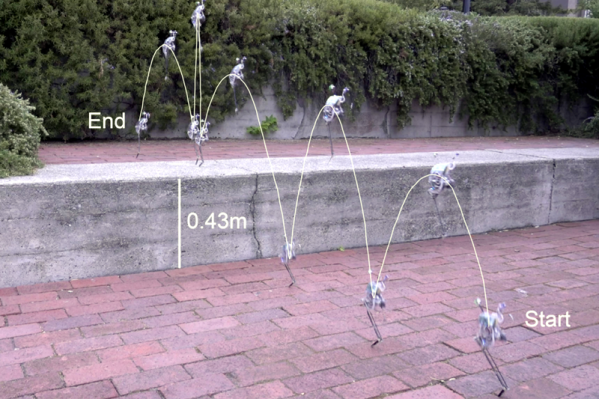
At first, we thought this robot was like a rabbit until we realized rabbits have a 300% bonus in the leg department. SALTO — a robot from [Justin Yim], [Eric Wang], and [Ronald Fearing] only has one leg but gets around quite well hopping from place to place. If you can’t picture it, the video below will make it very obvious.

According to the paper about SALTO, existing hopping robots require external sensors and often are tethered. SALTO is self-contained. The robot weighs a tenth of a kilogram and takes its name from the word saltatorial (adapted for leaping ) which itself comes from the Latin saltare which means to jump or leap.

Continue reading “One-Legged Robot Does The Hop”

Your Own Milliohm Meter

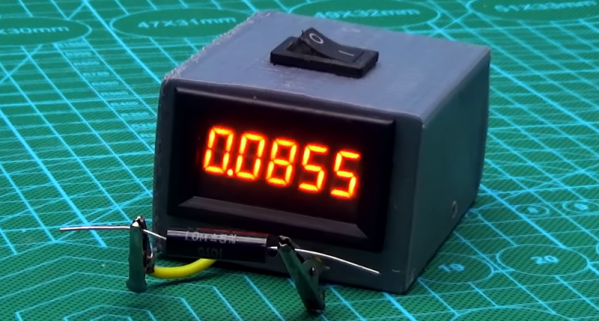
We like to pretend that wires are perfect all the time. For the most part that’s acceptable, but sometimes you really do care about those tiny fractional ohm quantities. Unfortunately though, most meters won’t read very low values. There are tricks you can use to achieve that aim, such as measuring low currents through a device with a known voltage applied. It is handier though to have an instrument to make the reading directly, and [Kasyan TV] did just that with a surprisingly low part count.

The whole thing is built from an LM317, a resistor, and a voltmeter module, that’s it. [Kasyan] mentions the meter’s accuracy means the lower digits are not meaningful, but it looks to us as though there are other sources of error — for example, there’s no way to zero out the probe’s resistance except during the initial calibration. Continue reading “Your Own Milliohm Meter”

Piezoelectric Crystals Explained

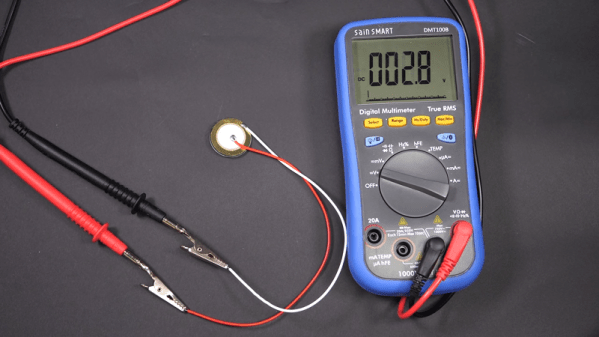
Summer in the Northern hemisphere means outdoor cooking. Matches are old school, and you are more likely to use a piezoelectric lighter to start your grill. [Steve Mould] has one, but he didn’t understand the physics behind why it works, so he decided to do the research and share it in a video.

The first two minutes is a recap of things you already know. But after that [Steve] gets into the crystal lattice structure of quartz. Using some computer animations and some peanut butter lids he shows you exactly why compressing the crystal generates electricity.

Continue reading “Piezoelectric Crystals Explained”

Student Rocket Makes It To Space

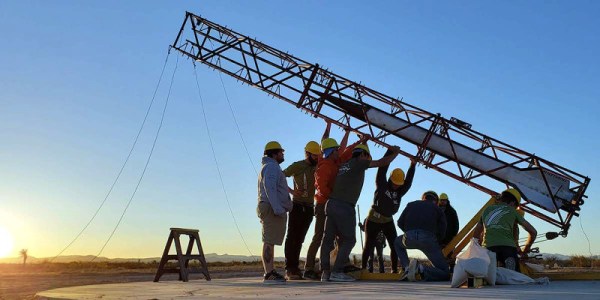
Where does the Earth’s atmosphere stop and space begin? It is tempting to take the approach Justice Potter Stewart did for pornography when judging a 1964 obscenity case and say “I know it when I see it.” That’s not good enough for scientists, though. The Kármán line is what the World Air Sports Federation (FAI) defines as space. That line is 100 km (62 miles or about 330,000 feet) above sea level. A recent student-built rocket — Traveler IV — claims to be the first entirely student-designed vehicle to pass that line.

The students from the University of Southern California launched the rocket from Spaceport America in New Mexico. The new record is over twice as high as the old record, set by the same team. The rocket reached approximately 340,000, although the margin of error on the measurement is +/- 16,800 feet, so there’s a slight chance they didn’t quite cross the line.

Continue reading “Student Rocket Makes It To Space”

Wolfram Engine Now Free… Sort Of

You’ve probably used Wolfram Alpha and maybe even used the company’s desktop software for high-powered math such as Mathematica. One of the interesting things about all of Wolfram’s mathematics software is that it shares a common core engine — the Wolfram Engine. As of this month, the company is allowing free use of the engine in software projects. The catch? It is only for preproduction use. If you are going into production you need a license, although a free open source project can apply for a free license. Naturally, Wolfram gets to decide what is production, although the actual license is pretty clear that non-commercial projects for personal use and approved open source projects can continue to use the free license. In addition, work you do for a school or large company may already be covered by a site license.

Given how comprehensive the engine is, this is reasonably generous. The engine even has access to the Wolfram Knowledgebase (with a free Basic subscription). If you don’t want to be connected, though, you don’t have to be. You just won’t be able to get live data. If you want to play with the engine, you can use the Wolfram Cloud Sandbox in which you can try some samples.

Continue reading “Wolfram Engine Now Free… Sort Of”

Paperclip Breadboard

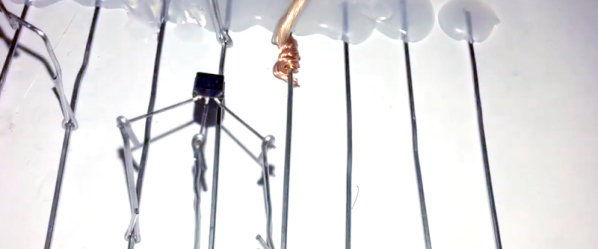
TV’s MacGyver would love the breadboard arrangement we saw recently: it uses paperclips and crimping to make circuits that can be more or less permanent with no soldering. The basic idea is simple. A cardboard base has a piece of paper affixed. Metal paperclips are bent straight and glued to the paper using PVA glue (you know, like ordinary Elmer’s; hot glue would probably work, too). You could probably salvage wires out of old house wiring that would work for this, too.

The scheme uses two sizes of paper clips. Large ones are made straight and form the rails, while small paperclips make connections. The rails are bent to have a little “ear” that pushes into the cardboard base to hold them still. A little glue stabilizes them. The ears poke out the back, so the author suggests covering them with duct tape, hot glue, or another piece of cardboard. Using the top of a shoebox would also solve the problem.

Continue reading “Paperclip Breadboard”