Forget Artificial Intelligence; Think Artificial Life

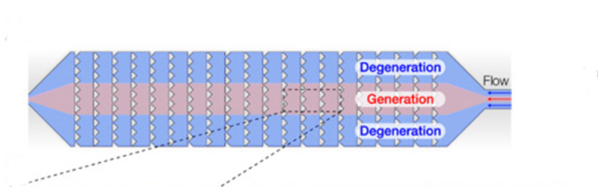
If you are a science fiction fan, you are probably aware of one of the genre’s oddest dichotomies. A lot of science fiction is concerned about if a robot, alien, or whatever is a person. However — sometimes in the same story — finding life is as easy as asking the science officer with a fancy tricorder. If you go to Mars and meet Marvin, it is pretty clear he’s alive, but faced with a bunch of organic molecules, the task is a bit harder. Now it is going to get harder still because Cornell scientists have created a material that has an artificial metabolism and checks quite a few boxes of what we associate with life. You can read the entire paper if you want more detail.

Three of the things people look for to classify something as alive is that it has a metabolism, self-arranges, and reproduces. There are other characteristics, depending on who you ask, but those three are pretty crucial.

Continue reading “Forget Artificial Intelligence; Think Artificial Life”
Televox: The Past’s Robot Of The Future

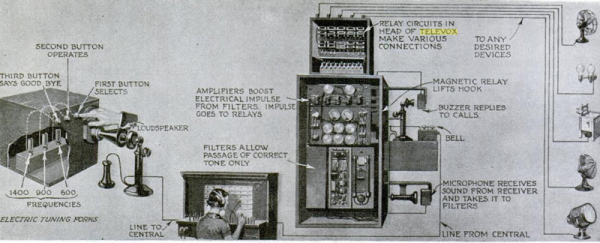
When I read old books, I like to look for predictions of the future. Since we are living in that future, it is fun to see how they did. Case in point: I have a copy of “The New Wonder Book of Knowledge”, an anthology from 1941. This was the kind of book you wanted before there was a Wikipedia to read in your spare time. There are articles about how coal is mined, how phonographs work, and the inner workings of a beehive. Not the kind of book you’d grab to look up something specific, but a great book to read if you just want to learn something interesting. In it there are a few articles about technology that seemed ready to take us to the future. One of those is the Televox — a robot from Westinghouse poised to usher in an age of home and industrial mechanical servants. Robots in 1941? Actually, Televox came into being in 1927.

If you were writing about the future in 2001, you might have pictured city sidewalks congested with commuters riding Segways. After all, in 2001, we were told that something was about to hit the market that would “change everything.” It had a known inventor, Dean Kamen, and a significant venture capitalist behind it. While it has found a few niche markets, it isn’t the billion dollar personal transportation juggernaut that was predicted.

But technology is like that. Sometimes things seem poised for greatness and disappear — bubble memory comes to mind. Sometimes things have a few years of success and get replaced by something better. Fax machines or floppy drives, for example. The Televox was a glimpse of what was to come, but not in any way that people imagined in 1941. Continue reading “Televox: The Past’s Robot Of The Future”

Custom Rotary Switch Takes A Motor

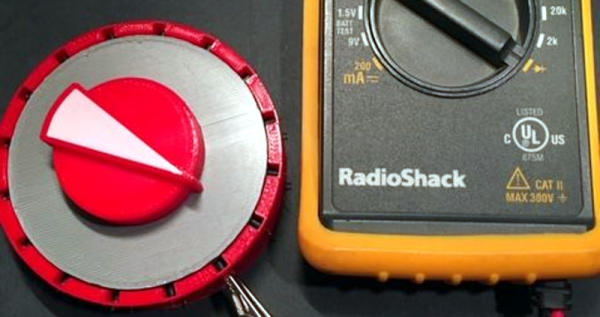
There are certain challenges we all will have to face sooner or later. Changing a flat tire in the rain, trying to put on a shirt that doesn’t quite fit, or producing a 16 position rotary switch for a replica computer front panel. There was a time when something like this would be a major undertaking, but with the help of a 3D printer [Mike Gardi] was able to build good looking switches that were big enough to be motor driven.

Switches of course are old tech, and there are plenty of ways to make contacts. [Mike] settled on using 16 small magnets and reed switches. This works, but you probably wouldn’t want to use it where the switch might get close to an external magnet. It does however make for a neat assembly without a lot of mechanical work. It also resists wear compared to a brush type arrangement.

The switch is a little large, but it could probably be made smaller with proper contacts. However, you still need at least some magnets to provide the detents without making mechanical changes.

We couldn’t help but think of the homemade rotary switches from the do it yourself computer that used sewing thread spools, wires, and paper clips. It would be fun to revisit that computer with an eye to making things using a 3D printer. We liked the knob, but if you only need a reproduction knob, there are other ways to go.

Graphene Is So Yesterday — Meet Borophene

It wasn’t long ago that graphene seemed to take the science and engineering communities by storm. You can make bits of it with a pencil and some sticky tape, yet it had all sorts of wonderful properties. The key, of course, is that it is a single layer of atoms. Now scientists have done the same trick with boron to form borophene, and it looks to be even more exciting than graphene. You can read a pretty dense paper about the material if you want to dig deeper.

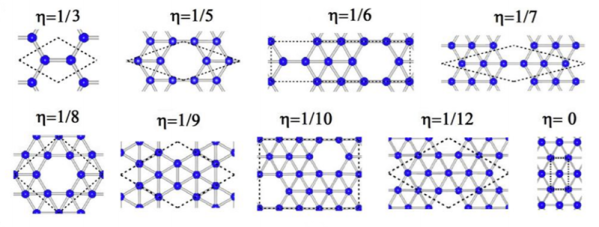
The new material is stronger and more flexible than graphene. It appears too that it could boost the performance of lithium-ion batteries. Computer simulations showed that borophene was possible back in 1990, but it wasn’t until 2015 that anyone was able to make any. The material is a good conductor of electricity and heat. It also exhibits superconductivity. Another exciting prospect is that it can be created in different arrangements, each with a unique set of properties. So you may be able to build borophene to be, for example, especially conductive or particularly strong.

Continue reading “Graphene Is So Yesterday — Meet Borophene”

A Laser Cutting 101

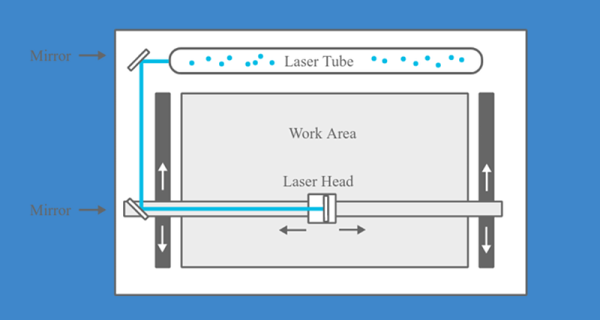
If you’ve worked with a laser cutter before, you might not find much new in [Maker Design Lab’s] recent post about getting started. But if you haven’t, you’ll find a lot of practical advice and clean clear figures. The write up focuses on a tube-style laser cutter that uses a gas-filled tube and mirrors. Some cheap cutters use a diode, and many of the same tips will apply to those cutters.

You can probably guess that a laser cutter can cut like a CNC and also engrave where the cut doesn’t go all the way through. But it can also mark metals and other surfaces by using a marking solution. If you’ve done CNC or 3D printing, the process is similar, but there are a few unique things to know, like the use of the marking solution.

Continue reading “A Laser Cutting 101”

Metal 3D Printing — A Dose Of Reality

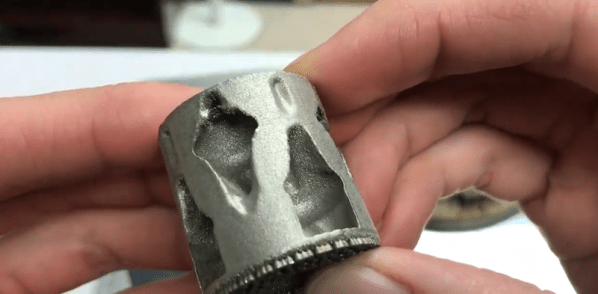
We have no doubt that hundreds of times a day a hacker is watching a 3D printer spew hot plastic and fantasizes about being able to print directly using metal. While metal printers are more common than ever, they are still out of reach for most people printing as a hobby. But as Mr. Spock once observed: “…you may find that having is not so pleasing a thing after all as wanting. It is not logical, but it is often true.” However, metal 3D printing has its own unique set of challenges. Texas A&M recently produced a short video explaining some of the design issues that you’ll encounter trying to make practical metal prints on an SLS (Selective Laser Melting) printer. You can see the video below.

The description says “It is more challenging to ‘metal 3D print’ a part than most people think. We’ve noticed the same even with plastic printers as friends will expect us to print the most outlandish things for them. What we like about this video is it helps to set expectations of the current state of the art so we’re not expecting far more than today’s metal printers can produce.

Among the features covered in the video are overhangs, which require supports. After removal, the surface is about like 80 grit sandpaper unless you perform further finishing. Just like plastic parts, warping and curling of large areas is a problem with metal. If you’ve ever been frustrated removing plastic support material, try having to ceramic grind metal supports off. They also use an EDM machine to cut especially tough supports, but it causes a lot of effort since it is likely to run through EDM wires and clog the filters.

We looked at recent advances in metal printing last year. We’ve seen homebrew machines that were little more than welders under computer control and we’ve seen plans by big players like HP to create metal prints, but at a steep price. Still, you can’t stop the march of 3D printing progress.

Continue reading “Metal 3D Printing — A Dose Of Reality”

Brain Hacking With Entrainment

Can you electronically enhance your brain? I’m not talking about surgically turning into a Borg. But are there electronic methods that can improve various functions of your brain? Fans of brainwave entrainment say yes.

There was an old recruiting ad for electrical engineers that started with the headline: The best electronic brains are still human. While it is true that even a toddler can do things our best computers struggle with, it is easy to feel a little inadequate compared to some of our modern electronic brains. Then again, your brain is an electronic device of sorts. While we don’t understand everything about how it works, there are definitely electric signals going between neurons. And where there are electric signals there are ways to measure them.

The tool for measuring electric signals in the brain is an EEG (electroencephalograph). While you can’t use an EEG to read your mind, exactly, it can tell you some pretty interesting information, such as when you are relaxed or concentrating. At its most basic we’ve seen toys and simple hobby projects that purport to be “mind controlled” but only at an incredibly rudimentary level.

Brainwave entrainment is a hypothesis that sending low frequency waves to your brain can give your mind a nudge and sync up brain activity with the equipment measuring it. The ability to synchronize with the brain could yield much better measurements for a meaningful interface between modern electronics and electric storm of thought happening in your head.

Continue reading “Brain Hacking With Entrainment”