Car Alarm Hacks 3 Million Vehicles

Pen testing isn’t about evaluating inks. It is short for penetration testing — someone ensuring a system’s security by trying to break in or otherwise attack it. A company called Pen Test Partners made the news last week by announcing that high-end car alarm systems made by several vendors have a critical security flaw that could make the vehicles less secure. They claim about three million vehicles are affected.

The video below shows how alarms from Viper/Clifford and Pandora have a simple way to hijack the application. Once they have access, they can find the car in real time, control the door locks, and start or stop the car engine. They speculate a hacker could set off the alarm from a nearby chase car. You’d probably pull over if your alarm started going off. They can then lock you in your car, approach, and then force you out of the car.


Continue reading “Car Alarm Hacks 3 Million Vehicles”

This SDR Uses A Tube

When you think of a software defined radio (SDR) setup, maybe you imagine an IC or two, maybe feeding a computer. You probably don’t think of a vacuum tube. [Mirko Pavleski] built a one-tube shortwave SDR using some instructions from [Burkhard Kainka] which are in German, but Google Translate is good enough if you want to duplicate his feat. You can see a video of [Mirko’s] creation, below.

The build was an experiment to see if a tube receiver could be stable enough to receive digital shortwave radio broadcasts. To avoid AC line hum, the radio is battery operated and while the original uses an EL95 tube, [Mirko] used an EF80.

Continue reading “This SDR Uses A Tube”

Raspberry Pi Camera With Smarts — Cloud Or Local?

[Mark West] gave an interesting presentation at last year’s GOTO Copenhagen conference. He shows how he took a simple Raspberry Pi Zero webcam and expanded it with AI. He actually added the intelligent features in two different ways: on in the Amazon cloud and another using the Intel Modvidius NCS USB stick directly connected to the USB. You can see the video below.

Local motion detection uses some open source software. You simply configure it using a text file and it even handles the video streaming. However, at that point, you just have a web camera — not amazing, nor very cost effective. However, you get a lot of false alarms with the motion detection software. A random cat walking past, clouds, trees, or even rain would push [Mark] an email and after 250 alert e-mails a day, [Mark] decided to make something better.

Continue reading “Raspberry Pi Camera With Smarts — Cloud Or Local?”

Joulescope DC Energy Analyzer Reviewed

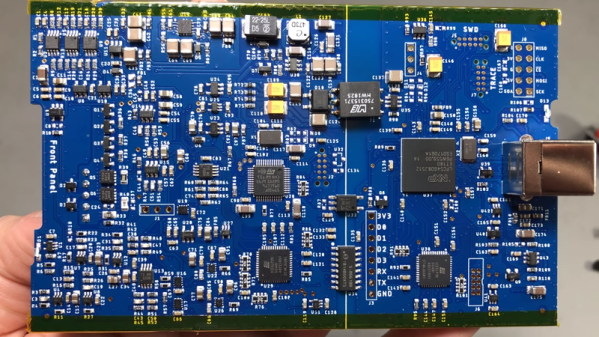
[VoltLog] got a hold of a prerelease unit of Joulescope — a DC energy analyzer that promises to make it easy to optimize power and energy usage of your electronic designs. You can find his review in the video below. The device is a very fast ammeter and voltmeter. Given that, it is easy to compute energy and, over time, power.

The device is set to retail for about $400 according to a letter in the video, although the website mentions closer to $800. Both of those seem to be a bit much for a piece of specialty gear that is really just a fast analog to digital converter and some software. To be fair, the device can read ranges between 18 microamps to 10 amps with resolutions as low as 1.5 nanoamps on the lower side of the range. Is it worth it? That will depend on your application and your price sensitivity.

Continue reading “Joulescope DC Energy Analyzer Reviewed”

The Strangest Gameboy Emulator We’ve Seen Yet

In the secret Hackaday bunker, we have some emacs users, some vi users, and some people who don’t really care. However, even the staunchest of our emacs supporters had to do a double take at [Vreeze’s] project that creates a GameBoy emulator using the venerable text editor. You can see [Alexei Nunez’s] reaction to the emulator in the video below.

The Eboy uses unicode characters to output the graphics. You can use emacs commands to load ROM images and use your keyboard to control the game.

Continue reading “The Strangest Gameboy Emulator We’ve Seen Yet”

Tech Imitates Life: Fireflies Make Better Light Bulbs

While we often think we are clever designers, living things often meet or beat the best human designs. It is easy to forget that nature even has living lightbulbs, among them the firefly. Researchers from Penn State decided to compare how fireflies create light and found that they deal with a problem similar to LEDs. The insight may lead to an increase in efficiency for LEDs, which is currently about 50%.

The problem is that some light generated never gets out of the LED (or the firefly’s body). Some light inevitably reflects back into the device. One known mitigation for this is creating a tiny texture pattern on the LED surface which allows more light to escape. These are typically a V-shaped structure etched into the surface. This isn’t news to the firefly, however, which has similar structures on their lanterns as do some other light-generating animals (apparently glowing cockroaches are a thing). However, the organic structures differ from LED textures in an important way.

Continue reading “Tech Imitates Life: Fireflies Make Better Light Bulbs”

Better Living Through Science: Why Your Kids Probably Aren’t Getting Measles

Oddly, there’s been a few recent outbreaks of measles. It struck me how when I was a kid, a few hundred kids getting measles wouldn’t have been news at all. However, even a handful makes the news now, since in 2000 the Center for Disease Control declared measles eradicated in the United States.

So how can an eradicated disease come back? How did we eradicate it to start with? The answers tell a pretty interesting tale of science applying to everyday life.

Continue reading “Better Living Through Science: Why Your Kids Probably Aren’t Getting Measles”