High Voltage Switching With MOSFETs

Using a MOSFET as a switch is generally pretty simple. Make the gate voltage sufficient with respect to the source and current flows through the channel. However, if you are switching higher voltages, you may need some additional circuitry to protect the device’s gate and possibly the microcontroller driving the whole thing, too. [Lewis] discusses high voltage switching in the latest in his series of videos dealing with MOSFETs. You can see the video below.

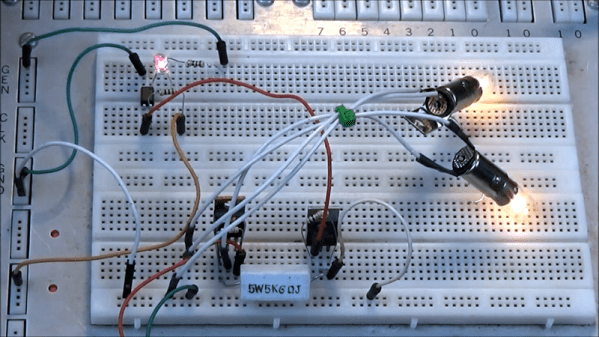
You’ll see in the video a breadboard setup driving a 50 V load and also a higher-voltage H-bridge. There are three major topics covered: Using an optoisolator, using a gate bleeder resistor, and using a zener diode to limit gate voltage.
Continue reading “High Voltage Switching With MOSFETs”

Arduino Analog I/O Multiplexer

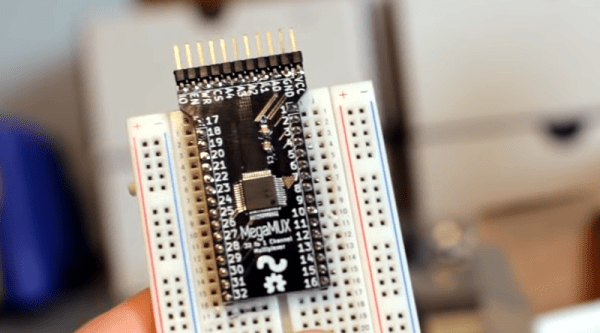
[SeanHodgins] has a project in mind where he needs to sample over 500 analog sensors. To get ready, he made a breakout board for 32-channel analog multiplexer device he wants to use. He put the project out on Hackaday.io and also has a video tutorial you can see below.

There are five input pins to the chip which lets you connect one analog pin to any one of 32 analog pins. Of course, in addition to the five control lines, you need some handshaking lines, too so you could use as many as eight digital pins to control the device.

Continue reading “Arduino Analog I/O Multiplexer”

WiFi Pool Controller Only Cost $20

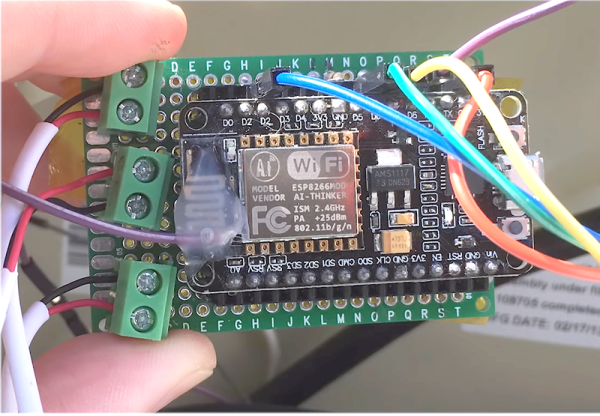
Pools have come a long way. It used to be you had a pump and if you were lucky it had a mechanical timer switch on it. That was it. Now you have digital controllers and spa jets and heaters. You can even get them that connect to your home automation system. If your pool isn’t new enough to do that already, you can get a range of add-on accessories. For a price. [Rob] paid $500 to get a remote for his pool. It wasn’t even WiFi, just a simple RF remote. In 3 years, the transmitter had burned out ($300 to replace) and he decided he had enough. For $20, [Rob] added MQTT control and monitoring to his pool using an ESP8266. You can see the video description of the project below.

Naturally, the instructions are a bit specific to the Pentair system he has. However, it isn’t as specialized as you might think. The project relies on the connection for a wired “spa-side remote” that most modern pool systems support. The electrical connections for these aren’t quite standard, but they are all very similar, so you have a good chance of reproducing this for your setup assuming you have a connection for one of these wired remotes.

Continue reading “WiFi Pool Controller Only Cost $20”

Linux Fu: Watch That Filesystem

The UNIX Way™ is to cobble together different, single-purpose programs to get the effect you want, for instance in a Bash script that you run by typing its name into the command line. But sometimes you want the system to react to changes in the system without your intervention. For example, you might like to watch a directory and kick off some program automatically when a file appears from a completed FTP transaction, without having to sit there and refresh the directory yourself.

The simple but ugly way to do this just scans the directory periodically. Here’s a really dumb shell script:

#!/bin/bash
while true
 do
   for I in `ls`
    do cat $I; rm $I
   done
 sleep 10
done

Just for an example, I dump the file to the console and remove it, but in real life, you’d do something more interesting. This is really not a good script because it executes all the time and it just isn’t a very elegant solution. (If you think I should use for I in *, try doing that in an empty directory and you’ll see why I use the ls command instead.)

Continue reading “Linux Fu: Watch That Filesystem”

Pocket Projector Uses Raspberry Pi

Who doesn’t want a pocket protector projector? Nothing will impress a date more than being able to whip out a PowerPoint presentation of your latest trip to the comic book convention. The key to [MickMake] build is the $100 DLP2000EVM evaluation module from Texas Instruments. This is an inexpensive light engine, and perfect for rolling your own projector. You can see the result in the video below.

If you don’t need compactness, you could drive the module with any Rasberry Pi or even a regular computer. But to get that pocket form factor, a Pi Zero W fits the bill. A custom PCB from [MickMake] lets the board fit in with the DLP module in a very small form factor.

Continue reading “Pocket Projector Uses Raspberry Pi”

Homebrew SDR Ham Radio In 9 Parts

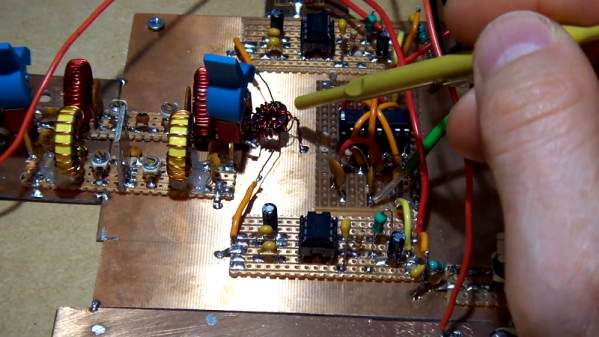
It used to be homebrew ham gear meant something simple. A couple of active devices that could send CW. Maybe a receiver with a VFO. But only the most advanced builders could tackle a wide range SSB transceiver. Today, that goal is still not trivial, but it is way easier due to specialty ICs, ready access to high-speed digital signal processing, and advances in software-defined radio techniques. [Charlie Morris] decided to build an SSB rig that incorporated these technologies and he shared the whole process from design to operation in a series of nine videos. You can see the first one below.

The NE612 is a child of the popular NE602 chip, which contains a Gilbert-cell mixer, and an oscillator that makes building a receiver much easier than it has been in the past. The chips are set up as direct conversion receivers and feed a Teensy which does the digital signal processing on the recovered audio.

Continue reading “Homebrew SDR Ham Radio In 9 Parts”

Cat Compels Raspberry Pi Flight Tracker

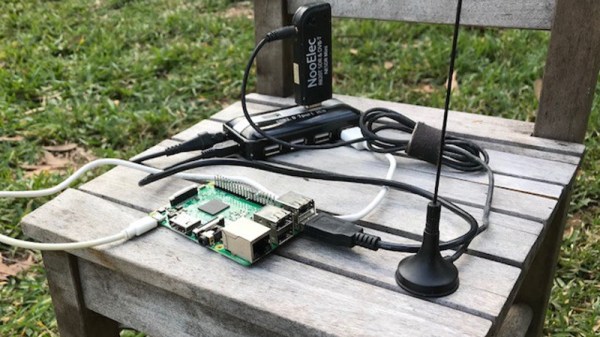
[Simon Aubury] owns a cat. Or perhaps it is the other way around, we can never really tell. One morning around 6AM, the cat — we don’t know its name — heard a low-flying aircraft and to signal its displeasure at the event, decided to jump onto [Simon’s] face as he slept. Thanks to the well-known mind control abilities of cats, [Simon] decided he had to know what plane was causing this scenario to recur. So he did what any of us what do. He used a Raspberry Pi and a software defined radio dongle to decode the ADS-B signals coming from nearby aircraft.

Picking up the signals and capturing them is easy thanks to the wide availability of USB radios and a program called Dump1090. However, the data is somewhat jumbled and not in a cat-friendly format. [Simon] turned to Apache Kafka — a tool for building real-time data pipelines — to process the data.

Continue reading “Cat Compels Raspberry Pi Flight Tracker”