3D Printed Tank Tracks

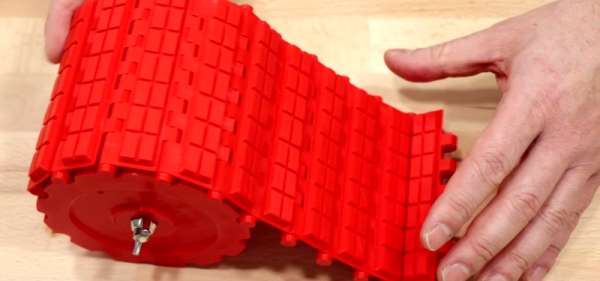
[Ivan] has been keeping his 3D printers busy with parts he’s experimenting with to build a tracked motion setup for a tank-like vehicle. His design uses several interlocking parts, so if you want to duplicate it, we hope your printer calibration is up to snuff. He’s still printing more parts and promises to release the files once the design proves out.

However, you can see he’s off to a good start. Small pieces fit together and accept a piece of filament as a sort of hinge. Some pins keep the filament from working out. Pads fit into the main parts and hold down with zip ties. The whole flexible tread locks into sprockets and a groove on a drive wheel.
Continue reading “3D Printed Tank Tracks”

Sharpening With Bluetooth

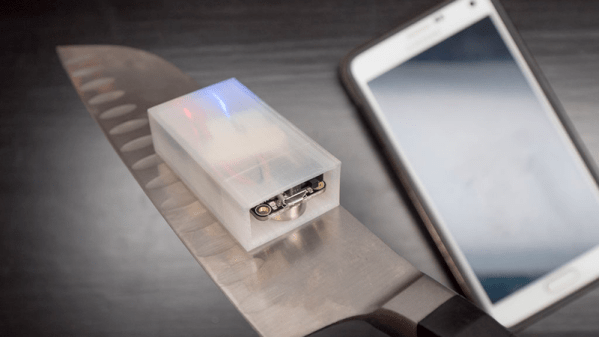
Few things are as frustrating in the kitchen as a dull knife. [Becky] and her chef friend collaborated to build a Bluetooth module to tell you when you are sharpening a knife at the optimum angle. That might sound a little specialized, but the problem boils down to one that is common enough in a lot of situations: how do you tell your exact orientation while in motion? That is, with the knife moving rapidly back and forth over the sharpening stone, how can you measure the angle of the blade reliably?

Looking for a challenge, [Becky’s] first attempt was to just use an accelerometer. It worked, but it wasn’t very precise. Her final answer turned out to be a full inertial measurement unit — the BNO055 — that combines an accelerometer, a magnetometer, and a gyroscope along with enough smarts to fuse the data into actual position data.

Continue reading “Sharpening With Bluetooth”

A Retrocomputer Disk On A Chip

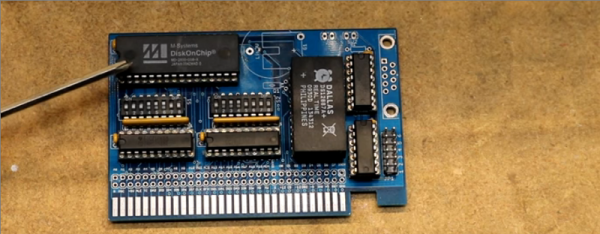
There have been a lot of different mass storage methods over the relatively short lifespan of the computer. Magnetic tapes, drums, all sorts of disks, and flash memory have each had their time. Each of these new innovations required some time to become easy to use. One of the early attempts to simplify using flash memory was the M-Systems DiskOnChip device. Looking like a standard 8K JEDEC-compatible memory device, it actually provided access to a flash disk drive ranging from 16MB to 1GB. [Smbakeryt] bought some of these devices and built an ISA board to provide a disk and clock for the old 8-bit bus. You can see a video discussion about the device below.

SanDisk bought M-Systems and discontinued the devices back in 2007. Of course, you can still design flash memory into your system, but the simple and efficient interface of the DiskOnChip is no more. It is a testament to how simple the interface is that the schematic for the little board fits on a page, including the DS12885 real time clock.

Continue reading “A Retrocomputer Disk On A Chip”

Oracle V Google Could Chill Software Development

Unless you’ve completely unplugged from the news, you probably are aware that the long-running feud between Oracle and Google had a new court decision this week. An appeal court found that Google’s excuse of fair use wasn’t acceptable and that they did infringe on Oracle’s copyrights to Java. Oracle has asked for about $9 billion in damages, although the actual amount is yet to be decided. In addition, it is pretty likely Google will take it up to the Supreme Court before any actual judgment is levied.

The news is aimed at normal people, so it is pretty glossy about what exactly happened. We set out to try to make sense of it all. We found a pretty good article from [Michaela Barry] about what the courts previously found.  There were three main parts:

  • There were 37 API (Application Programming Interface) declarations taken verbatim from Java. This would be like a C header file if you aren’t familiar with Java.
  • Google decompiled 8 security files and used them.
  • The rangeCheck function — 9 lines of Java code — were exactly the same in Oracle’s Java and Android.

Continue reading “Oracle V Google Could Chill Software Development”

Apple One, On FPGA

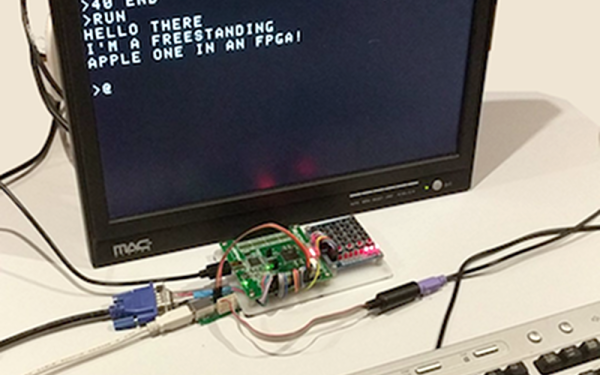
Today, Apple is known for iPhones, iPads, and a commitment to graphical user interfaces. But that wasn’t how it all started. The original Apple was a single board computer built around a 6502. In 1976, you could snag one for $666.66, but you needed to supply your own TV, power supply, and keyboard. [Alangarf] didn’t have an Apple 1, but he did have a 6502 CPU core for FPGAs from [Andrew Holme] that he fleshed out to an Apple I clone with a VGA output and PS/2 keyboard port. The project works with either an iCE40 board or a Terasic DE0 board. You could probably port it to other similar FPGAs.

This is much more practical than trying to find an original, as Apple bought a lot of the old boards back and destroyed them. According to the Apple-1 Registry there are only about 71 of the boards still in existence, and that’s with the annotation that 4 of those may be lost and 8 might be duplicates. We’ve heard that of those there are only six that actually still work.

Continue reading “Apple One, On FPGA”

Forth Version 1 Runs Again

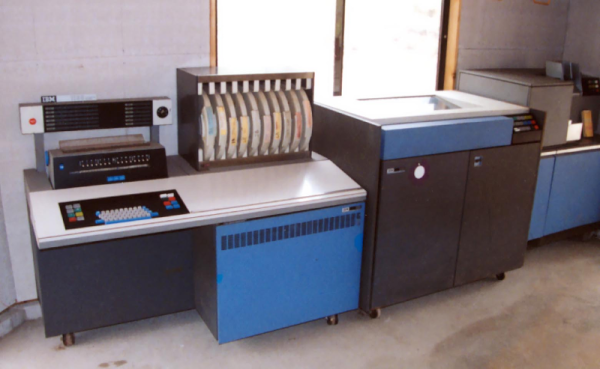
Some people love Forth and some people hate it. However, you usually think of Forth as something running on a little computer such as an 8-bit microcomputer. When [Chuck Moore] developed the system back in the 1960s though, it ran on an IBM 1130. [Carl Claunch] took a scanned listing of the original code and got it running once again.

There are actually a few blog posts with details. Luckily, Forth is pretty simple — especially the core parts. However, there are a lot of differences from a modern Forth. The most obvious is that the dot keyword starts a definition and does not print the top of stack. However, internal details are different too — the system, for example, stores characters in packed EBCDIC — an ASCII-like code used by IBM computers.

Continue reading “Forth Version 1 Runs Again”

Everything You Wanted To Know About Transformers (But Were Afraid To Ask)

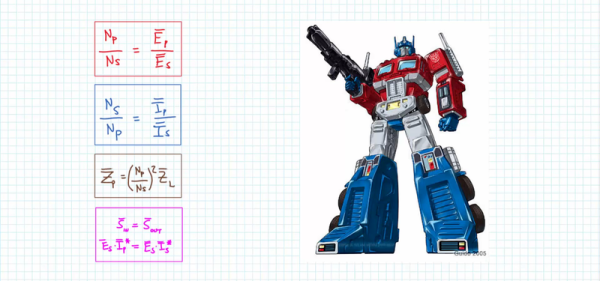
[Jim Pytel] has a lot of very good instructional videos on his channel, and he recently added one you’ll enjoy on transformers. You probably know that transformers convert one AC voltage into another AC voltage. Some step up voltage, some step down voltage, and others simply pass voltage through but isolate the input from the output.

The 40 minute video covers basics including how the transformer works, the meaning of the turns ratio, and how transformers reflect impedance. You probably should understand how to compute AC power, but if you need a refresher [Jim] has a video for that, too.

Continue reading “Everything You Wanted To Know About Transformers (But Were Afraid To Ask)”