Need A Thousand Extra PWM Pins?

If your Arduino runs out of I/O lines, you can always add one of the several I/O expander chips that takes a serial interface to set its several pins. Or perhaps you could buy something like an Arduino Mega, with its extra sockets to fulfil your needs. But what would you do if you really needed more pins, say a thousand of them? Perhaps [Brian Lough] has the answer. OK, full disclosure: If you really need a thousand, the video isn’t exactly for you, as he shows you how to add up to 992 PWM outputs. The chip he uses works with any microcontroller (the video shows an ESP8266), and we suppose you could use two daisy chains of them and break the 1,000 barrier handily.

We like how short the video is (just two minutes; see below) as it gets right to the point. The PCA9685 chip gives you 16 12-bit PWM channels via an I2C interface. You can daisy chain up to 62 of the boards to get the 992 outputs promised.

Continue reading “Need A Thousand Extra PWM Pins?”

Simple Quantum Computing In 150 Lines Of Python

What does it take to build a quantum computer? Lots of exotic supercooled hardware. However, creating a simulator isn’t nearly as hard and can give you a lot of insight into how this kind of computing works. A simulator doesn’t even have to be complicated. Here’s one that exists in about 150 lines of Python code.

You might wonder what the value is. After all, there are plenty of well-done simulators including Quirk that we have looked at in the past. What’s charming about this simulator is that with only 150 lines of code, you can reasonably read the whole thing in a sitting and gain an understanding of how the different operations really affect the state.

Continue reading “Simple Quantum Computing In 150 Lines Of Python”

The Forgotten Workstation: Sun JavaStation

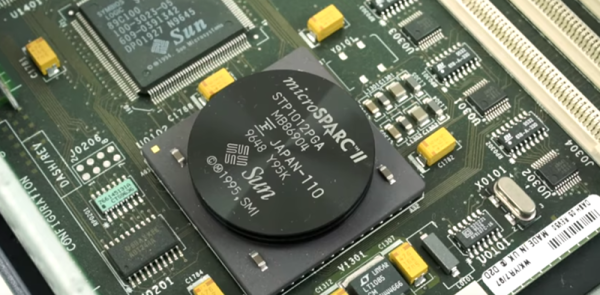
These days, conversations about Java tend to center around Oracle and Google fighting it out in court. But back in 1996, Sun was the keeper of Java and promoted it heavily. They even released a diskless workstation that only runs Java applets. The Sun JavaStation was affectionately called the “Mr. Coffee” and [Cameron Gray] wants to show you how it worked and what’s inside of it.

A single screw frees the innards from the small case. Inside looks like a dense PC from the era, although the parts inside are a far cry from a typical PC. The CPU was a 110 MHz microSPARC II soldered directly to the motherboard. The four RAM slots could take up to 64 megabytes of PC RAM.

Continue reading “The Forgotten Workstation: Sun JavaStation”

Who Made The First Human Audio Recordings? Edison? Not So Fast!

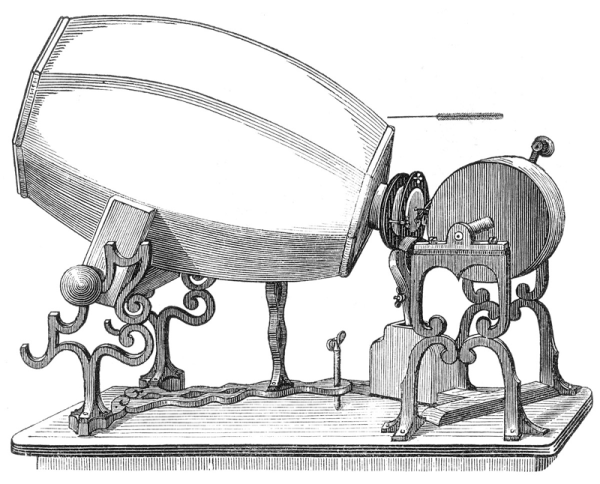
You probably learned in school that Thomas Edison was the first human voice recorded, reciting Mary Had a Little Lamb. As it turns out though, that’s not strictly true. Edison might have been the first person to play his voice back, but he wasn’t the first to deliberately record. That honor goes to a French inventor named Édouard-Léon Scott de Martinville. He wanted to study sound and created the phonautograph — a device which visualized sound on soot-covered paper. They were not made to be played back, but the information is there. These recordings were made around 1860. There’s a 9-part video series about how the recordings were made — and more interestingly — how they were played back using modern technology. Part 1 appears below.

We say around 1860 because there were some early recordings starting around 1857 that haven’t been recovered. Eventually, the recordings would have a tuning fork sound which allows modern playback since the known signal can estimate the speed of the hand-cranked cylinder. The date of the first recovered recording was today, April 9th, 158 years ago.

Continue reading “Who Made The First Human Audio Recordings? Edison? Not So Fast!”

Tiny Neural Network Library In 200 Lines Of Code

Neural networks have gone mainstream with a lot of heavy-duty — and heavy-weight — tools and libraries. What if you want to fit a network into a little computer? There’s tinn — the tiny neural network. If you can compile 200 lines of standard C code with a C or C++ compiler, you are in business. There are no dependencies on other code.

On the other hand, there’s not much documentation, either. However, between the header file and two examples, you should be able to figure it out. After all, it isn’t much code. The example in the repository directs you to download a handwriting number recognition dataset from the Internet. Once it trains that data, it shows you the expected output from the first item in the data set and then processes the first item and shows you the result.

Continue reading “Tiny Neural Network Library In 200 Lines Of Code”

Circuit VR: The Dickson Charge Pump

There was a time when taking a low DC voltage — say a single battery — and converting it to a higher voltage was painful. Now, however, cheap and easy-to-use DC to DC converters are readily available. For some small tasks, though, these can seem like overkill. For example, consider a case where you need to supply a higher voltage for a MOSFET gate that doesn’t draw much current. Perhaps you need that higher voltage to trigger a microcontroller’s programming mode and nothing else. The current draw is minimal, and a full-blown DC to DC converter is overkill. For cases like that, it is tempting to use some voltage multiplication scheme. There are many, but for this post, I’m going to take you inside a Dickson charge pump. This is Circuit VR because not only are we going to discuss the circuit, we’ll look at an LT Spice simulation you can try yourself.

The Dickson is interesting because it doesn’t require any AC conversion or transformers. Instead, it uses diodes or other switching elements to transfer charge between capacitors in stages. Each stage will effectively increase the voltage by the supply voltage — in theory. Reality isn’t so kind, though, as we’ll see.

Continue reading “Circuit VR: The Dickson Charge Pump”

Soldering Saves Data From Waterlogged Laptop

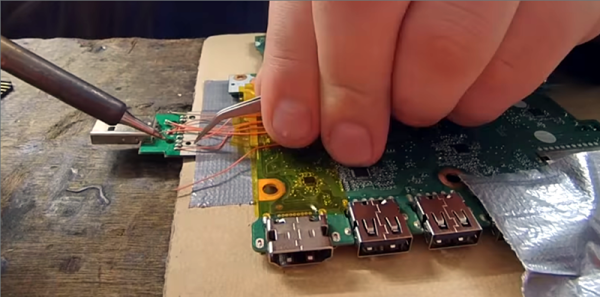
What happens when you drop your laptop in the pool? Well, yes, you buy a new laptop. But what about your data. You do have backups, right? No, of course, you don’t. But if you can solder like [TheRasteri] you could wire into the flash memory on the motherboard and read it one last time. You can see the whole exploit in the video below.

There’s really three tasks involved. First is finding the schematic and board layout for motherboard. Apparently, these aren’t usually available from the manufacturer but can be acquired in some of the seedier parts of the Internet for a small fee. Once you have the layout, you have to arrange to solder wires to the parts of the flash memory you need to access.

Continue reading “Soldering Saves Data From Waterlogged Laptop”