How To Run A Pagekite Server To Expose Your Raspberry Pi

Last time I showed you how to expose a web service on a Raspberry Pi (or, actually, any kind of device) by using a reverse proxy from Pagekite. On your Pi, you just need a simple Python script. However, it also depends on the Pagekite server, which isn’t always convenient. There are limits to the free service, and you don’t control the entire thing. The good news is twofold: the same Python script you use to set up the client-side can also set up a server. The other good news is the entire thing is open source.

In practical terms, then, if you have a computer that is always on and has an IP address that can be found on the public internet, you can run your own Pagekite server (they call it a front end) and service your own backends.

Continue reading “How To Run A Pagekite Server To Expose Your Raspberry Pi”

Arduino Detects Pants On Fire

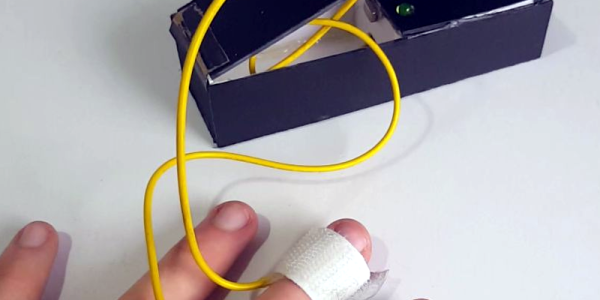
Hard as it is to imagine, lie detectors have been sold as children’s toys for a number of years. A simple battery-operated device clipped to your fingers and would show the conductivity of your skin. The concept — which is probably not very reliable — observers that lying causes you to imperceptibly sweat which causes a sudden increase in your skin’s conductivity. These cheap toys would have a meter and you’d note the meter deflection to determine if the subject was lying.

You can debate the amusement value of interrogating your friends, perhaps, but they were pretty common and still exist (including some that shock you if they detect you are lying). Seventeen-year-old [BuildIt] has his own modern take on this classic device using — what else? — an Arduino. You can see a video of the device below.

Continue reading “Arduino Detects Pants On Fire”

Expose Your Raspberry Pi On Any Network

Everyone’s talking about the Internet of Things (IoT) these days. If you are a long-time Hackaday reader, I’d imagine you are like me and thinking: “so what?” We’ve been building network-connected embedded systems for years. Back in 2003, I wrote a book called Embedded Internet Design — save your money, it is way out of date now and the hardware it describes is all obsolete. But my point is, the Internet of Things isn’t a child of this decade. Only the name is.

The big news — if you can call it that — is that the network is virtually everywhere. That means you can connect things you never would have before. It also means you get a lot of data you have to find a reason to use. Back in 2003, it wasn’t always easy to get a board on the Internet. The TINI boards I used (later named MxTNI) had an Ethernet port. But your toaster or washing machine probably didn’t have a cable next to it in those days.

Today boards like the Raspberry Pi, the Beagle Bone, and their many imitators make it easy to get a small functioning computer on the network — wired or wireless. And wireless is everywhere. If it isn’t, you can do 3G or 4G. If you are out in the sticks, you can consider satellite. All of these options are cheaper than ever before.

The Problem

There’s still one problem. Sure, the network is everywhere. But that network is decidedly slanted at letting you get to the outside world. Want to read CNN or watch Netflix? Sure. But turning your computer into a server is a little different. Most low-cost network options are asymmetrical. They download faster than they upload. You can’t do much about that except throw more money at your network provider. But also, most inexpensive options expose one IP address to the world and then do Network Address Translation (NAT) to distribute service to local devices like PCs, phones, and tablets. What’s worse is, you share that public address with others, so your IP address is subject to change on a whim.

What do you do if you want to put a Raspberry Pi, for example, on a network and expose it? If you control the whole network, it isn’t that hard. You usually use some kind of dynamic DNS service that lets the Pi (or any computer) tell a well-known server its current IP address (see figure below).

Continue reading “Expose Your Raspberry Pi On Any Network”

Spectrum Analyzer With 555 Fits In A Tin

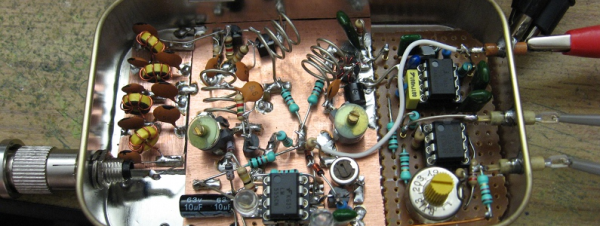
[VK2ZAY] has a thing for 555 chips. Before the ready availability of microcontrollers, the 555 was the hardware hacker’s swiss army knife. After all, even though the chip is supposed to be a timer, it is really a bunch of simple pieces you can use to make a timer: a pair of comparators, a few transistors, and a flip-flop. You can use those parts in many different ways, and a timer is just one of them.

[VK2ZAY] used one as a key component in a simple spectrum analyzer. The 555 generates a ramp voltage which alters the frequency of an oscillator. The oscillator mixes with the input signal and a fixed-frequency superregenerative detector creates an output voltage proportional to the input signal strength. You can see a video of the whole setup, below.

Continue reading “Spectrum Analyzer With 555 Fits In A Tin”

High Impedance Headphones? They’re In The Can!

[George Trimble] likes to build crystal radios. The original crystal radio builders used high impedance headphones. In modern builds, you are as likely to include a powered amplifier to drive a speaker or normal headphones (which are usually around 4 to 16 ohms).

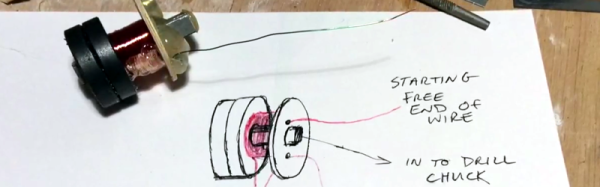
[George] builds his own speakers using chile cans, some wire, a few magnets, part of a Pepsi can (we are pretty sure someone will leave a comment that Coke cans sound better), and the iron core out of an audio transformer. You can see a very detailed video of the process, below.

There is a little woodworking and hot gluing involved. The result is decidedly homemade looking, but if you want to say you built it yourself (or, if you are a prepper trying to get ready to  rebuild after the apocalypse and you can’t find a cache of headphones) this might be just the ticket.

Most of the headphone hacks we see start with a pair of headphones. That’s a bit tautological, but the goal is usually to add features, not make the whole thing. It does give you some hacker cred, though, to be able to look at the other guy’s radio and say, “Oh. I see you used commercial headphones.”

Continue reading “High Impedance Headphones? They’re In The Can!”

Wilderness Radio Build

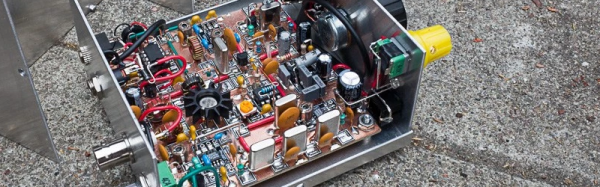
[AA7EE] is no stranger to building radios. His latest is a from-scratch build of a 20 meter QRP transceiver based on the popular SST design. Although the SST has been available as a kit, [AA7EE] incorporated some design changes from others and some of his own, too. He even added an onboard keyer to simplify operation. You can see videos of the radio below.

The build uses Manhattan-style PCB pads. Although the construction is very attractive, the real value of the post is the detailed explanation of not only how, but why everything is the way it is. This isn’t a simple project, and being able to see it completed step-by-step is very educational. About the only decision not adequately explained was the change of red and yellow knobs to black! You can see both versions in the videos below.

The Manhattan construction is tidy, but the radio also has an attractive case. The size is just big enough to stack a pair of paddles on top.

There may be some more enhancements for the little radio coming. We’ve covered [AA7EE’s] RF exploits before, including a physically attractive radios and details about the same construction method used in this radio.

Continue reading “Wilderness Radio Build”

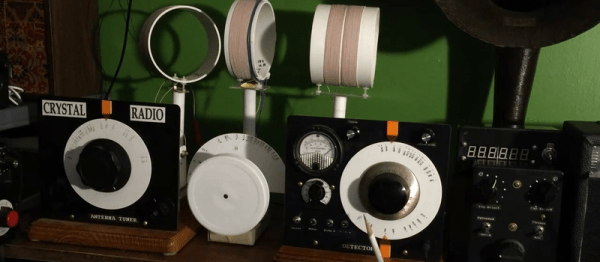
High Performance Crystal Radio

When you think of a crystal radio, you probably think of something simple maybe built out of household scraps. Not if you are [Chris Wendling]. He recently posted a video (see below) of his high-performance crystal set. He doesn’t take any shortcuts: he has several hundred feet of antenna wire, and uses a cold-water pipe ground system. With no amplifier, a strong signal input is crucial.

The radio has four subsystems: an antenna tuner, a bandpass filter, a detector, and a powered audio output system. He also has a truly enormous system of speakers on the ceiling–this isn’t the crystal radio you made in the boy scouts.

Continue reading “High Performance Crystal Radio”