Shower Thoughts In Your Car

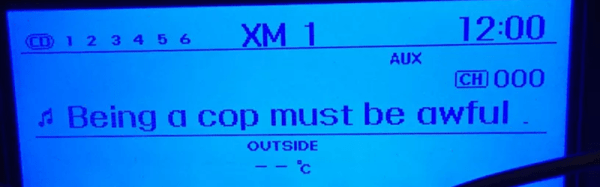
The subreddit for Shower Thoughts offers wisdom ranging from the profound to the mundane. For example: “Every time you cut a corner you make two more.” Apparently, [Harin] has a bit of an addiction to the subreddit. He’s been sniffing the CAN bus on his 2012 Hyundai Genesis and decided to display the top Shower Thought on his radio screen.

To manage the feat he used both a Raspberry Pi and an Arduino. Both devices had a MCP2515 to interface with two different CAN busses (one for the LCD display and the other for control messages which carries a lot of traffic.

The code is available on GitHub. There’s still work to do to make the message scroll, for example. [Harin] has other posts about sniffing the bus, like this one.

We’ve covered CAN bus quite a bit, including some non-automotive uses. We’ve even seen the CAN bus for model railroading.

I’m Sorry Dave, I Only Say 28 Phrases

A few years ago, you could buy an IRIS 9000 Bluetooth speaker. Its claim to fame was that it looked like the “eye” from the HAL 9000 computer on 2001: A Space Oddessy. There’s something seductive about the idea of having a HAL eye answer your queries to Google Now or Siri. The problem is, it still sounds like Google or Siri, not like HAL.

[Badjer1] had the same problem so he decided to build his own eye. His goal wasn’t to interface with his smartphone’s virtual assistant, though. He settled on making it just be an extension cord with USB ports. As you can see in the video below, the build has HAL-style memory units, a key, and can speak phrases from the movie (well, 28 of them, at least). The key is like the one Dave used to deactivate HAL in the movie.

Continue reading “I’m Sorry Dave, I Only Say 28 Phrases”

Digital Wind Chimes

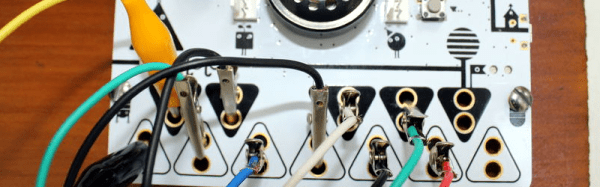
Quality wind chimes are not cheap. No matter how much you spend, though, they generally sound the same year after year. If that bothers you, maybe [sensatroniclab] can help. They’ve posted a simple design for a digital wind chime using the Ototo music generator.

The Ototo is reasonably priced and promises to let you make music from anything (well, anything conductive, anyway).  Because the Ototo handles all the music production, the only real building part of the project is the wind sensors. The sensors are made with conductive fabric with a marble at the end for weight.

In the video below you can see [Matthew Ward] talk about the device and actually play it like you might a harp. This would be a good school project owing to the simplicity of using the Ototo, although [sensatroniclab] is actually working on accessibility music projects.

Continue reading “Digital Wind Chimes”

Find A Drone

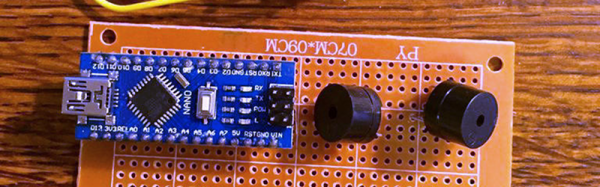
Flying a drone usually leads to–sooner or later–crashing a drone. If you are lucky, you’ll see where it crashes and it won’t be out of reach. If you aren’t lucky, you’ll know where it is, but it will be too high to easily reach. The worst case is when it just falls out of the sky and you aren’t entirely sure where. [Just4funmedia] faced this problem and decided to use some piezo buzzers and an Arduino to solve it.

Yeah, yeah, we know. You don’t really need an Arduino to do this, although it does make it easy to add some flexibility. You can pick two tones that are easy to hear and turn on the buzzers with a spare channel or sense a loss of signal or power.

Continue reading “Find A Drone”

Virtually Free Rapsberry Pis

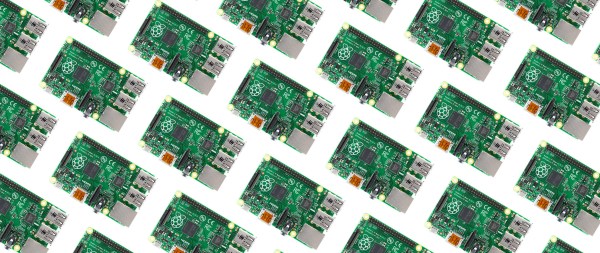
One of the nice things about the Raspberry Pi is that it runs Linux and you can do a lot of development right on the board. The converse of that is you can do a lot of development on a Linux desktop and then move things over to the Pi once you get the biggest bugs out. However, sometimes you really need to run code on the actual platform.

There is, however, an in-between solution that has the added benefit of upping your skills: emulate a Pi on your desktop. If you use Linux or Windows on your desktop, you can use QEMU to execute Raspberry Pi software virtually. This might be useful if you don’t have a Pi (or, at least, don’t have it with you). Or you just want to leverage your large computer to simplify development. Of course we would be delighted to see you build the Pi equivalent of the Tamagotchi Singularity but that’s a bit beyond the scope of this article.

Since I use Linux, I’m going to focus on that. If you insist on using Windows, you can find a ready-to-go project on Sourceforge. For the most part, you should find the process similar. The method I’ll talk about works on Kubuntu, but should also work on most other Debian-based systems, including Ubuntu.

Continue reading “Virtually Free Rapsberry Pis”

Where (Almost) No GoPro Has Gone Before

What would it be like to ride a six foot rocket to nearly 400,000 feet at Mach 5.5? Thanks to UP Areospace and some GoPro cameras, you can find out.

The rocket was a test for the Maraia Capsule project. Mach 5.5, for reference, is 3,800MPH. It appears several different GoPro cameras took the footage. You can see the upward travel, some great views of Earth, and the return on the video below.

Continue reading “Where (Almost) No GoPro Has Gone Before”