Breadboard Colecovision

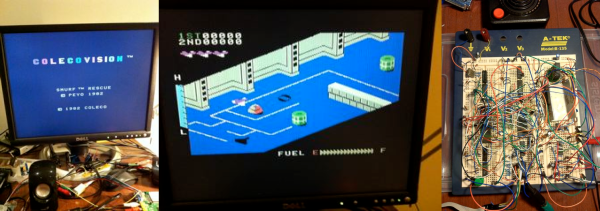
The Colecovision was a state-of-the-art game console back in 1983. Based around the Z-80, it was almost a personal computer (and, with the Adam add-on, it could serve that function, complete with a daisy wheel printer for output). [Kernelcrash] set out to recreate the Colecovision on a breadboard and kept notes of the process.

His earlier project was building a Funvision (a rebranded VTech Creativision) on a breadboard, so he started with the parts he had from that project. He did make some design changes (for example, generating separate clocks instead of using the original design’s method for producing the different frequencies needed).

Continue reading “Breadboard Colecovision”

Triple Threat RTL-SDR System Reads Trunked Radio

In the old days, if you wanted to listen to police, fire, or other two-way radio users, you didn’t need much more than a simple receiver. Today, you are more likely to need something a little more exotic thanks to the adoption of trunked radio systems. To pick up the control channels and all the threads of a talk group conversation, you might need a wide bandwidth receiver.

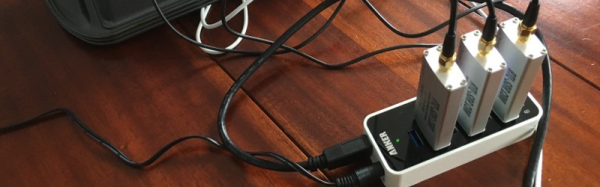
[Luke Berndt] found he needed 6 MHz to monitor the stations he wanted to hear. This is easily in the reach of dedicated software defined radios (SDR). However, [Luke] wanted to use cheap RTL-SDRs and their bandwidth is about 2 MHz. The obvious hacker solution? Use three of them!

If you haven’t looked at a trunked system before, it essentially allows a large number of users to share a relatively small number of channels. When someone wants to talk, they move to an unused channel just for that transmission. Suppose Alice asks Bob a question that happens to be on channel 12. Bob’s reply might be on channel 4. A follow up from Alice could be on channel 3.

In practice, this means that receiving the signal isn’t difficult to decode. It is just difficult to find (and follow as it jumps around). This is an excellent job for multiple SDRs and the approach even reduces the burden on the CPU, which doesn’t have to decode signals that aren’t essential to the conversation.

[Luke] includes source code and also notes how to change the serial numbers of the dongles since each has to be unique. We have seen so many great projects with the RTL-SDR that it is hard to choose our favorite. It is especially great knowing that the dongle was only meant to receive television, and all these projects are hacks in the best sense of the word.

Thanks [WA5RRior] for the tip.

Arduino RF Network Analyzer

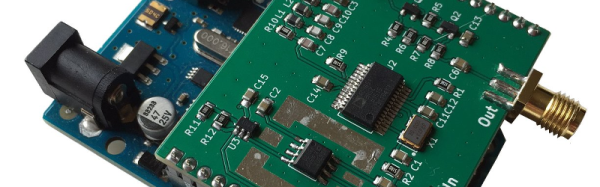
What do you get when you combine a direct digital synthesis (DDS) chip, a power detector, and an Arduino? [Brett Killion] did make that combination and wound up with a practical network analyzer.

The project uses an Analog Devices AD9851 DDS chip clocked at 180 MHz which will output a sine wave at any frequency from 0 Hz and 72 MHz. A Butterworth low pass filter processes the DDS signal and then feeds a two-transistor amplifier. The circuit will output about 0dBm into 50 ohms. The power detector is an Analog Devices AD8307 along with a 50-ohm input load. There is no filtering on the power detector so it can measure from very low frequencies to 500MHz.

Continue reading “Arduino RF Network Analyzer”

Faking A Hollow State Device

There’s been a resurgence of interest in vacuum tubes. Even if you do think audio sounds better through a tube, you have to admit the care and feeding of filaments and plate voltages isn’t trivial. [Ed Nisley] decided to sidestep all that and just build an objet d’art that looks like a tube.

A burned out halogen bulb stands in for the tube, and a ceramic base holds the bulb. It also conceals–what else–an Arduino. The Arduino drives a knock-off Neopixel LED hidden in a faux plate cap. The result is a glass envelope bathed in a cold blue and purple glow that changes under software control.

We’d really like to see this kind of tube inside some rebuilt piece of tube gear. Or maybe Korg should offer LED lighting options for their recent tube in a chip form factor. If you really want to be a top-tier tube hacker, you can always try your hand at repair.

Connect Four Robot Uses Raspberry Pi

Most people play games for entertainment. Hackers build robots to play games for entertainment. That’s what [piandchips] did. He used a Raspberry Pi and a MeArm kit to build a Connect 4-playing robot. The robot–named 4-Bot–has to do two things: the first is it has to be able to manipulate the pieces. Secondly, it has to be able to see the board. The MeArm imbues 4-Bot with the manipulation ability, and a clever scanning system does the trick.

Continue reading “Connect Four Robot Uses Raspberry Pi”

A Spicy Regenerative Reciever

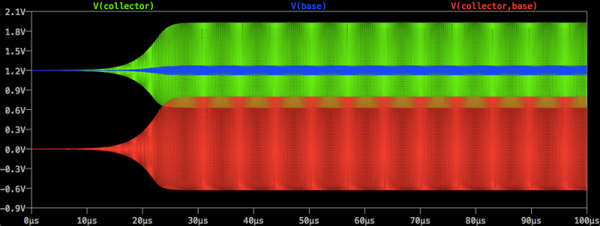
We recently posted a three-part series about using LTSpice to simulate electronic circuits (one, two, three). You might have found yourself wondering: Can you really simulate practical designs with the program? This quick analysis of [QRP Gaijin’s] minimalist regenerative receiver says “yes”.

Continue reading “A Spicy Regenerative Reciever”

Transforming Spice

Spice is a circuit simulator that you should have in your toolbox. While a simulator can’t tell you everything, it will often give you valuable insight into the way your circuit behaves, before you’ve even built it. In the first installment of this three-part series, I looked at LTSpice and did a quick video walkthrough of a DC circuit. In the second, I examined two other parts of Spice: parameter sweeps and AC circuits. In this final installment, I want to talk a bit more about real-world component performance and also look at modeling transformers.

Recap

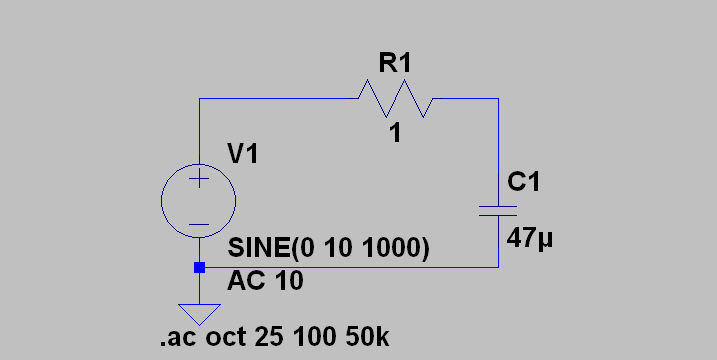
lowpasssLast time we looked at a low pass filter, but it wasn’t practical because the components were too perfect. Only in simulation do voltage sources and wires have zero resistance. There was no load resistance either, which is unlikely. Even an oscilloscope probe will load the circuit a little.

The resulting AC analysis showed a nice filter response that was flat to about 1 kHz and then started roll off as the frequency increased. Suppose the source had an 8 ohm series resistor. How does that change the circuit response?

Continue reading “Transforming Spice”