Two Portable Oscilloscopes: Shootout

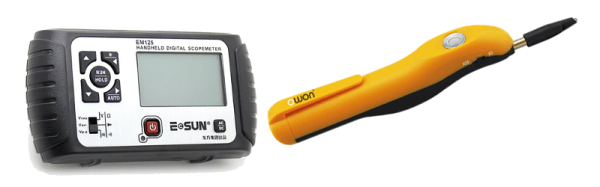
Last time I introduced you to two relatively inexpensive and somewhat portable scopes: the EM125, which is a cross between a digital voltmeter and an oscilloscope, and the Wave Rambler, which is a scope probe with a USB connector attached. Both of the devices cost about $100, and both have their plusses and minuses.

This time, though, I wanted actually to look at some real-world signals. To make that easy, I grabbed yet another scope-like thing I had handy: an Embedded Artists Labtool. This is an interesting board in its own right. It is an LPC-Link programmer attached to an LPC ARM board that has several high-speed A/D channels. However, I’m not using any of that capability for now. The board also has a cheap ARM processor (an LPC812) on it that serves only to generate test signals. The idea is you can use the Labtool in a classroom with no additional equipment.

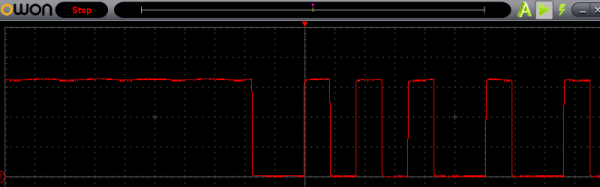
The Labtool’s demo CPU generates a lot of different signals, but with only one channel on the test scopes, it didn’t make sense to look at, for example, I2C data. So I stuck with two different test signals: a varying pulse width modulation signals and a serial UART transmitter.

Continue reading “Two Portable Oscilloscopes: Shootout”

Warbots: Is It Already Too Late?

In 1971, a non-profit formed that holds the World Economic Forum each year. The Forum claims it “Engages the foremost political, business and other leaders of society to shape global, regional and industry agendas.” This year, the Forum hosted a session: What If: Robots Go To War? Participants included a computer science professor, an electrical engineering professor, the chairman of BAE, a senior fellow at the Vienna Center for Disarmament and Non-Proliferation, and a Time magazine editor.

Continue reading “Warbots: Is It Already Too Late?”

A Tale Of Two (Sub $100) Oscilloscopes

Hi, I’m Al, and I’m an oscilloscope-holic. Just looking around my office, I can count six oscilloscope or oscilloscope-like devices. There are more in my garage. If you count the number of scopes I’ve owned (starting with an old RCA scope with a round tube and a single vertical scale), it would be embarrassing.

On the other hand, if you are trying to corral electrons into doing useful things, a scope is a necessity. You can’t visualize what’s happening in a circuit any better than using an oscilloscope. Historically, the devices were expensive and bulky. I’ve had many Tektronix and HP scopes that stayed in one place, and you brought what you were working on to them (sometimes called a “boat anchor”). It wasn’t that long ago that one of my vintage Tek scopes had its own dedicated cart so I could wheel it to where it was needed.

These days, scopes are relatively cheap, depending on what you have in mind for performance. They are also highly portable, which is nice. In fact, it is an indication of how spoiled I’ve become that my main bench scope–a Rigol DS1104Z–weighs seven pounds, yet I still look for something smaller for quick jobs.

That’s how I came into possession of two cheap scopes I wanted to talk about. They are similar in ways but different in others. Neither are going to replace a real bench scope, but if you want something portable, or you are budget-limited, they might be worth a look.

Continue reading “A Tale Of Two (Sub $100) Oscilloscopes”

It’s A Bird, It’s A Plane, No… It’s High Voltage EPROM Man!

At Hackaday, we cover some pretty high-tech builds. Sometimes, though, you see something simple, but it still makes you feel happy to see it. That’s pretty much the case with [ProtoG’s] High Voltage EPROM Man.

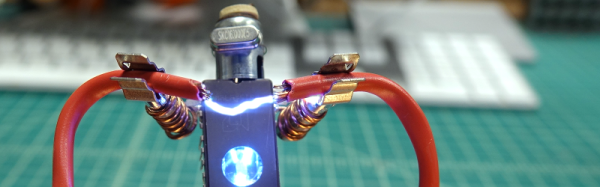
The parts probably came out of a junk box, but the good news is that they don’t have to work, and you can freely substitute anything you have. According to [ProtoG], the “robot” head is a bulb socket with a crystal for the visor. The arms are fuses with fuse clips for the hands. The knees are adjustable caps, and the feet are TO-220 transistors.

Continue reading “It’s A Bird, It’s A Plane, No… It’s High Voltage EPROM Man!”

Don’t Shovel Snow; Build An Epic Melt System!

When [Ronald Walters] was building a new house, he decided he didn’t want to shovel snow anymore. So he built a snow melt system under his new driveway. He knew the system would be expensive to operate, but he reasoned it was cheaper than back surgery and much cheaper than having a heart attack.

The system uses PEX pipe on rebar and insulation that is all set down before the concrete in the driveway. An instant-on water heater produces the heat that melts the snow and ice off [Ronald’s] driveway with no shoveling required. The working fluid includes anti-freeze, of course, and there is a set of pumps, flow valves, and flow meters to keep everything flowing when the system is in operation.

Continue reading “Don’t Shovel Snow; Build An Epic Melt System!”

Misleading Tech: Kickstarter, Bomb Sights, And Medical Rejuvinators

Every generation thinks it has unique problems and, I suppose, sometimes it is true. My great-grandfather didn’t have to pick a cell phone plan. However, a lot of things you think are modern problems go back much further than you might think. Consider Kickstarter. Sure, there have been plenty of successful products on Kickstarter. There have also been some misleading duds. I don’t mean the stupid ones like the guy who wants to make a cake or potato salad. I mean the ones that are almost certainly vaporware like the induced dream headgear or the Bluetooth tag with no batteries.

Overpromising and underdelivering is hardly a new problem. In the 30’s The McGregor Rejuvenator promised to reverse aging with magnetism, radio waves, infrared and ultraviolet light. Presumably, this didn’t work. Sometimes products do work, but they don’t live up to their marketing hype. The Segway comes to mind. Despite the hype that it would revolutionize transportation, the scooter is now a vehicle for tourists and mall cops.

One of my favorite examples of an overhyped product comes from World War II: The Norden Bomb Sight. What makes the Norden especially interesting is that even today it has a reputation for being highly accurate. However, if you look into it, the Norden–although a marvel for its day–didn’t always live up to its press.

Continue reading “Misleading Tech: Kickstarter, Bomb Sights, And Medical Rejuvinators”

Giant Mersenne Prime Found

Ever hear of a Mersenne prime? These are prime numbers that are one less than a power of two. Named after Marin Mersenne, a French Minim friar, who studied them in the early 17th century, there is a distributed computing project on the Internet to find Mersenne primes called GIMPS (Great Internet Mersenne Prime Search). The project recently announced they have found the largest known prime.

Continue reading “Giant Mersenne Prime Found”