Raspberry Pi Communication Via LASER

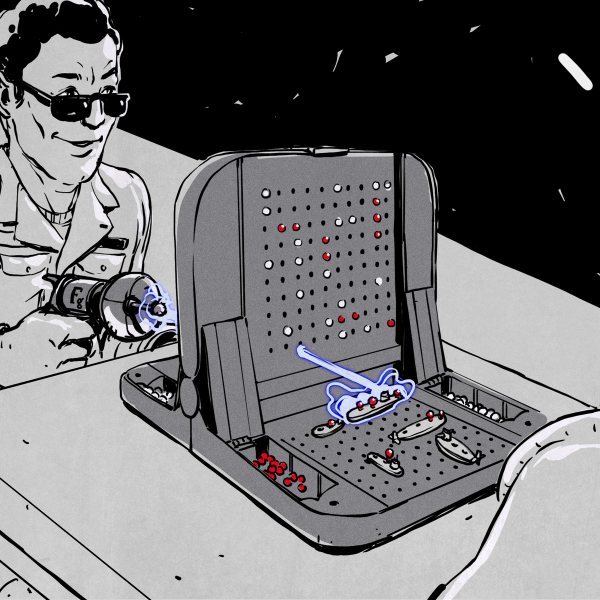
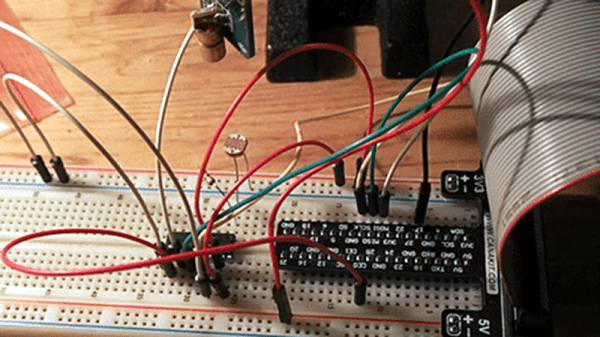
[Nick Touran] wanted to make two Raspberry Pi’s communicate wirelessly. There are lots of options, but [Nick] used a LASER and a photoresistor, along with Morse code. If you don’t find Morse code fancy enough, you could always refer to it as OOK (on/off keying). The circuit uses a common LASER module and an ordinary photoresistor that varies in resistance based on light. A resistor forms a voltage divider with the photoresistor and an external A/D reads the resulting voltage.

The circuit works, but we couldn’t help but notice a few items. Not all photoresistors are as sensitive to the same light wavelengths, so for the maximum range you’d want to pick a particular photoresistor.  While the analog to digital converter is certainly workable, we couldn’t help but wonder if you couldn’t set up the divider to use the inherent threshold of the Raspberry Pi’s input pins for a simpler circuit. Of course, if you used the same technique with an Arduino, you could use the built-in A/D converter, and the A/D converter is probably easier to get working.
Continue reading “Raspberry Pi Communication Via LASER”

Alfred P. Morgan: A Generation’s Radio Hacker

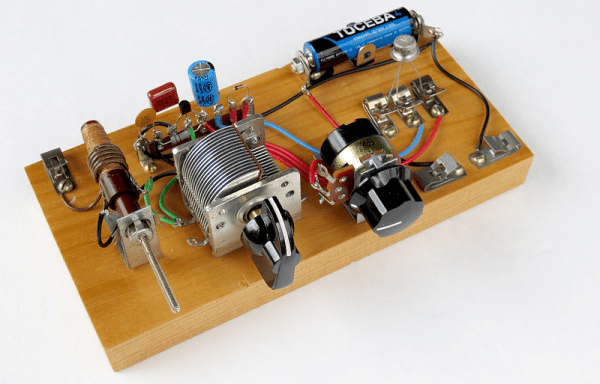
I was surfing the web looking for interesting projects the other day when I ran into [SkyKing’s] exquisite transistor demodulator radio builds. He mentioned that they were “Alfred P. Morgan-style” and that brought back a flood of memories about a man who introduced a whole generation to electronics and radio.

[Morgan] was born in 1889 and in the early part of the twentieth century, he was excited to build and fly an airplane. Apparently, there wasn’t a successful flight. However, he eventually succeeded and wrote his first book: “How to Build a 20-foot Bi-Plane Glider.” In 1910, he and a partner formed the Adams Morgan company to distribute radio construction kits. We probably wouldn’t remember [Morgan] for his airplanes, but we do recognize him for his work with radio.

By 1913, he published a book “The Boy Electrician” which covered the fundamentals of electricity and magnetism (at a time when these subjects were far more mysterious than they are today). [Morgan] predicted the hacker in the preface to the 1947 edition. After describing how a boy was frustrated that his model train automated to the point that he had nothing actually to do, [Morgan] observed:

The prime instinct of almost any boy at play is to make and to create. He will make things of such materials as he has at hand, and use the whole force of dream and fancy to create something out of nothing.

Of course, we know this applies to girls too, but [Morgan] wrote this in 1913, so you have to fill in the blanks. I think we can all identify with that sentiment, though.

Continue reading “Alfred P. Morgan: A Generation’s Radio Hacker”

The Three Week Three Dollar Binary Watch

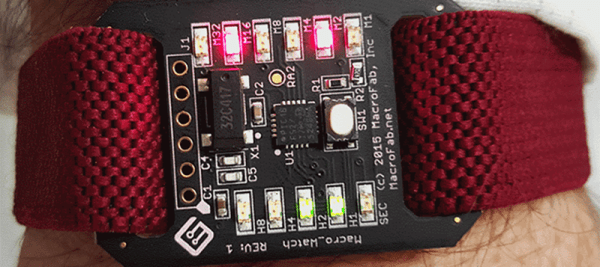
There’s a Maker Faire in three weeks, and your group wants to design and build a binary watch to give to attendees. You don’t have much time, and your budget is $3 per watch. What do you do? If you are [Parker@Macrofab] you come up with a plan, buy some parts, and start prototyping.

[Parker] selected the PIC16F527 because it had enough I/O and was inexpensive. A cheap crystal and some miscellaneous discrete parts rounded out the bill of materials. Some cheap ESD straps would serve for a band. He did the prototype with a PICDEM board and immediately ran into the bane of PIC programmers: the analog comparators were overriding the digital I/O pins. With that hurdle clear, [Parker] got the rest of the design prototyped and laid a board out in Eagle.

Continue reading “The Three Week Three Dollar Binary Watch”

Graphene Super Caps: Coming Soon?

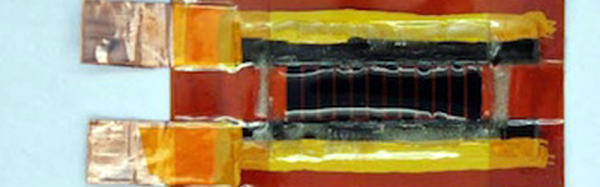
If you read Hackaday regularly, you’ve probably heard that you can use a LASER to create graphene. There’s been a bit of research on how to make practical graphene supercapacitors using the technique (known as LIG or LASER-induced graphene). Researchers at Rice University have been working on this, and apparently they’ve had significant success inducing graphene capacitors on a Kapton substrate. The team has published a paper in Advanced Materials (which is behind a paywall) about their work.

In particular, Rice claims that they have easily produced supercapacitors with an energy density of 3.2 mW/cubic centimeter (that’s what the University’s website reports; they probably mean mW-hours/cubic centimeter) with capacitances near one millifarad per square centimeter. A key benefit of the construction method is that the capacitors continued to work after researchers bent them 10,000 times. A flexible capacitor is useful in wearable devices that would often flex, or in a device like a cell phone that could bend in your back pocket as you sit.

Continue reading “Graphene Super Caps: Coming Soon?”

Robot Listens To Commands–Literally

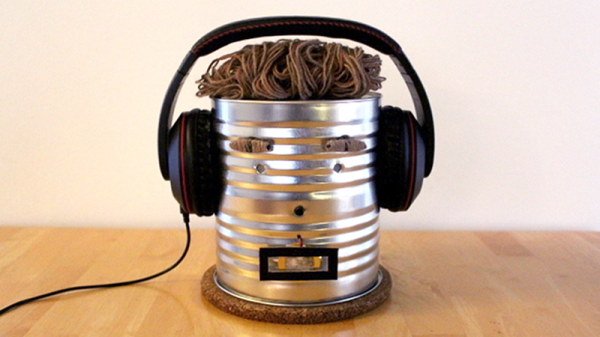
Where you might see a can, [Adam Kumpf] sees a robot. [Adam’s] robot (named [Canny]) doesn’t move around, but it does have expressive eyebrows, multicolored eyes, and a speaker for a mouth. What makes it interesting, though, is the fact that it receives audio commands via the headphones it wears. You can see [Canny] in action in the video below.

The headphones couple audio tones to [Canny’s] microphone using AFSK (audio frequency shift keying). [Canny] uses an opamp to bring the microphone level up and then uses a 567 PLL IC to decode the audio tones. [Adam] selected two clever frequencies for the mark and space (12345 Hz and 9876 Hz). In addition to being numerically entertaining, the frequencies are far enough apart to be easy to detect, pass through the headphones with no problem, and are not harmonically related.

Continue reading “Robot Listens To Commands–Literally”

Corkscrew LASER “Hologram”

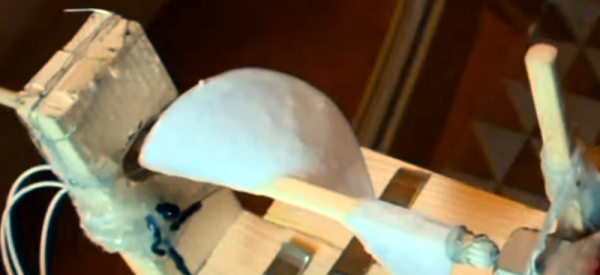
If you watch much science fiction, you know that in the future, there’re plenty of 3D holographic displays. From Princess Leah’s distress call to the Star Trek holodeck, there’s no shortage of computers that can make realistic images. It might not be up to holodeck standards, but [freedscript] created a 3D display for an Arduino using a chopstick, a motor, some paper, and a LASER. Of course, it isn’t actually a hologram, but neither is half the stuff you see on TV (Star Trek’s holographic characters were disturbingly solid for standing waves). The display is a type of volumetric display.

Continue reading “Corkscrew LASER “Hologram””

Does The Internet Make You Stupid?

A recent post by [Christian Heilmann] is one of several I’ve read lately talking about how Web sites–Stack Overflow, in particular–are breeding a new kind of developer. The kind of developer that simply copies and pastes example code or schematics with no real understanding of what’s going on. His conclusion is that developers who don’t fully understand what they are doing will become disinterested and burn out. He’s talking about software developers, but I think you could extend the argument to developers of all kinds, including hardware hackers. He concluded that–at least while learning–you stick to the old ways of doing things.

I have trouble disagreeing with [Christian] on the details, but I do disagree with the conclusion. People have copied work from other sources for a very long time. We’ve all seen circuits that were clearly either torn from a datasheet or even glued together from multiple datasheet examples way before there was an Internet.

There’s two things that are slightly different today: First, everyone has easy access to lots of examples. You don’t have to go find a book (possibly at a library), search through it, and find one or two examples. A quick Google will find dozens or hundreds of examples.

The second thing that is different is that there are places exist like Stack Overflow where you don’t even have to go looking. You can simply ask, “How do I do X?” and you will get answers from someone. It might be wrong. You might not understand it. But you’ll probably get some kind of answer.

Continue reading “Does The Internet Make You Stupid?”