BreadboardOS, A Command Line Interface For The Pico

Operating systems! They’re everywhere these days, from your smart TV to your smartphone. And even in your microcontrollers! Enter BreadboardOS for the Raspberry Pi Pico.

BreadboardOS is built on top of FreeRTOS. It’s aim is to enable quick prototyping with the Pi Pico. Don’t confuse operating system with a graphical environment — BreadboardOS is command-line based. You’d typically interface with it via a serial terminal emulator, but joy of joys, it does support color!

Using BreadboardOS is a little different than typical microcontroller development. Creating an application involves adding a “service” which is basically a task in FreeRTOS parlance. The OS handles running your service for you. Via the text interface, you can query running services, and start or kill them at will.

Meanwhile, running df will happily give you stats on the flash usage of the Pi Pico, and free will tell you how full the memory is doing. If you really want to get raw, you can make calls to control GPIO pins, the SPI hardware, or other peripherals, and do it right on the command line.

BreadboardOS isn’t for everyone, but it could prove a useful tool if you like that way of doing things. It’s not the only OS out there for the Pi Pico, either!

Continue reading “BreadboardOS, A Command Line Interface For The Pico”

The Perfect Desktop Kit For Experimenting With Self Driving Cars

When we think about self-driving cars, we normally think about big projects measured in billions of dollars, all funded by major automakers. But you can still dive into this world on a smaller scale, as [jmoreno555] demonstrates.

The build consists of a small RC car—an HSP 94123, in fact. It’s got a simple brushed motor inside, driven by a conventional speed controller, and servo-driven steering. A Raspberry Pi 4 is charged with driving the car, but it’s not alone. It’s outfitted with a Google Coral USB stick, which is a machine learning accelerator card capable of 4 trillion operations per second. The car also has a Wemos D1 onboard, charged with interfacing distance sensors to give the car a sense of its environment. Vision is courtesy of a 1.2-megapixel camera with a 160-degree lens, and a stereoscopic camera with twin 75-degree lenses. Software-wise, it’s early days yet. [jmoreno555] is exploring the use of Python and OpenCV to implement basic lane detection and other self driving routines, while using Blender as a simulator.

The real magic idea, though, is the treadmill. [jmoreno555] realized that one of the frustrations of working in this space is in having to chase a car around a test track. Instead, the use of a desktop treadmill allows the car to be programmed and debugged with less fuss in the early stages of development.

If you’re looking for a platform to experiment with AI and self-driving, this could be an project to dive in to. We’ve covered some other great builds in this space, too. Meanwhile, if you’ve cracked driving autonomy and want to let us know, our tipsline is always standing by!

3D Print A Drill-Powered Helicopter Toy Because It’s Simply Fun

These days, you can get a fully remote-control helicopter that you can fly around your house for about $30. Maybe less. Back in the day, kids had to make do with far simpler toys, like spinning discs that just flew up in the air. [JBV Creative] has built a toy just like that with his 3D printer. It may be simple, but it also looks pretty darn fun.

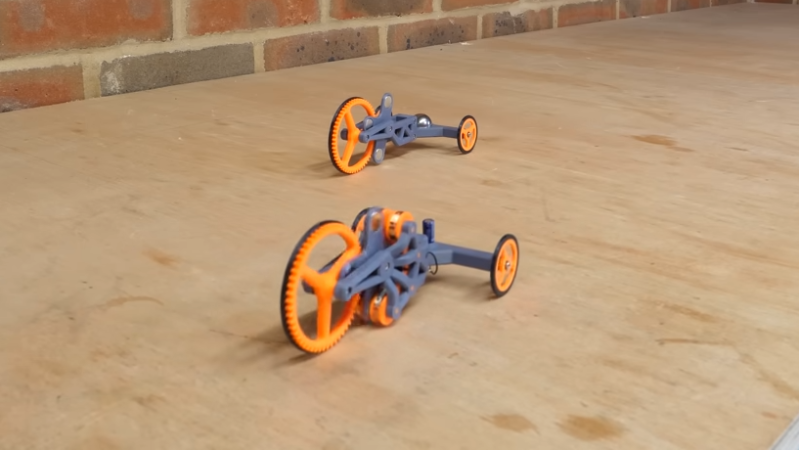
The design is straightforward. It uses a power drill to spin up a geartrain, which in turn drives a small disc propeller. Spin the propeller fast enough and it’ll launch high into the air. The geartrain mounts to the drill via the chuck, and it interfaces with the propeller with a simple toothed coupler. Alternatively, there’s also a hand-cranked version if you don’t have a power drill to hand.

Launching is easy. First, the drill spins the propeller up to speed. Then, when the drill’s trigger is released, it slows down, and the propeller spins free of the toothed coupler, with the lift it generates carrying it into the sky.

Files are available online for those interested. We could imagine this toy could make the basis for a great design competition. Students could compete to optimise the design with more effective gear ratios or better airfoils. We’ve seen similar designs before, too. Video after the break.

Continue reading “3D Print A Drill-Powered Helicopter Toy Because It’s Simply Fun”

Supercon 2023: Building The Ultimate Apple IIe, Decades Later

The Apple II was launched in 1977, a full 47 years ago. The Apple IIe came out six years later, with a higher level of integration and a raft of new useful features. Apple eventually ended production of the whole Apple II line in 1993, but that wasn’t the end. People like [James Lewis] are still riffing on the platform to this day. Even better, he came to Supercon 2023 to tell us all about his efforts!

[James]’s talk covers the construction of the Mega IIe, a portable machine of his own design. As the name suggests, the project was based on the Mega II chip, an ASIC for which he had little documentation. He wasn’t about to let a little detail like that stop him, though.

The journey of building the Mega IIe wasn’t supposed to be long or arduous; the initial plan was to “just wire this chip up” as [James] puts it. Things are rarely so simple, but he persevered nonetheless—and learned all about the Apple II architecture along the way.

Continue reading “Supercon 2023: Building The Ultimate Apple IIe, Decades Later”

You’ve Probably Never Considered Taking An Airship To Orbit

There have been all kinds of wild ideas to get spacecraft into orbit. Everything from firing huge cannons to spinning craft at rapid speed has been posited, explored, or in some cases, even tested to some degree. And yet, good ol’ flaming rockets continue to dominate all, because they actually get the job done.

Rockets, fuel, and all their supporting infrastructure remain expensive, so the search for an alternative goes on. One daring idea involves using airships to loft payloads into orbit. What if you could simply float up into space?

Continue reading “You’ve Probably Never Considered Taking An Airship To Orbit”

The Great Green Wall: Africa’s Ambitious Attempt To Fight Desertification

As our climate changes, we fear that warmer temperatures and drier conditions could make life hard for us. In most locations, it’s a future concern that feels uncomfortably near, but for some locations, it’s already very real. Take the Sahara desert, for example, and the degraded landscapes to the south in the Sahel. These arid regions are so dry that they struggle to support life at all, and temperatures there are rising faster than almost anywhere else on the planet.

In the face of this escalating threat, one of the most visionary initiatives underway is the Great Green Wall of Africa. It’s a mega-sized project that aims to restore life to barren terrain.

Continue reading “The Great Green Wall: Africa’s Ambitious Attempt To Fight Desertification”

Your Open-Source Client Options In The Non-Mastodon Fediverse

When things started getting iffy over at Twitter, Mastodon rose as a popular alternative to the traditional microblogging platfrom. In contrast to the walled gardens of other social media channels, it uses an open protocol that runs on distributed servers that loosely join together, forming the “Fediverse”.

The beauty of the Fediverse isn’t just in its server structure, though. It’s also in the variety of clients available for accessing the network. Where Twitter is now super-strict about which apps can hook into the network, the Fediverse welcomes all comers to the platform! And although Mastodon is certainly the largest player, it’s absolutely not the only elephant in the room.

Today, we’ll look at a bunch of alternative clients for the platform, ranging from mobile apps to web clients. They offer unique features and interfaces that cater to different user preferences and needs. We’ll look at the most notable examples—each of which brings a different flavor to your Fediverse experience.

Continue reading “Your Open-Source Client Options In The Non-Mastodon Fediverse”