Autoimmune diseases occur when the immune system starts attacking the body’s own cells. They can cause a wide range of deleterious symptoms that greatly reduce a patient’s quality of life. Treatments often involve globally suppressing the immune system, which can lead to a host of undesirable side effects.
However, researchers at the University of Chicago might have found a workaround by tapping into the body’s own control mechanisms. It may be possible to hack the immune system and change its targeting without disabling it entirely. The new technique of creating “inverse vaccines” could revolutionize the treatment of autoimmune conditions.
[Allen] was inspired by a TED talk from over a decade ago that involved targeting flying mosquitoes with high-powered scanning lasers. This technology never really came to fruition, and raised many questions about laser safety and effectiveness.
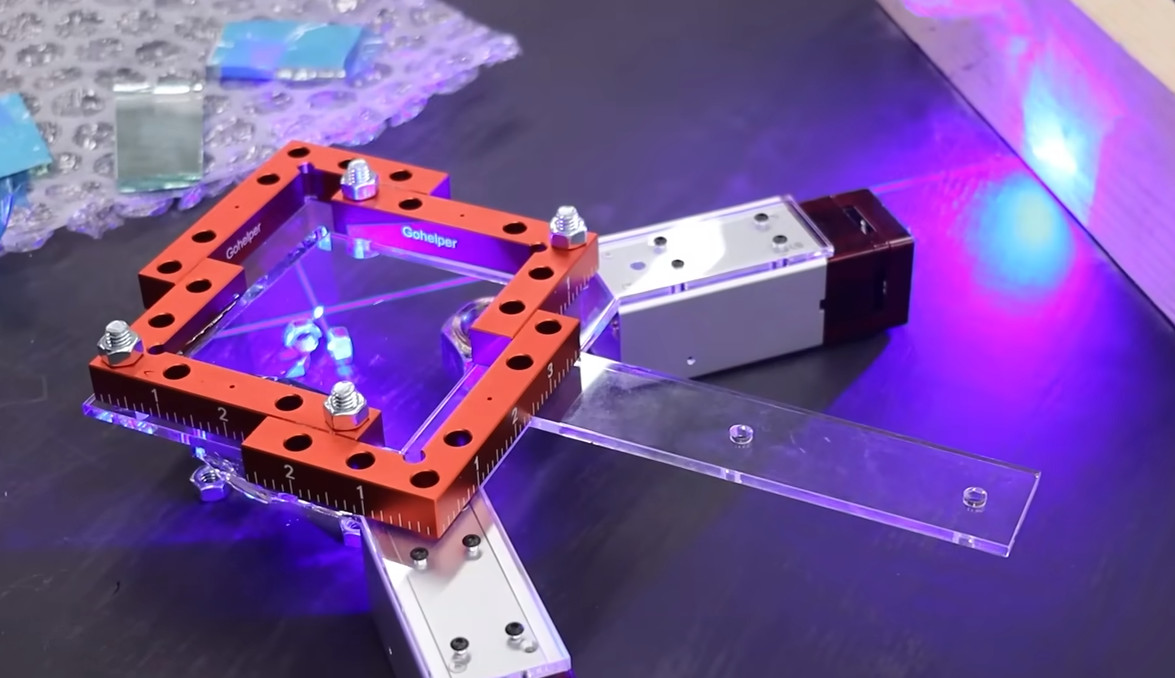
Testing the idea with only two mirrors installed.
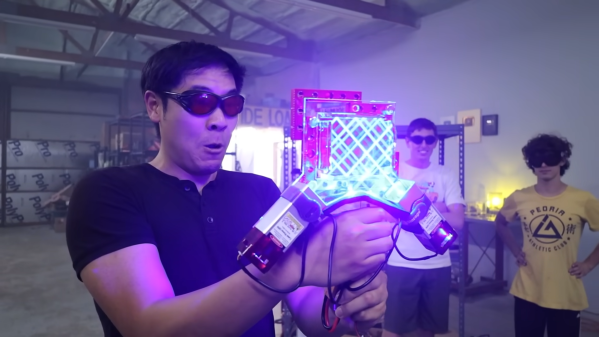
This solution keeps the lasers, but goes a slightly different route — two 10-watt lasers bounced between multiple mirrors to create a laser death grid. It goes without saying that 10 watt lasers will blind you near instantly even at great range, and can burn skin and cause all manner of other horrors. Bouncing them around with mirrors and waving them about at mosquitoes is a really poor idea when even incidental exposure can do real harm.
Indeed, the laser is so powerful that it burns holes in the mirrors [Allen] used in early testing. It was around this time that [styropyro] was brought in to help ensure everyone involved got through the project with their eyesight intact.
[Allen]’s crew wears laser safety goggles when operating the horrifying handheld device, which mitigates some risk. The team also quickly notice beams escaping from various directions, due in part to the holes burned in their clothes. Electing to wrap the device in a heatproof blanket to avoid accidentally dazzling any nearby pilots was an obvious idea but turning the device off and destroying it would have been smarter.
Sadly, despite looking like the coolest cyberpunk weapon we’ve seen in years, the device doesn’t even kill mosquitoes very effectively. The bugs largely avoided the device, and only a few that flew directly into a beam ended up being cooked. The whole time watching the video, we feared someone dropping the rig, leading to a 10-watt beam bouncing off and striking some poor innocent bystander.
Distorted guitars were a big part of the rock revolution last century; we try to forget about the roll. As a youth, [David Hilowitz] couldn’t afford a loud aggressive amp, a distortion pedal, or even a proper electric guitar. This experience ended up teaching him that you can use random old audio hardware as a distortion effect.
[David’s] guitar journey started when he found a classical guitar on a dumpster. He learned to play, but longed for the sound of a proper electric guitar. Family friends gifted him a solitary pickup, intending he build a guitar, but he simply duct-taped it to his steel-strung classical instead. The only thing he lacked was an amp. He made do with an old stereo system and a record pre-amp. With his his faux-electric guitar plugged into the microphone input, he was blessed with a rudimentary but pleasant distortion that filled his heart with joy.
[David] goes on to explain the concepts behind distorted guitar sounds, and how his home hi-fi was able to serve as a passable starter amp when he was young and couldn’t afford better. He then goes on the hunt for more old gear at a local Goodwill store, finding a neat old tape deck that similarly produced some nice warm distorted tones. In [David’s] experience, old hi-fi gear with microphone inputs can generally do a decent job in this role, with electric guitar pickups typically overloading the preamps which expect a lower-level signal. It’s different to what you’d get from a Big Muff or Boss DS-1, but it’s a neat sound nonetheless.
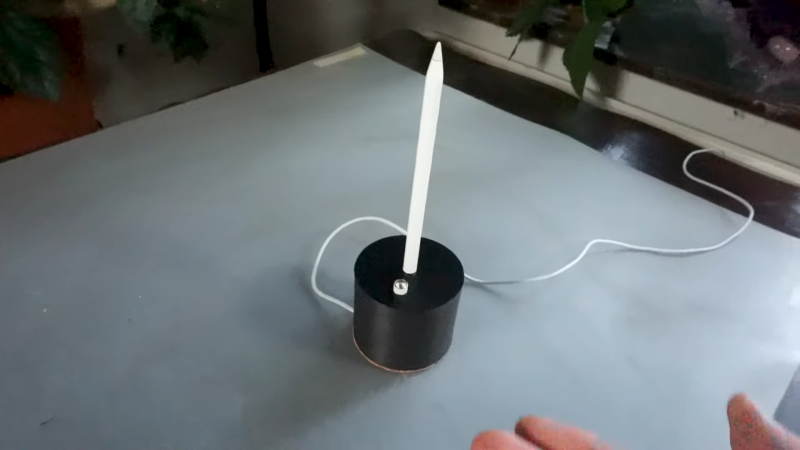
The Apple Pencil is a neat tool for digital creativity, but the user experience is a bit blah when it comes to charging. You either have to plug it into an iPhone or iPad directly, or an iPhone charger using a special adapter. It’s a bit below Apple’s usual seamless best. [Handy Bear] got around this fuss by building their own Apple Pencil dock.
The concept is simple. At its heart, it’s not dissimilar from a regular pen holder. It consists of a 3D printed round base filled with quick cement for heft. The base weighs almost a pound, and has a cork base so it sits nicely on a desk. A Lightning charge cable is fed into the base of the device, with the Apple Pencil adapter permanently fitted. All one has to do is remove the cap from the Apple Pencil, slot it into the adapter, and place the cap in the storage hole provided. The base then keeps the device charged, upright, and ready for use.
It’s not a complicated build, but it solves a fundamental problem with the Apple Pencil. It’s hard to imagine fancy-schmancy creatives are leaving these things just floating around on their desks with cables going everywhere; you’d think Apple would be selling a $99 dock for these by now. Instead, it’s up to the DIYers and the aftermarket.
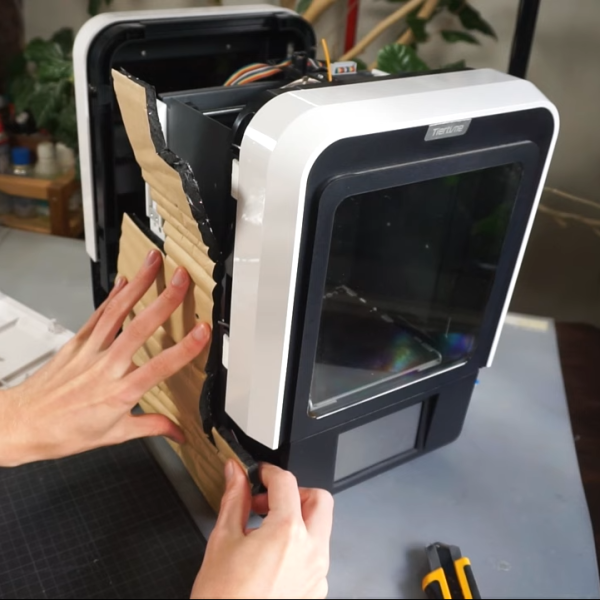
The video starts by exploring two different acoustic foams; one black, one white. The latter was found to hold a flame when ignited, making it a poor choice for a 3D printer with many hot components. The black foam, advertised for use in automotive installations, was reluctant to burn at all, and so made a safer choice.
The UP Mini 3 printer is then disassembled to receive its soundproofing treatment. The printer’s various panels all got a healthy lashing of thick sticky insulating foam. This took some work, thanks to the need to cut around various ribs and screw bosses on the panels. Cut appropriately, though, the printed was able to be reassembled neatly with its foam hidden inside.
Unfortunately, the work didn’t have a great effect on the printer’s sound output. That’s perhaps unsurprising, given it still has uninsulated panels like the front window which are still free to radiate sound. The foam did help cut down on fan noise and high-pitch sounds from the printer, but the annoying medium and low pitched noises from the printer’s motors were still very audible.
Using an enclosure or a quieter stepper driver are probably more effective DIY methods to quiet a noisy printer; share your own ideas in the comments. Video after the break.
The build starts with a square wooden dowel, cut into lengths to serve as the main body of the matches. Regular tiny matches were then harvested for their flammable matchheads, made of potassium chlorate. Sourcing the material this way is far simpler than attempting a chemical synthesis from raw materials. Once roughly ground, the material was glued on to the end of the wooden rod to finish the match. [Handy Bear] then whipped up a giant matchbox to suit, using the ignition strips from multiple smaller matchboxes in the process.
Impressively, the monster matches work, and work well. They readily ignite when struck, and are able to keep a strong flame burning for some time. However they’re not quite potent enough to fully ignite the wood, so they don’t burn down like the real thing. We could see these being a great way to light a campfire with less hassle than regular matches, even if they are a bulky solution to the problem.
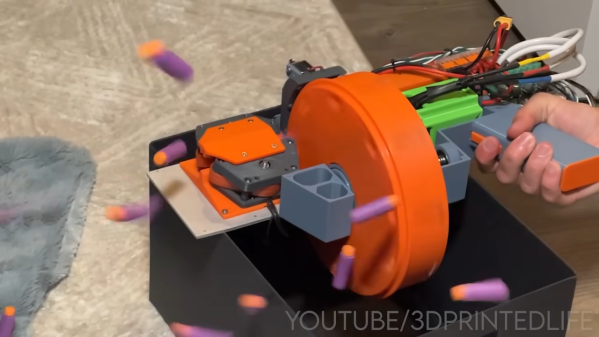
Nerf has made plenty of fully-automatic blasters over the years, but their toys typically lack punch, precision, and fire rate. [3DprintedLife] set about building a blaster to rectify that last shortcoming, aiming for design that could fire 100 darts per second.
The design uses half length darts which tend to fly a little nicer from high-powered blasters. It fires them using belts driven by powerful motors, similar to wheel blasters. The darts themselves are loaded into a drum magazine which has sliders to push the darts into the wheels as the drum rotates by.
It all sounds straightforward enough, but getting it all working in harmony is a challenge—particularly at a fire rate of 100 darts per second. The build video explains the trials and tribulations involved in getting near that fire rate, with darts getting shredded and magazines throwing out parts along the way. A good helping of iterative design helps get everything playing nice, with the darts neatly leaving the magazine and flying downrange at great speed. The slow-motion videos of darts flying out of the blaster in rapid succession are a special treat.
Files are available via Onshape for those looking to dive deeper into the design. We’ve seen some other neat Nerf blasters before, too. Video after the break.