GaN Charger Teardown Reveals Value Of This New Technology

Every so often, a new technology comes along that offers a broad range of benefits over what we already have. Just as lithium-ion batteries have made nickel-cadmium cells boring and old hat, gallium nitride semiconductors are making silicon parts look unimpressive by comparison. [Brian Dipert] looked at what this means in a practical sense by tearing down a GaN phone charger.

The charger in question is a 30 watt USB-C charger produced by Voltme. It cost [Brian] just $10, as prices of GaN hardware have come down significantly as economies of scale have kicked in. The charger measures just 1.2×1.3×1.2 inches, and weighs only 1.5 ounces. That compact size is thanks to GaN semiconductors, which are able to run cooler at higher power levels than their silicon forebearers.

Cracking into the charger required levering open the case. The back panel came off with some work, revealing the mains terminals, which deliver AC power to the PCB inside via the case holding them in contact. Interestingly, the entire circuit inside is filled with an adhesive thermal goop, which helps pass heat from the hottest components to the charger’s case. [Brian] is able to guide us through the circuit, and he identified many of the major components. However, some of the markings on chips were beyond his research skills, and he asks any knowing readers to contribute their own information.

It’s interesting to see just what makes the high-powered compact chargers of today tick. Plus, it’s a hallmark of progress that what was once considered a wonder material can now be had in a $10 commodity phone charger from Amazon. How times change!

Could 1080p Video Output From The RP2040 Be Possible?

Modern microcontrollers often have specs comparable with or exceeding early gaming consoles. However, where they tend to fall short is in the video department, due to their lack of dedicated graphics hardware. With some nifty coding, though, great things can be achieved  — as demonstrated by [TEC_IST]’s project that gets the RP2040 outputting 1080p video over HDMI.

The project builds on earlier work that saw the RP2040 outputting digital video over DVI. [TEC_IST] realized that earlier methods already used up 30% of the chip’s processing power just to reach 320×240 output. To get to 1080p resolution would require a different tack. The idea involved using the 32-bit architecture of the RP2040 to output a greater data rate to suit the higher resolution. The RP2040 can do a 32-bit move instruction in a single clock cycle, which, with 30 GPIO pins, would be capable of a data rate of 3.99 Gbits/second at the normal 133 MHz clock speed. That’s more than enough for 1080p at 60 Hz with a 24-bit color depth.

Due to the limitations of the chip, though, some extra hardware would be required. [TEC_IST] has drawn up a design that uses external RAM as a framebuffer, while using shift registers and other supporting logic to handle dumping out signals over HDMI. This would just leave the RP2040 to handle drawing new content, without having to redraw existing content every frame.

[TEC_IST] has shared the design for a potential 1080p HDMI output board for the RP2040 on GitHub and is inviting comment from the broader community. They’re yet to be built and tested, so it’s all theoretical at this stage. Obviously, a lot of heavy lifting is being done off-board the microcontroller here, but it’s still fun to think of such a humble chip doing such heavy-duty video output. Continue reading “Could 1080p Video Output From The RP2040 Be Possible?”

Huygens’ Telescopes Weren’t Very Good, Now We Think We Know Why

[Christiaan Huygens] was a pretty decent mathematician and scientist by the standards of the 17th century. However, the telescopes he built were considered to be relatively poor in quality for the period. Now, as reported by Science News, we may know why. The well-known Huygens may have needed corrective glasses all along.

Much of Huygens’ astronomical work concerned Saturn.

Huygens is known for, among other things, his contribution to astronomy. He discovered Titan, the largest moon of Saturn, and also studied the planet’s rings. He achieved this despite telescopes that were described at the time as fuzzy or blurrier than they otherwise should have been.

Huygens built two-lens telescopes, and would keep a table of which lenses to combine for different magnification levels. However, his calculations don’t align well with today’s understanding of optics. As it turns out, Huygens may have been nearsighted, which would account for why his telescopes were blurry. To his vision, they may indeed have been sharp, due to the nature of his own eyes. Supporting this are contemporary accounts that suggest Huygens father was nearsighted, with the condition perhaps running in the family. According to calculations by astronomer Alexander Pietrow, Huygens may have had 20/70 vision, in which he could only read at 20 feet what a person with “normal” vision could read from 70 feet away.

It’s a theory that answers a mildly-interesting mystery from many hundreds of years ago. These days, our troubles with telescopes are altogether more complex. If only a simple pair of glasses could solve NASA’s problems!

Foldable PCB Becomes Tiny Rover

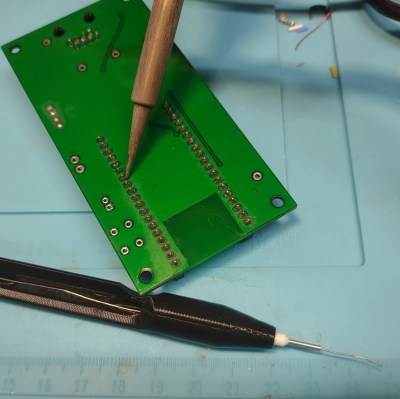
Typically, when you’re putting electronics in a robot, you install the various controller PCBs into the robot’s chassis. But what if the PCB itself was the chassis? [Carl Bugeja’s] latest design explores just that idea.

Yes, [Carl] decided to build a tiny robotic rover out of a foldable PCB. This choice was made as using a flexible foldable PCB would allow for the creation of a 3D chassis without the need for bulky connectors joining several boards together. A key part of the design was allowing the structure to unfold easily for serviceability’s sake. To that end, the structure is held together by the bolts that also act as the axles for the rover’s wheels. Even more brilliantly, the wheels are turned by motors built into the very PCB itself. Control is via a PlayStation controller, connected wirelessly to command the robot.

The little bot is surprisingly capable, especially when juiced up with a twin-cell lithium battery. It’s tiny, with minimal ground clearance, so it’s not the best at driving on rough surfaces. Having all-wheel-drive helps, though.

[Carl] specifically credits Altium Designer for making the design possible, thanks to its advanced 3D visualization tools that support foldable PCBs. Video after the break.

Continue reading “Foldable PCB Becomes Tiny Rover”

Cold War Military Telephones Now Usable Thanks To DIY Switch Build

The TA-1042 is the most badass looking telephone you’ll ever see. It’s a digital military telephone from the 1980s, but sadly non-functional unless it’s hooked up to the military phone switches it was designed to work with. These days, they’re really only useful as a heavy object to throw at somebody… that is, unless you had the suitable supporting hardware. As it turns out, [Nick] and [Rob] were able to whip up exactly that.

Their project involved implementing the TA-1042’s proprietary switching protocol on a Raspberry Pi Pico. The microcontroller’s unique Programmable I/O subsystem proved perfect for the task. With a little programming and a hat for the Pico to interface with the hardware, they were able to get the TA-1042 working as intended. It involved learning how to encode and decode the Manchester encoded data used by the Digital Non-secure Voice Terminal equipment. Notably, the TA-1042 isn’t the only phone you can use with this setup. You can also hook up other US military DNVT phones, like the TA-954 or TA-1035.

If you want this hardware for yourself, you can simply buy one of [Nick] and [Rob]’s DNVT switches from Tindie. Alternatively, you can roll your own with the source code provided on GitHub.

We’ve seen these phones before repurposed in an altogether different fashion. We’ve also taken a deep dive into the details of the military’s AUTOVON network.

Continue reading “Cold War Military Telephones Now Usable Thanks To DIY Switch Build”

Make Anything Clockwork With This Ridiculous Stick-On Device

Clockwork devices were popular right up until motors and electronics proved far more capable in just about every way. However, there’s something charming about a device you can wind up to make it do its thing. To recreate this feeling on modern technology, [Kousuke Saito] created a clockwork winder that you can fit to a wide variety of modern appliances. 

Somehow it just feels right.

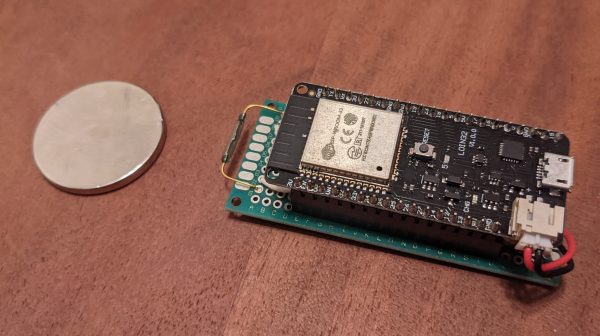
The design is simple. It consists of a motor which is run from a battery. The two components are installed in a 3D printed housing with a magnet on the bottom. When the device is attached to a metal surface, a switch is activated which turns the motor on. The motor is attached to a large printed “winding key” that would be familiar to anyone who has used a clockwork toy or timepiece before. If the magnetic manner of activation is familiar, you might recall it from [Kousuke Saito’s] chirping cicada project.

It’s a silly build, to be sure. Regardless, when placed on certain appliances, like a simple fan, the motion really does imply that the clockwork winder is connected to the mechanism inside. It’s a falsehood, of course, but a joyous one.

We’ve featured some real clockwork hardware before, too, like these amazing time locks.

Continue reading “Make Anything Clockwork With This Ridiculous Stick-On Device”

The BLE Datalogging Scale Of A Thousand Uses

Whether you’re making coffee or beer or complex chemicals, weighing your ingredients carefully and tracking them is key to getting good results. [Tech Dregs] decided to build a logging scale that would work seamlessly with his smartphone, and shared the design on YouTube.

The design begins with a Greater Goods manual electronic scale, which was chosen for its convenient design and 750 gram load cell. Once cracked open, [Tech Dregs] pulled out the original PCB to replace it with his own. Only the original buttons are used, with an Seed Xiao ESP32-C3 replacing the scale’s original brains. The original LCD screen was swapped out for an OLED display, and it also got a rechargeable lithium battery for better usability.

The real value of the project, though, is its communication capability. It’s able to talk to an Android smartphone over Bluetooth Low Energy. Thanks to a custom app, [Tech Dregs] is able to log weight readings from the scale over time and even graph them live on the smartphone. As a demonstration, the scale is used to log the weight of a cup as it fills with a shot of coffee, which should serve [Tech Dregs] well in his coffee automation projects.

We’ve seen bathroom scales hacked before, too, with similar connectivity upgrades.

Continue reading “The BLE Datalogging Scale Of A Thousand Uses”