Remoticon 2021 // Jay Bowles Dips Into The Plasmaverse

Every hacker out there is familiar with the zaps and sizzles of the Tesla coil, or the crash and thunder of lighting strikes on our hallowed Earth. These phenomena all involve the physics of plasma, a subject near and dear to Jay Bowles’s heart. Thus, he graced Remoticon 2021 with a enlightening talk taking us on a Dip Into the Plasmaverse.

Jay’s passion for the topic is obvious, having fallen in love with high voltage physics as a teenager. He appreciated how tangible the science was, whether it’s the glow of neon lighting or the heating magic of the common microwave. His talk covers the experiments and science that he’s studied over the past 17 years and in the course of running his Plasma Channel YouTube channel. Continue reading “Remoticon 2021 // Jay Bowles Dips Into The Plasmaverse”

Ion Thrusters: Not Just For TIE Fighters Anymore

Spacecraft rocket engines come in a variety of forms and use a variety of fuels, but most rely on chemical reactions to blast propellants out of a nozzle, with the reaction force driving the spacecraft in the opposite direction. These rockets offer high thrust, but they are relatively fuel inefficient and thus, if you want a large change in velocity, you need to carry a lot of heavy fuel. Getting that fuel into orbit is costly, too!

Ion thrusters, in their various forms, offer an alternative solution – miniscule thrust, but high fuel efficiency. This tiny push won’t get you off the ground on Earth. However, when applied over a great deal of time in the vacuum of space, it can lead to a huge change in velocity, or delta V.

This manner of operation means that an ion thruster and a small mass of fuel can theoretically create a much larger delta-V than chemical rockets, perfect for long-range space missions to Mars and other applications, too. Let’s take a look at how ion thrusters work, and some of their interesting applications in the world of spacecraft!

Continue reading “Ion Thrusters: Not Just For TIE Fighters Anymore”

You Can Find Military Radars On Publicly-Available Satellite Data

When it comes to hunting down military radar installations and associated hardware, we typically think of equipment that is firmly in the price bracket of nation states and their military forces. Whether it’s early warning radar, those used for air defence, or for naval purposes, you’d think it was relatively difficult to intercept or track these emissions.

However, a new tool built by geocomputation lecturer Ollie Ballinger shows this isn’t the case. In fact, openly-available data captured via satellite can be used to find all manner of military radar emitters. Let’s explore how!

Continue reading “You Can Find Military Radars On Publicly-Available Satellite Data”

PlayStation 4 Controller Gets A USB-C Upgrade

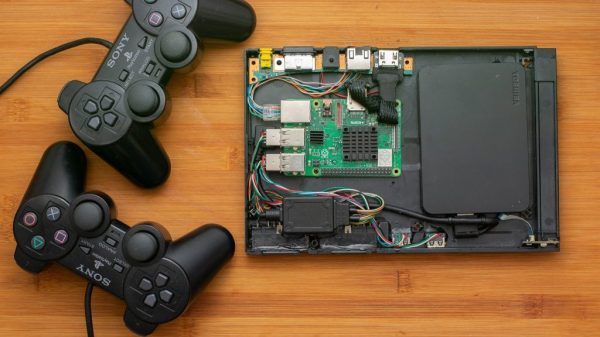
Micro USB was once the connector of choice for applications where USB-A was too big, but now USB-C has come to dominate all. It’s becoming standard across the board for many peripherals, and [Ian] recently decided that he wanted to upgrade his PS4 controller to the newer standard. Hacking ensued.

The hack consists of a small breakout board that enables a USB-C connector to be fitted into the PS4 controller in place of the original micro USB port. [Ian] explains what needs to be done to complete the mod, which first involves disassembling the controller carefully to avoid damage. The original microUSB breakout board can then be removed, and fitted with one of a selection of replacement boards available on Github to suit various revisions of PS4 controller. A little filing is then required to allow the new connector to fit in the controller case, and [Ian] notes that using an 0.8mm thick PCB is key to enabling the new breakout board to fit inside the shell.

It’s a neat hack that makes charging PS4 controllers way easier in the modern environment without having to keep legacy micro USB cables around. We’ve actually seen similar hacks done to iPhones, too, among other hardware. Video after the break.

Continue reading “PlayStation 4 Controller Gets A USB-C Upgrade”

Researchers Build Neural Networks With Actual Neurons

Neural networks have become a hot topic over the last decade, put to work on jobs from recognizing image content to generating text and even playing video games. However, these artificial neural networks are essentially just piles of maths inside a computer, and while they are capable of great things, the technology hasn’t yet shown the capability to produce genuine intelligence.

Cortical Labs, based down in Melbourne, Australia, has a different approach. Rather than rely solely on silicon, their work involves growing real biological neurons on electrode arrays, allowing them to be interfaced with digital systems. Their latest work has shown promise that these real biological neural networks can be made to learn, according to a pre-print paper that is yet to go through peer review.
Continue reading “Researchers Build Neural Networks With Actual Neurons”

ESP32 Virtual Machine Lets You Change Programs On The Fly

Often, reprogramming a microcontroller involves placing it in reset, flashing the code, and letting it fire back up. It usually involves shutting the chip down entirely. However, [bor0] has built a virtual machine that runs on the ESP32, allowing for dynamic program updates to happen.

The code is inspired by the CHIP-8, a relatively ancient interpreter that had some gaming applications. [bor0] had already created a VM simulating the CHIP-8, and repurposed it here, taking out the gaming-related drawing instructions and replacing them with those that control IO pins. Registers have also been changed to 16 bits for added flexibility and headroom.

It’s probably not something with immediate ground-breaking applications for most people, but it’s a different way of working with and programming the ESP32, and that’s pretty neat.

The ESP32 is a powerful chip, too, as we all know – and it makes a great 8-bit emulator to boot. Sound off in the comments with your thoughts on what would make a killer application for the ESP32 VM!

[Thanks to satancete for the tip!]

Bionic Implants Can Go Obsolete And Unsupported, Too

When a piece of hardware goes unsupported by a company, it can be frustrating. Bugs may no longer get fixed, or in the worst cases, perfectly good hardware can stop working entirely as software licences time out. Sadly, for a group reliant on retinal implants from company Second Sight, the company has since stopped producing and supporting the devices that give them a crude form of bionic sight.

The devices themselves consist of electrodes implanted into the retina, which can send signals to the nervous system which appear as spots of light to the user. A camera feed is used to capture images which are then translated into signals sent to the retinal electrodes. The results are low-resolution to say the least, and the vision supplied is crude, but it gives users that are blind a rudimentary sense that they never had before. It’s very much a visual equivalent to the cochlear implant technology.

The story is altogether too familiar; Second Sight Medical Products came out with a cutting-edge device, raised money and put it out into the world, only to go bankrupt down the road, leaving its users high and dry. Over 350 people have the implants fitted in one eye, while one Terry Byland is the sole person to have implants in both his left and right eyeballs. Performance of the device was mixed, with some users raving about the device while others questioned its utility.

Continue reading “Bionic Implants Can Go Obsolete And Unsupported, Too”