Gravity is one of the more obvious forces in the universe, generally regarded as easily noticeable by the way apples fall from trees. However, the underlying mechanisms behind gravity are inordinately complex, and the subject of much study to this day.
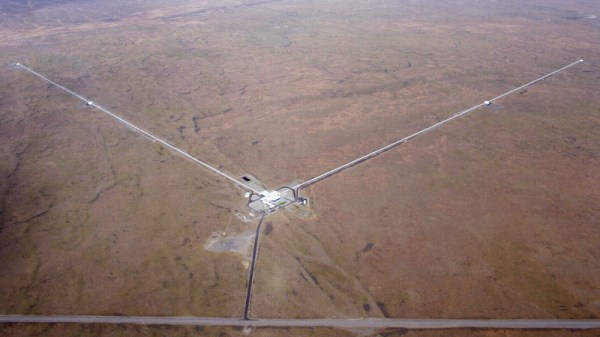
A major component of this study is around the concept of gravitational waves. First posited by Henri Poincaré in 1905, and later a major component of Einstein’s general theory of relativity, they’re a phenomena hunted for by generations of physicists ever since. For the team at the Laser Interferometer Gravitational-wave Observatory, or LIGO, finding direct evidence of gravitational waves is all in a day’s work.
A vital shipping lane has been blocked in Egypt, as a 220,000 ton container ship, the MV Ever Given, became lodged sideways in the channel Tuesday morning local time. The Suez Canal, long a region of trading and strategic importance, has been blocked to travel in both directions as authorities make frantic efforts to free the ship.
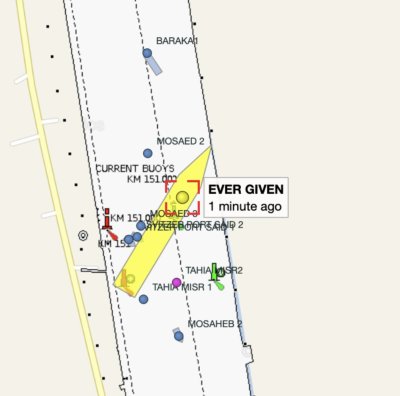
Live tracking shows a flurry of activity around the stricken vessel. If you find yourself transiting the Suez Canal next week, don’t do this. Everyone’s patience is going to be pretty thin.
The Ever Given is carrying goods from China to Rotterdam, making a northward journey through the canal. The exact reason for grounding remains unclear, though such incidents are often due to mechanical malfunction or navigational errors in the tight confines of the channel. Like many important waterways, the Suez Canal requires transiting vessels to take on a pilot. This is to ensure that ships passing through the canal have someone onboard with experience of navigating the 673-foot wide passage. However, incidents still happen, as with huge container ships, there is minimal room for error.
A flotilla of tugboats dispatched to the area have begun working to free the ship, working in concert with excavators on the banks of the canal. This photo taken by [Julianne Cona] at the incident shows the sheer scale of the problem — with the excavator digging at the bow a tiny speck in the shadow of the gigantic ship.
We’re sure shipping firms and residents of the Netherlands are eager for a quick resolution, whether its to avoid costly delays or simply to get those online purchases sooner. If you live near the canal and want to keep an eye on what’s happening, you could always grab a software-defined radio and track things in real time. Alternatively, watch the progress on Vessel Finder. And, if you’ve got strong opinions on the proper procedure for navigating the Suez Canal, sound off in the comments!
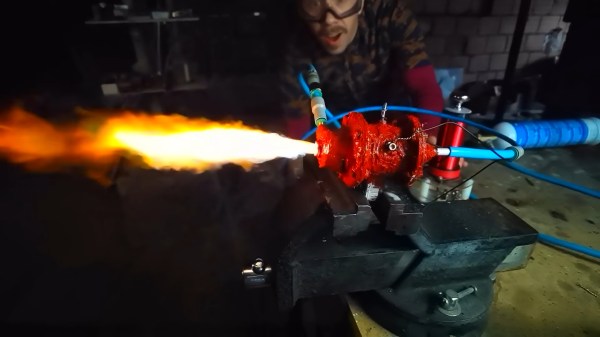
Rocket engines are known for one thing above all else, and that’s getting hot. It’s this very property that makes them such a challenge to build and run from a materials engineering standpoint. It’s hard enough to build one with advanced metal alloys, but [Integza] presses on with trying to make one on a 3D printer. Progress is being made, but success remains elusive. (Video, embedded below.)
To try and mitigate the thermal effects of burning propellants in his engine design, [Integza] looked to vortex cooling. This is where oxygen is swirled around the outer edge of the combustion chamber in a vortex, acting as a buffer layer between the burning fuel and the chamber walls. With 3D printed chamber components, keeping temperatures as low as possible is key, after all. Unfortunately, despite using a special ceramic-laden resin for printing and lathering the rocket components in various refractory materials, it wasn’t possible to stop the chambers leaking. Solid combustion was possible for a few seconds at a time, but eventually each motor tested turned into a ball of flames as the walls broke down.
Thankfully, nobody was hurt in testing, and [Integza] has a clear idea of the problems that need to be fixed in the next iteration. We’ve featured other vortex cooled rockets before – the theory is sound. As always, the devil is in the implementation.
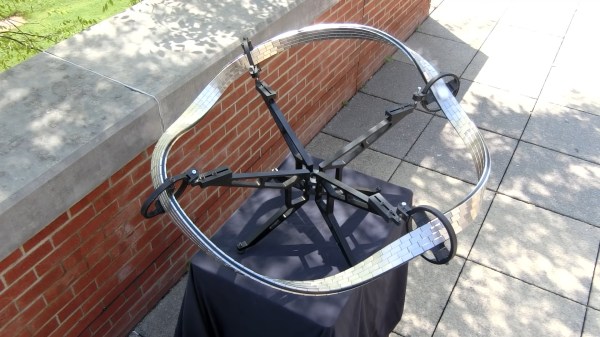
Superconductors are interesting things, though we don’t really rely on them for much in our day to day lives. They’d be supremely useful, if only they didn’t need to be so darned cold. While the boffins toil away in the lab on that problem however, there’s still some fun to be had, as demonstrated by the Möbius Strip levitation track at Ithaca College. (Video, embedded below.)
The rig takes advantage of the fact that superconductors can levitate over magnets, and vice versa. Under certain conditions, the superconductor can even lock into position over a magnet, due to flux pinning, wherein flux “tubes” from the magnet’s field penetrate a superconductor and are pinned in place by currents in the superconductor. It’s an awe-inpsiring effect, with the superconducting material appearing to magically float at a locked height above the magnetic surface, quite distinct from traditional magnetic levitation.
Construction of the track wasn’t straightforward. Early attempts at producing a Möbius Strip twisted through 540 degrees were unsuccessful in steel. The team then switched tack, using a flexible plastic which was much more pliable. This was then covered in neodymium magnets to create the necessary field, and the resulting visual effect is one of a silver-bricked magnetic road.
It’s a great display, and one that quite intuitively demonstrates the concepts of both a Möbius Strip and superconducting levitation. If room-temperature semiconductors become a real thing, there’s every possibility this could become an always-on installation. It’s also the trick behind one of the coolest hoverboards we’ve ever seen. Video after the break.
When we think about the onward march of automotive technology, headlights aren’t usually the first thing that come to mind. Engines, fuel efficiency, and the switch to electric power are all more front of mind. However, that doesn’t mean there aren’t thousands of engineers around the world working to improve the state of the art in automotive lighting day in, day out.
Sealed beam headlights gave way to more modern designs once regulations loosened up, while bulbs moved from simple halogens to xenon HIDs and, more recently, LEDs. Now, a new technology is on the scene, with lasers!
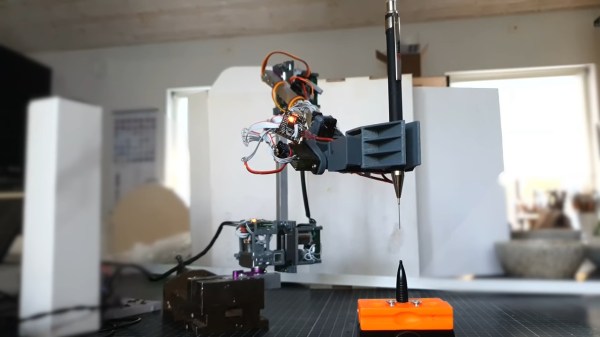
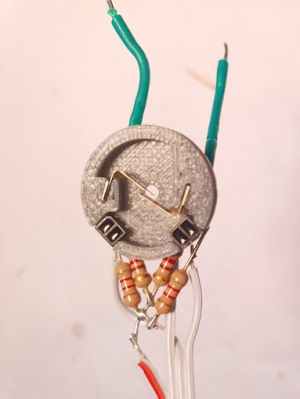
Part of the “special sauce” that makes this arm so capable is the custom optical encoders installed in the servo motors themselves.
[Adam]’s first robot arm build was a major disappointment, when the servos he had purchased for the build turned out to be terrible at holding an angle. With limited funds, he elected to improve on what he had, learning much about precision control techniques along the way. [Adam] taught himself how to implement industrial strength control loops using hobby hardware, by implementing additional encoders into servos and taking into account velocity and torque in addition to just position. With a magnetic encoder on the servo output shaft and a tiny optical encoder hand-built for inside the motor itself, much higher accuracy is achievable by allowing the control system to compensate for backlash.
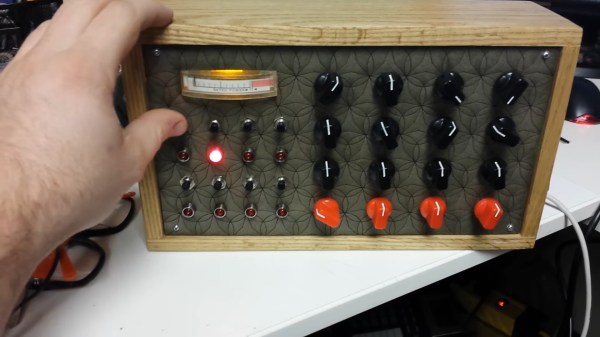
In the world of homebrew synthesizers, there are plenty of noiseboxes and grooveboxes that make all kinds of wacky and wild noises. However, common projects like the Auduino and Atari Punk Console are often limited in that they can’t readily be programmed to play multiple notes or any sort of discernable rhythm. [Nick Poole] changes this with his Auduino step sequencer build.
The build takes the Auduino grain synthesizer, and modifies it by adding a step sequencer. This is possible as the Auduino code, which runs on the old-school ATMEGA-based Arduinos, is incredibly fast, leaving plenty of processing time for extra features to be added. [Nick] adds eight LEDs and eight buttons to the build, allowing the user to select one of eight steps to modify. Then, the sound parameters for the step can be altered with the standard Auduino controls. This lets the user quickly and easily build up 8-step melodies, something that was previously impossible with the Auduino.
It’s a fun build, and one that makes a great intro into the world of DIY synth builds. The techniques learned here will serve any aspiring maker well if they dive further into the world of modular synthesis and associated arcana. Video after the break.