It’s a job that’s ideally suited for the average microcontroller. In this case, [Alex] chose the venerable Arduino Uno. Paired with a bunch of buttons and a 16 x 2 character LCD, it has a simple-to-navigate interface for dialling in a shot. The trick to splash and droplet photography is to first open a valve to release a droplet, and then fire a flash a set time after to capture the droplet in flight, after it’s hit the surface of the liquid. [Alex]’s design uses a MOSFET to trigger the water valve, and optoisolators to safely trigger the flash and camera.
[Alex] has gotten some impressive results with the rig, and it would serve as a great starting point for anyone looking to get into the field. We’ve seen similar builds before, too. If you’ve got your own fancy photography rig for those otherwise-impossible shots, be sure to drop us a line!
Humans often like to monitor their exercise habits with the use of a pedometer, which tracks steps taken during a walk. Such devices are a little cumbersome for smaller creatures however, but no matter. Hamsters tend to get most of their workouts done on a wheel anyway, so it’s simple enough to instrument the equipment instead.
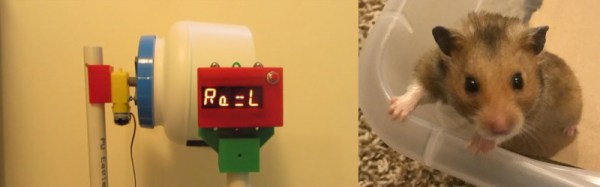
The build is a simple tachometer, using an infrared emitter and sensor pair to read the rotation speed of the hamster wheel. The wheel itself is light-colored plastic, so a strip of black felt is used to create a non-reflective section, creating a pulse one per revolution that can be read by the Adafruit Feather 32U4 running the show. Data on peak speed and total rotations is available for tracking the exercise habits of the hamster in question, output on a set of 14-segment displays.
It’s a fun project, and one that would be a great way to teach kids about pet care and basic embedded systems. Hamster performance could even be uploaded to the cloud with a more advanced build, and training milestones linked to rewards a la Premier League footballers. At the end of the day, a hamster wheel is just an exercise bike for our four-legged friends, and we’ve seen those hacked too. Video after the break.
Growing fresh vegetables at home is a popular pastime, even moreso in a year when we’ve all been locked inside. However pests can easily spoil a harvest, potentially putting a lot of hard work down the drain. [Matt] of [DIY Perks] isn’t one to give up his tomatoes without a fight, however, and came up with a solution to protect his plants.
The trick is to take advantage of the mildly conductive slime excreted by snails as they travel along the ground. To protect potted plants, [Matt] places two strips of copper tape around the perimeter of the pot, spaced about a centimeter apart. Each strip is connected to one terminal of a 9 V battery. When a snail attempts to cross the strips, it completes a circuit between the two, and the electrical current that flows irritates the snail, forcing it to retreat.
[Matt] notes that no snails were harmed in the making of the video, and that the solution is far kinder to the slimy critters than poisons or traps. He also goes so far as to demonstrate alternative solutions for garden beds, as well. We’ve more commonly seen [Matt] working with lighting, though it’s great to see he has a bit of a green thumb, too. Video after the break.
These days, we’re blessed with cellular data networks that span great swathes of the Earth. By and large, they’re used to watch TV shows and argue with strangers online. However, they’re also a great tool to use to interact with hardware in remote locations, particularly mobile ones where a wired connection is impractical.
In this series, we’re taking a look at tips and tricks for doing remote cellular admin the right way. First things first, you’ll need a data connection – so let’s look at choosing a modem.
Options Abound
When shopping around for cellular data modems, it can be difficult to wade through the variety of options out there and find something fit for purpose. Modems in this space are often marketed for very specific use cases; at the consumer level, many are designed to be a no-fuss home broadband solution, while in the commercial space, they’re aimed primarily to provide free WiFi for restaurants and cafes. For use in remote admin, the presence of certain features can be critical, so it pays to do your research before spending your hard earned money. We’ve laid out some of the common options below.
Consumer Models
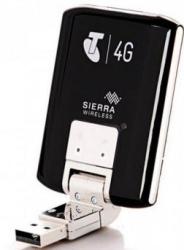
The Sierra Aircard 320U is ancient now, with limited frequency bands available. Its flimsy flexible connector is also a drawback. However, its ease of configuration with Linux systems makes it a dream to use in remote access situations. Unlike many others, it acts as a Direct IP connection, not appearing as a separate router.
Many telecommunications providers around the world sell cheap USB dongles for connecting to the Internet, with these first becoming popular with the rise of 3G. They’re somewhat less common now in the 5G era, with the market shifting more towards WiFi-enabled devices that share internet among several users. These devices can often be had for under $50, and used on prepaid and contract data plans.
These devices are often the first stop for the budding enthusiast building a project that needs remote admin over the cellular network. However, they come with certain caveats that can make them less attractive for this use. Aimed at home users, they are often heavily locked down with firmware that provides minimal configuration options. They’re generally unable to be set up for port forwarding, even if you can convince your telco to give you a real IP instead of carrier-grade NAT. Worse, many appear to the host computer as a router themselves, adding another layer of NAT that can further complicate things. Perhaps most frustratingly, with these telco-delivered modems, the model number printed on the box is often not a great guide as to what you’re getting.
A perfect example is the Huawei E8327. This comes in a huge number of sub-models, with various versions of the modem operating in different routing modes, on different bands, and some even omitting major features like external antenna connectors. Often, it’s impossible to know exactly what features the device has until you open the box and strip the cover off, at which point you’re unable to return the device for your money back.
All is not lost, however. The use of VPNs can help get around NAT issues, and for the more adventurous, some models even have custom firmware available on the deeper, darker forums on the web. For the truly cash strapped, they’re a viable option for those willing to deal with the inevitable headaches. There are generally some modems that stand out over others in this space for configurability and ease of use. This writer has had great success with a now-aging Sierra Aircard 320U, while others have found luck with the Huawei E3372-607. As per earlier warnings though, you don’t want to accidentally end up with an E3372-608 – thar be dragons.
When it comes to competitive fighting games, having the right controller in your hands can make the difference between victory and defeat. Many tournaments have strict rules around controllers for this very reason. [Akaki Kuumeri] has recently put together a custom controller, aimed at maximising performance in Super Smash Brothers: Ultimate on the Nintendo Switch. (Video, embedded below.)
The build is assembled in an attractive 3D-printed body, made to be reminiscent of the original Nintendo Entertainment System controller. Inside, a cheap third-party Gamecube controller is used to interface with the console. Mechanical keyboard switches are used to replace the buttons and even the analog sticks, with a special modifier key that enables walking and running across the stage. This is pulled off with a handful of resistors emulating the intermediate position of the analog sticks, and makes pulling off advanced combos easier.
There are many racing wheels on the market for the budding sim enthusiast. Unfortunately, lower end models tend to have a limited range of motion and ship with cheap plastic wheels that don’t feel good in the hand. As always, if what’s on the shelf doesn’t meet your needs, you can always build your own. [ilge]’s DIY racing wheel build is a great example of how to go about it.
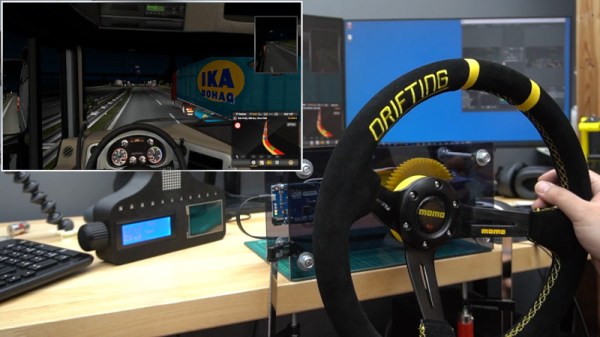
It’s a no-frills build, with an Arduino Leonardo doing the USB Human Interface Device duties in this case. It reads a standard 10K potentiometer via an analog input to determine wheel position. To enable a realistic 900 degrees of motion, unlike the standard 270 degree rotation of the potentiometer, [ilge] uses 3D printed gears of 15 and 54 degrees respectively. This also has the benefit of allowing the wheel to be mounted to a stout bearing for smooth motion. The steering wheel itself is a high quality drift wheel from MOMO, and the benefit of building your own setup is that you can choose whatever wheel you like to taste.
It’s a simple build both mechanically and electronically speaking, but one that serves as a great entry into building a DIY sim for the beginner. We’d love to see further upgrades towards force feedback, or even shift paddles added on the back. Those looking to go all out can even consider building a motion platform. Video after the break.
While some love to carve up mountain roads, and others relish the challenge of perfectly apexing every corner at the track, many crave a different challenge. Drag racing is a sport all about timing, finesse, and brute power. Like any other discipline in motorsport, to compete you’ll need a vehicle finely honed for the task at hand. Here’s how you go about getting started on your first quarter-mile monster.
It’s All About Power, Right?
It’s true that if you want to go faster, having more power on tap is a great way to do it. If that’s what you’re looking for, we’ve covered that topic in detail – for both the naturally aspirated and forced induction fans. However, anyone that’s been to the drag strip before will tell you that’s only part of the story. All of the power in the world isn’t worth jack if you can’t get it down to the ground. Even if you can, you’ve still got to keep your steering wheels planted if you intend to keep your nose out of the wall. So, if you want more power, consider the articles linked above. For everything else that’s important in drag racing, read on below.