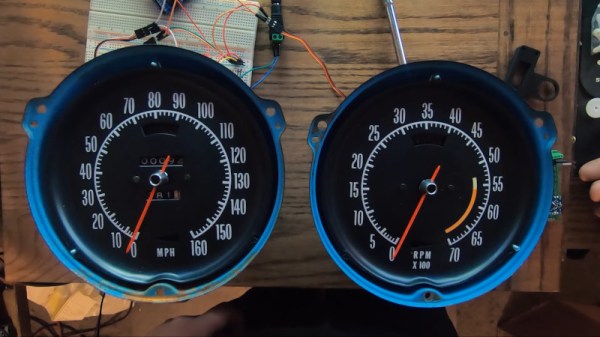
[Wesley Kagan] is building a Corvette with a V12 engine swap. Much of the driveline will be entirely replaced, which means the components to drive the mechanical speedometer and tachometer will no longer be present in the final car. Instead, [Wesley] came up with his own electronic gauge conversion to do the job.
It’s a build that respects the original aesthetic of the car, reusing the original gauges but driving them differently. In place of the original mechanical drives from the transmission and distributor respectively, the speedometer and tach instead get servos installed in the back with a 3D printed gear train. The odometer gets its own continuous rotation servo, too. An Arduino Nano is used to drive the servos, using data from a GPS module and the car’s ignition system.
Perhaps the best-known ridesharing service, Uber has grown rapidly over the last decade. Since its founding in 2009, it has expanded into markets around the globe, and entered the world of food delivery and even helicopter transport.
One of the main headline research areas for the company was the development of autonomous cars, which would revolutionize the company’s business model by eliminating the need to pay human drivers. However, as of December, the company has announced that it it spinning off its driverless car division in a deal reportedly worth $4 billion, though that’s all on paper — Uber is trading its autonomous driving division, and a promise to invest a further $400 million, in return for a 26% share in the self-driving tech company Aurora Innovation.
Playing A Long Game
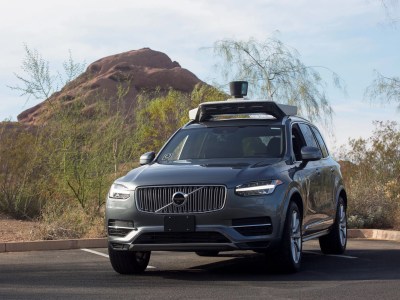
Uber’s self-driving efforts have been undertaken in close partnership with Volvo in recent years.
Uber’s driverless car research was handled by the internal Advanced Technologies Group, made up of 1,200 employees dedicated to working on the new technology. The push to eliminate human drivers from the ride-sharing business model was a major consideration for investors of Uber’s Initial Public Offering on the NYSE in 2019. The company is yet to post a profit, and reducing the amount of fares going to human drivers would make it much easier for the company to achieve that crucial goal.
However, Uber’s efforts have not been without incident. Tragically, in 2018, a development vehicle running in autonomous mode hit and killed a pedestrian in Tempe, Arizona. This marked the first pedestrian fatality caused by an autonomous car, and led to the suspension of on-road testing by the company. The incident revealed shortcomings in the company’s technology and processes, and was a black mark on the company moving forward.
The Advanced Technology Group (ATG) has been purchased by a Mountain View startup by the name of Aurora Innovation, Inc. The company counts several self-driving luminaries amongst its cofounders. Chris Urmson, now CEO, was a technical leader during his time at Google’s self-driving research group. Drew Bagnell worked on autonomous driving at Uber, and Sterling Anderson came to the startup from Tesla’s Autopilot program. The company was founded in 2017, and counts Hyundai and Amazon among its venture capital investors.
Aurora could also have links with Toyota, which also invested in ATG under Uber’s ownership in 2019. Unlike Uber, which solely focused on building viable robotaxis for use in limited geographical locations, the Aurora Driver, the core of the company’s technology, aims to be adaptable to everything from “passenger sedans to class-8 trucks”.
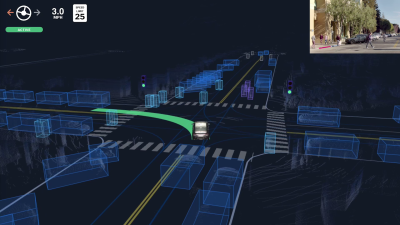
Aurora has been developing self-driving technology to handle real-world situations since its founding in 2017. Being able to master the challenges of a crowded city will be key to succeeding in the marketplace.
Getting rid of ATG certainly spells the end of Uber’s in-house autonomous driving effort, but it doesn’t mean they’re getting out of the game. Holding a stake in Aurora, Uber still stands to profit from early investment, and will retain access to the technology as it develops. At the same time, trading ATG off to an outside firm puts daylight between the rideshare company and any negative press from future testing incidents.
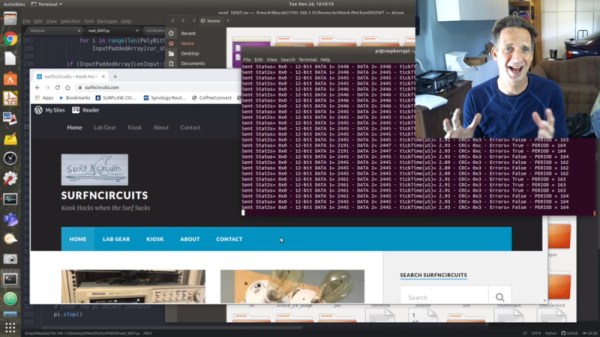
[Mark]’s initial attempts relied on Python and the RPI.GPIO library. Unfortunately, the overheads introduced made decoding SENT traffic impossible. Undeterred, [Mark] pressed on, leveraging the pigpio library and its callback function which allowed sampling at up to one microsecond. This was fast enough to read the messages from a LX3302A inductive position sensor that uses the protocol.
It’s a project that could prove useful for those trying to work with certain sensors who want to avoid adding complexity to a Raspberry Pi project. Files are available on Github for the curious. We’ve seen other direct sensor builds with the Pi, before too – like this power monitoring system. Video after the break.
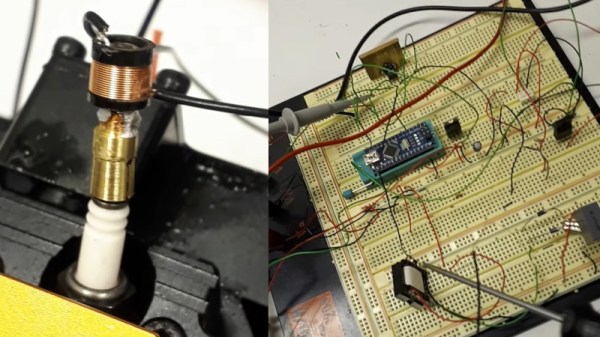
The spark plug was a key invention in the history of the internal combustion engine, allowing combustion to be easily controlled and engines to rev faster than messy earlier designs. Mid-century cars tended to rely on points ignition with a distributor and coil, however more modern designs place a coil on top of each individual spark plug. [Roger Moore] decided to build a similar setup for a small model engine on his workbench.
The rig is built with an Arduino, a flyback transformer, a smattering of MOSFETs and passives, an IGBT and a capacitor. The Arduino outputs PWM through a MOSFET which is stepped up through the transformer, and then charges the capacitor. The capacitor is then discharged into a coil mounted on top of the sparkplug of the single-cylinder engine, which fires the spark. The timing of the spark is determined by a Hall effect sensor reading a magnet placed on the flywheel.
Later development aims to shrink the system further to fit on a V10 design [Roger] is planning to make. It’s been done on a small scale before, and we’d love to see another tiny engine with way too many cylinders. Video after the break.
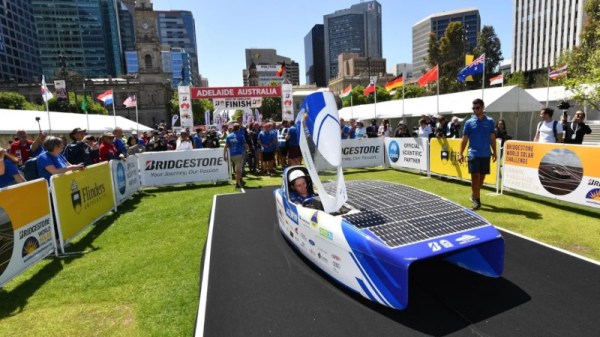
Solar power is a great source of renewable energy, but has always had its limitations. At best, there’s only 1,000 Watts/m2 available at the Earth’s surface on a sunny day, and the limited efficiency of solar panels cuts this down further. It’s such a low amount that solar panels on passenger cars have been limited to menial tasks such as battery tending and running low-power ventilation fans.
However, where some might see an impossibility, others see opportunity. The World Solar Challenge is a competition that has aimed to show the true potential of solar powered transport. Now 30 years since its inception, what used to be impossible is in fact achieved by multiple teams in under one tenth of the original time. To keep competitors on their toes, the rules have been evolving over time, always pushing the boundaries of what’s possible simply with sunlight. This isn’t mainstream transportation; this is an engineering challenge. How far can you go in a solar car?
At one end of the synthesizer world, there stands commercial instruments designed for the ultimate in sound quality and performance, tailored to the needs of professional musicians. On the other, there are weird, wacky prototypes and artistic builds that aim to challenge our conception of what a synth should be. The VOC-25 by [Love Hultén] falls firmly in the latter category.
The synth is built around the Axoloti Core, a microcontroller board set up for audio experimentation. Packing stereo DACs and ADCs, and MIDI input and output, it’s the perfect base for such a project. Loaded up with vocal samples, it’s played by a keyboard in a fairly typical sense. Where things get interesting is the panel containing 25 sets of plastic teeth. The teeth open and close when the user plays the corresponding note, thanks to a solenoid. Along with the clacking sound of the machinery and pearly whites themselves, it adds quite a creepy vibe to the piece.
With its clean pastel enclosure, we can imagine this piece as the star of an avant-garde filmclip, or merely something to terrify children at a Maker Faire. It’s a fun build, to be sure. We’ve seen some other great experimental synths over the years, too – this 48 Game Boy build comes to mind. Video after the break.
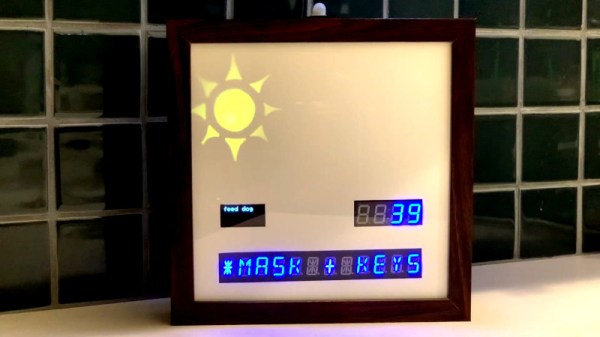
Smartphones are portals to an overwhelming torrent of information. Yes, they’re a great way to find out the time, your bus schedule, and the weather, but they’re also full of buzzers and bells going off every three minutes to remind you that your uncle has reposted a photo of the fish he caught ten years ago. Sometimes, it’s better to display just the essentials, and that’s what Weather Note does.
It’s built around the Adafruit Feather Huzzah, a devboard built around the venerable ESP8266. It’s a great base for an Internet of Things project like this one, with WiFi built-in and ready to go. The Weather Note talks to a variety of online platforms to scrape weather data and helpful reminders, with the assistance of If This Then That, or IFTTT. Reminders to walk the dog or get some milk are displayed on a small OLED screen, while there’s also a bunch of alphanumeric displays for other information. WS2812 LEDs are used behind a shadowbox to display weather conditions, with cute cloud, rain, and sun icons. It’s all wrapped up in a tidy frame perfect for the mantlepiece or breakfast table.
It’s a great build to learn about programming for the Internet of Things, and with those bright LED displays, it’s probably a viable nightlight too. It’s a rare project that can both tell you about the weather and keep you from stubbing your toe in the kitchen, after all. Those desiring a stealthier build should consider going down the smart mirror route instead. Video after the break.