Nerf Blaster Becomes Light Gun Controller

Traditional light guns rely on quirks of CRT technology, and thus don’t play well with modern LCD televisions and monitors. However, die hard retro gamers aren’t known for moving on from the classics, and have persevered to build new hardware to suit the games of old. In just this vein, [BrittLiv] grabbed some Nerf blasters, and built a pair of light guns that work with today’s hardware.

The build relies on Ultramarc’s light gun kits, which work in a similar way to the original Wiimote. A camera inside the blaster is used to triangulate an LED bar placed on top of the screen for clean and accurate tracking. [BrittLiv] combined the Ultramarc kit with some clever hacks to a Nerf DoubleStrike blaster, stealthily hiding the buttons inside to interface with the original trigger and cocking mechanism, as well as the locking tab in the rail.

There’s both a wired and wireless version, and the setup looks to be a great way to enjoy classics like Duck Hunt and Point Blank. The blasters work great with common platforms like MAME and RetroPi as the Ultramarc hardware emulates a standard USB mouse.

We’ve seen some wild light gun hacks before, like this build that uses cameras and maths to make things work without an LED bar at all! Video after the break.

Continue reading “Nerf Blaster Becomes Light Gun Controller”

Cryptic Calendar Makes For A Useful Wall Ornament

Hackers love a good clock build, but its longer term cousin, the calendar, is more seldom seen in the wild. Regardless, they can be just as useful and elegant a project, as this cryptic design from [Wolfspaw] demonstrates.

The project consists of a series of rotating wheels, displaying a series of arcane symbols. When the markings on the wheel align correctly with the viewing window, they display the date, month, and day of the week, respectively. The wheels themselves are fitted with 3D printed gear rings, which are turned by stepper motors under the control of an Arduino Nano. Hall effect sensors and magnets are used to keep everything appropriately aligned, while a DS3231 real time clock handles timekeeping duties.

It’s a tidy build, and we think the cryptic design adds a little mystery, making this an excellent conversation piece. The build is actually a remix of a project we’ve featured before, scaled and given a unique twist to suit [Wolfspaw]’s own personal aesthetic. Video after the break.

Continue reading “Cryptic Calendar Makes For A Useful Wall Ornament”

Animated Pumpkins Sing And Scare On Halloween

The animated video combined with the 3D-printed prop makes for an excellent effect.

Carving Jack O’ Lanterns out of pumpkins is a favorite Hallowe’en tradition for many, but relying on candles and knives is decidedly low-tech. [Lewis] of [DIY Machines] decided to whip up something a little more animated to scare the local trick-or-treaters instead.

The build consists of 3D printed pumpkins, lit from behind with a low-cost projector. Driven by a Raspberry Pi, the projector plays video files that project animated faces onto the pumpkins. The effect is great, giving the illusion of a real anthropomorphic Jack O’ Lantern sitting on your very porch. To control the system, a series of arcade buttons are hooked up to the Raspberry Pi allowing visitors to activate a song, a scare, or a story.

It’s a fun build that is a great way to add some interactivity to your Hallowe’en decorations. If you want to take your work up a notch, consider projecting on to your whole house. Video after the break.

Continue reading “Animated Pumpkins Sing And Scare On Halloween”

N64 Power Adapter Works Around The World

Modern electronics such as phone and laptop chargers are pretty versatile no matter where you find yourself in the world. Capable of running off anything from 100-250V, all you need is a socket adaptor and you’re good to go. Video game consoles of the 1990s weren’t so flexible however. [MattKC] was tired of messing around with step down transformers to run his US market N64, and decided to rectify this, building a universal adapter to run the console instead.

It’s a proper hacked build, assembled out of a jumble of old parts. An broken N64 power adapter was harvested for its case and unique DC plug, which carries 12V and 3.3V to the console. Few compact power supplies exist delivering this pair of voltages, so [MattKC] got creative. An old router was sourced for its 12V 2A supply, and was combined with a 3.3V buck converter to supply both rails. With some creative bodging and plenty of mounting tape, the supplies were crammed inside the original case and wired up to the original jack and a figure 8 cable, allowing easy socket changes in different countries without the use of ugly adapters.

While few of us routinely travel with 25 year old Nintendo consoles, for those that do, the convenience of a single universal supply can’t be overstated. Fitting a step-down transformer into carry-on luggage simply isn’t practical, after all. We’ve featured similar hacks as far back as 2006, or more recently, a project seeking to rebuild a new PSU for the venerable Amiga 500. Video after the break.

Continue reading “N64 Power Adapter Works Around The World”

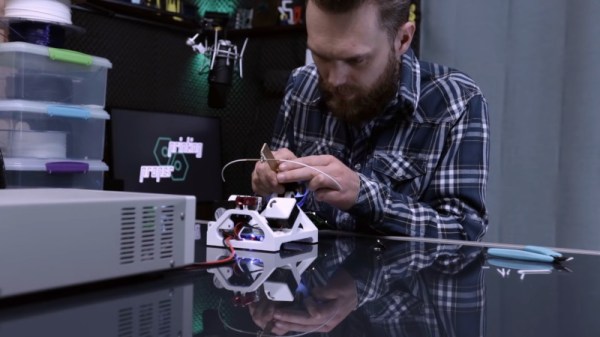
Optical Centrepunch Is An Easy Build If You Need One

Tired of getting his centerpunches thereabouts but not quite there, [Uri] decided something had to be done. A common tool to solve this problem is the optical centerpunch, but models on sale were just a little too pricy for something so basic. Instead, [Uri] elected to build his own.

An optical centerpunch is a simple tool that helps machinists hit a centerpunch dead on target, time after time. A guide is used that holds a clear plastic rod with a dot in the center. This dot is lined up over the spot to be centerpunched. The plastic rod is then removed and replaced with the actual punch that does the work. Not content to build something utilitarian, [Uri] instead sculpted the tool into a likeness of Sgt Pepper (of Yellow Submarine fame). Seeing the hunk of bare brass quickly become a recognisable figure on camera is a testament to [Uri’s] skill as a sculptor.

It’s a tool that can be readily built by anyone with a lathe, or, at the very least, a decent drill press. We imagine it would be particularly useful for those without perfect vision, making it easier to get punches on the mark on a regular basis. [Uri] has graced these pages before, too — he previously built an ornate tool to make all the other hammers jealous. Video after the break.

Continue reading “Optical Centrepunch Is An Easy Build If You Need One”

Tesla Begins “Full Self Driving” Public Beta As Waymo And Cruise Go Unattended

Self-driving technology is a holy grail that promises to forever change the way we interact with cars. Thus far, there’s been plenty of hype and excitement, but full vehicles that remove the driver from the equation have remained far off. Tesla have long posited themselves as a market leader in this area, with their Autopilot technology allowing some limited autonomy on select highways. However, in a recent announcement, they have heralded the arrival of a new “Full Self Driving” ability for select beta testers in their early access program.

Taking Things Up A Notch

Telsa’s update notes highlight the new “Full Self-Driving” capabilities. Drivers are expected to pay continuous attention and be prepared to take over at any time, as the system “may do the wrong thing at the worst time.”

The new software update further extends the capabilities of Tesla vehicles to drive semi-autonomously. Despite the boastful “Full Self Driving” moniker, or FSD for short, it’s still classified as a Level 2 driving automation system, which relies on human intervention as a backup. This means that the driver must be paying attention and ready to take over in an instant, at all times. Users are instructed to keep their hands on the wheel at all times, but predictably, videos have already surfaced of users ignoring this measure.

The major difference between FSD and the previous Autopilot software is the ability to navigate city streets. Formerly, Tesla vehicles were only able to self-drive on highways, where the more regular flow of traffic is easier to handle. City streets introduce far greater complexity, with hazards like parked cars, pedestrians, bicycles, and complicated intersections. Unlike others in the field, who are investing heavily in LIDAR technology, Tesla’s system relies entirely on cameras and radar to navigate the world around it. Continue reading “Tesla Begins “Full Self Driving” Public Beta As Waymo And Cruise Go Unattended”

Exoskeleton Muscles Powered By Hydrogen

The idea of building a suit that increases the wearer’s strength is a compelling one, often featured in science fiction. There are a handful of real world examples, and [Alex] can now add his to the list. The build comes with a twist however, relying on hydrogen to do the work.

At its heart, the build is not dissimilar to other artificial muscle projects. The muscles in [Alex’s] build consist of a rubber tube inside a nylon braid. When the rubber tube is inflated, it expands, causing the nylon braid to shorten as it grows wider. Commonly, such builds rely on compressed air to power the muscles, however [Alex] took a different path. Instead, water is electrolysed in a chamber designed to look like Iron Man’s arc reactor, with the resulting gases produced being used to drive the muscles. With five muscles ganged up to pull together, the wearable arm support is capable of generating up to 15 kg of pull force.

It’s a design that has a few benefits; the electrolyser has no moving parts, and is much simpler and quieter than a typical air compressor. Obviously, there is a risk of fire thanks to the flammable gases used, but [Alex] explains the precautions taken to minimise this risk in the video.

Exosuits may not be mainstream just yet, but that doesn’t mean people aren’t working to make them a reality. We’ve featured a few before, like this open-source design. Video after the break.

Continue reading “Exoskeleton Muscles Powered By Hydrogen”