In 2018, the Camp Fire devastated a huge swathe of California, claiming 85 lives and costing 16.65 billion dollars. Measured in terms of insured losses, it was the most expensive natural disaster of the year, and the 13th deadliest wildfire in recorded history.
The cause of the fire was determined to be a single failed component on an electrical transmission tower, causing a short circuit and throwing sparks into the dry brush below – with predictable results. The story behind the failure was the focus of a Twitter thread by [Tube Time] this week, who did an incredible job of illuminating the material evidence that shows how the disaster came to be, and how it could have been avoided.
Mismanagement and Money
The blame for the incident has been laid at the feet of Pacific Gas and Electric, or PG&E, who acquired the existing Caribou-Palermo transmission line when it purchased Great Western Power Company back in 1930. The line was originally built in 1921, making the transmission line 97 years old at the time of the disaster. Despite owning the line for almost a full century, much of the original hardware was not replaced in the entire period of PG&Es ownership. Virtually no records were created or kept, and hardware from the early 20th century was still in service on the line in 2018.
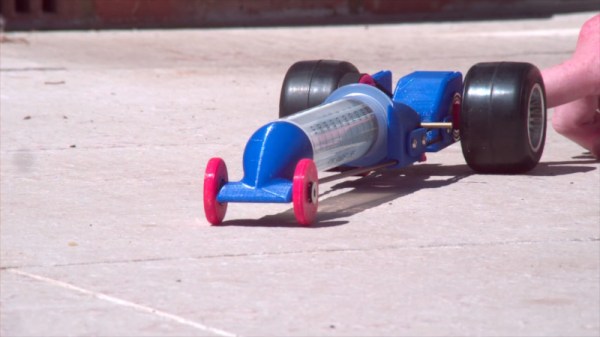
Atmospheric pressure is all around us, and capable of providing a great deal of force when used properly. As Otto Von Guericke demonstrated with his Magdeburg hemispheres over 350 years ago, simply removing air from a chamber to create a vacuum can have astounding results. More recently, [Tom Stanton] has used vacuum to power a small 3D-printed dragster.
In the dragster build, a typical plunger syringe is plugged at the end, and the plunger pulled back. Atmospheric pressure acts against the vacuum, wanting to push the plunger back towards its original position. To make use of this, a string is attached to the plunger, causing it to turn a gear as it moves forward, driving the rear wheels through a belt drive. With the correct gear ratio on the belt drive, the dragster is capable of spinning its tires and shooting forwards at a quick pace.
The work is a great follow on from [Tom]’s earlier vacuum experiments, using syringes as small rockets. It reminds us of the classic CO2 dragsters from high school competitions, and would be a great project for any science class. Video after the break.
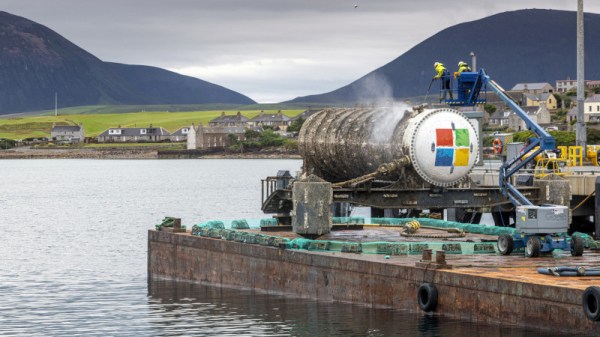
Back in 2018, Microsoft began Project Natick, deploying a custom-designed data center to the sea floor off the coast of Scotland. Aiming to determine whether the underwater environment would bring benefits to energy efficiency, reliability, and performance, the project was spawned during ThinkWeek in 2014, an event designed to share and explore unconventional ideas.
This week, Microsoft reported that the project had been a success. The Northern Isles data center was recently lifted from the ocean floor in a day-long operation, and teams swooped in to analyse the hardware, and the results coming out of the project are surprisingly impressive.
Since the widespread manufacture of plastics began in earnest in the early 1950s, plastic pollution in the environment has become a major global problem. Nowhere is this more evident than the Great Pacific Garbage Patch. A large ocean gyre that has become a swirling vortex full of slowly decaying plastic trash, it has become a primary target for ocean cleanup campaigns in recent years.
However, plastic just doesn’t magically appear in the middle of the ocean by magic. The vast majority of plastic in the ocean first passes through river systems around the globe. Thanks to new research, efforts are now beginning to turn to tackling the issue of plastic pollution before it gets out to the broader ocean, where it can be even harder to clean up. Continue reading “Targeting Rivers To Keep Plastic Pollution Out Of The Ocean”→
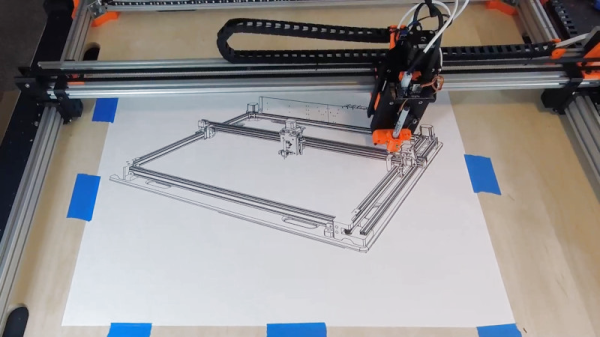
The CNC bug is a familiar ailment in these parts. Often, patients present with persistent obsession with computer controlled machinery, most commonly after initial contact with gateway hardware such as 3D printers or basic plotters. Once diagnosed, there is no cure – simply the desire to build, and build again. [Adam Haile] knows this all too well, and built the Cyberplotter in service to the affliction.
The Cyberplotter is the culmination of [Adam]’s CNC wishlist – a two-axis build with a seriously large build area, and the capability to mount a whole bunch of different tools for different jobs. With a work area of up to 800mm x 750mm depending on what’s mounted, it can produce some seriously big output. With a Smoothieboard 5X running the show, [Adam] does all kinds of neat hacks to make the system play with different gadgets on the business end. There’s a laser for engraving, and a top-notch pen plotter featuring a high-quality linear rail for precise movement. But the fun doesn’t stop there – [Adam] goes so far as mounting a Z-axis, camera, and even a Sharpie-based airbrush which we’d never even contemplated before.
It’s not [Adam]’s first build, and past experience shines through here – armed with prior knowledge, the build does many things well without compromising on outright capability. You may find [Adam]’s name familiar – we’ve featured his Engravinator on these pages before. Video after the break.
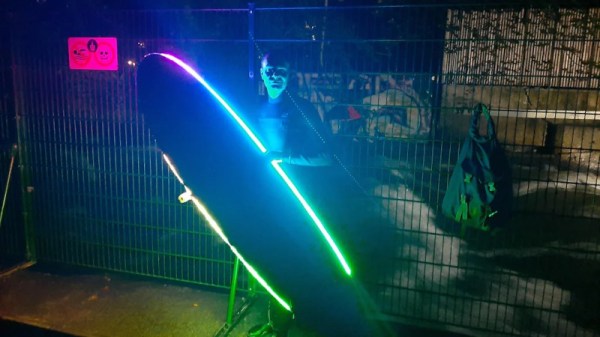
Surfing is an activity predominantly enjoyed during the day, primarily for reasons of warmth and water safety. Of course, if you prefer to carve the waves at night, you might enjoy the latest project from [Moritz Sivers] – a surfboard kitted out with motion-reactive LEDs.
The build consists of a regular surfboard, with a channel cut around the perimeter into which WS2812B LED strips are glued. Powered by a lithium rechargable battery, commands are given by an Arduino Nano hooked up to a MPU6050 3-axis gyroscope. This allows the Arduino to change the light patterns based on the movement of the board. Left and right turns, pumping the board, and surfing down a wave all come with their own animations.
Around the world, governments and city planners have long struggled with the issue of transport. Getting people where they need to be in a timely fashion is key to making a city a comfortable, attractive place to live. As far as public transport is concerned, this typically consists of buses on the roads, and trams and trains on rails.
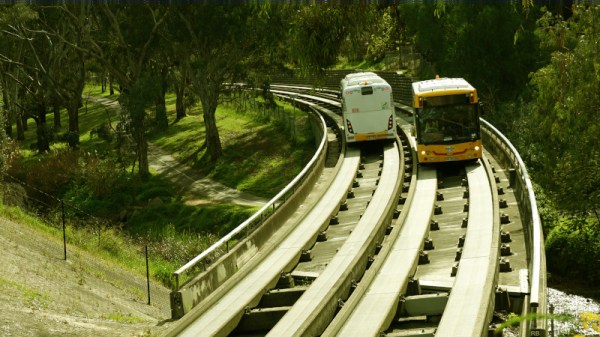
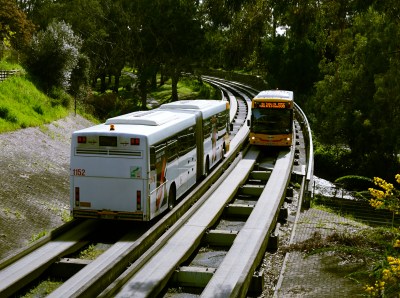
Down in the city of Adelaide, Australia, things get a little muddled, however. Nestled in a river valley lies a special transportation network known as the O-Bahn, where buses ride on concrete rails and the drivers can even take their hands off the wheel. The system remains a rarity worldwide, and was spawned by a perfect storm of conflicting requirements.
A Child of Circumstance
In the 1970s, the South Australian government found itself backed into a corner. Facing a booming population in the north-eastern suburbs, new transport links with greater capacity were needed to get people to the central business district. Original plans from the 1960s had called for more freeways to be built all over the city to solve the problem. In the face of stiff public opposition, legislation was passed in 1970 blocking the construction of any new freeways for a full decade, forcing the government to consider alternatives.
O-Bahn buses passing at speed near Stephens Terrace. Buses formerly reached speeds up to 100 km/h on the network; this was dropped to 85 km/h in 2012, adding 20 seconds to the average run. Credit: Lewin Day
Despite plans being shelved, a corridor of land stretching from the city to the north-east had already been acquired for freeway construction. This was retained, and studies were commissioned to determine the best transportation solution to suit the needs of the area. The “North East Adelaide Public Transport Review” suggested light-rail or a busway would be the best solution.
Initial plans were proposed to link the north-east with a light-rail tramway that would connect with the existing tramline from the city proper to Glenelg in the west. However, the City of Adelaide protested the plan, believing that extending the existing tramline to the east would damage the city’s carefully planned structure. Plans were made to rectify this by running part of the line underground, massively increasing costs, and the proposal was shelved.
It was at this time, the guided busway in Essen, Germany came to the attention of the state government. Aiming to help reduce congestion by allowing buses to share tram tunnels, it began as a demonstration which later developed into the Spurbus network. The system offered lower cost and higher flexibility than light rail, and avoided the need to carve up the city to hook in to the existing light rail network. Had Adelaide laid out its existing heavy or light rail networks differently, the O-Bahn might not have gotten a look in. However, back in the early 1980s, it was an easy solution in a sea of difficult choices.