An Easy Hack For Working With Your Hands On Video Calls

Video calls are okay. While some advocate for the benefit of body language over a standard phone call, they remain an imperfect substitute for in-person interaction. [Amos] wanted to be able to demonstrate things better when on a video chat, so devised this simple solution for when he’s working with his hands.

The hack consists of a mirror attached to a clothespeg with a flexible piece of wire. This simple device can then be clipped to the screen of a laptop, and the mirror adjusted to allow the webcam to view the user’s desk. By positioning it correctly, the user can both show their desk and their face together, in split screen. It’s a great way to explain something while giving viewers a clear shot of your face and your hands at the same time.

It’s not exactly complicated, but a nifty hack that could prove useful to anyone trying to teach without having to muck about with complicated digital handwriting setups or multiple webcams. There’s a shortage at the moment, anyway. If you’re looking for a way to chat with your less tech savvy relatives, consider repurposing an old Android tablet. Video after the break.

Continue reading “An Easy Hack For Working With Your Hands On Video Calls” →

How To Get Into Cars: Nat Atmo Engine Mods

While the car world is obsessed with everything boosted these days, many still yearn for the smooth power delivery and sonorous tone of a naturally aspirated engine. Of course, everyone still wants to go fast, so here’s how you go about getting more power out of your car without bolting on a big turbo or whining supercharger.

Intakes: This Can Get Pretty Invovled

A modified intake installed on a Honda S2000. Also referred to as “cold-air intakes”, they aim to suck in air at lower temperature which helps produce more power – hence the shield between the air filter and exhaust.

The intake is one of the first modifications made by many budding car enthusiasts. Throwing on a chromed intake pipe with a big pod filter was the mod to have back in the Fast and Furious era. Power gains can be had, though typically these are minor – on the order of 5-10 horsepower at most. It all depends on the car in question. A BMW M5 V10 was designed for high performance, with a highly advanced intake with individual throttle bodies from the factory. It’s unlikely any eBay parts are going to unlock horsepower that BMW’s engineers didn’t already find. Conversely, early Mazda Miatas are known to have a restrictive intake, largely due to the flap-type air flow meter. Replacing this with a freer-flowing setup has merit.

Continue reading “How To Get Into Cars: Nat Atmo Engine Mods” →

Quality Upgrades Give Old Synth New Lease On Life

Technology marches on at a rapid pace, but in many fields much love remains for older hardware. While still highly capable, there’s often room for improvement thanks to components made available in the intervening years. After longing for his SY-77 synthesiser of the 90s, [Mark] sourced a tired SY-99, the next model up in the line – and set to work on some upgrades.

The SY-99 relied on floppy disks for storage, but the mechanical drives are now difficult to maintain, to say nothing of the unreliability of floppy media. [Mark] installed a SD Card HXC floppy emulator instead, using a Sparkfun SD breakout to neatly install the card slot in the synth’s case. The tired LCD was replaced with a newer model using the same controller, with an LED backlight proving a nice upgrade over the original EL unit.

Additionally, [Mark] realised that there was scope to create his own upgrade modules with off-the-shelf SRAM chips. This proves far cheaper than sourcing second-hand Yamaha stock off eBay, and is readily achievable by anyone with a basic understanding of digital logic. The ICs can be had for a few dollars, versus well over $50 for the original cards – if you can even find them. Some labor is involved, but it’s a lot less painful to the wallet.

[Mark]’s work is a great example of how hardware that was once prohibitively expensive can be given greater functionality at a lower cost thanks to new technology. We’ve seen other synths modded too, like this Korg Monotron. If you’ve been tinkering away in a keyboard yourself, be sure to let us know!

[Thanks to CRJEEA] for the tip]

Floppy Drive Keyboard Is Inefficient Fun

Most of us are used to a typical 101-key setup for typing on our machines. Mobile and touchscreen devices have offered alternative interfaces over the years, but generally still sticking to QWERTY or other similar layouts. [foone] cares not for convention however, building a text-entry device based on the iconic floppy disk.

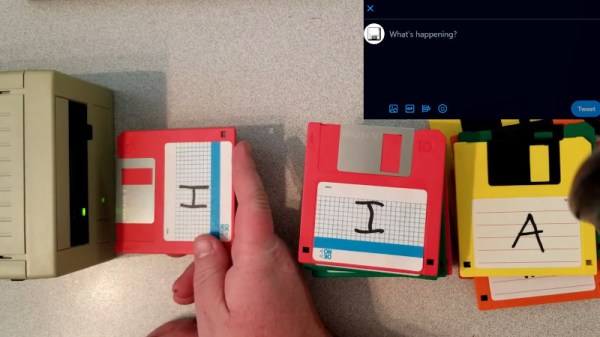
The build starts with a standard PC floppy drive, hooked up to an interface board to allow it to work over USB. It’s hooked up to a Raspberry Pi, which runs a Python program that listens out for media insertion events. When a new disk is detected, it reads the volume label, and sends it over to a Teensy LC which simulates a USB keyboard attached to the host PC. The setup uses 29 disks, for A-Z, !, shift, and space. It’s all stuffed inside a SCSI disk enclosure which helpfully provides a power supply along with the classic beige 90s aesthetic.

While you’re probably not going to be typing out your dissertation on this thing, it makes for an excellent conversation piece. We’ve featured some of [foone]’s eclectic work before, too. Video after the break.

Continue reading “Floppy Drive Keyboard Is Inefficient Fun” →

3D Printed Train Set Aims For Speed

For most involved in the hobby, model trains involve buying track from off-the-shelf suppliers, and lots of delicate painting and finishing. Conversely, [Ivan] just wanted to make something fast and fun, busting out the 3D printer in due course.

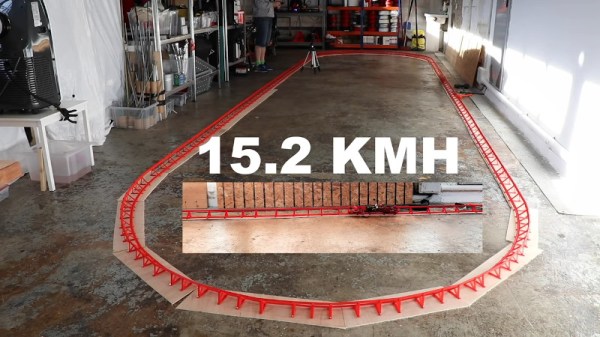
While the title of “World’s fastest toy train” is somewhat dubious, the build has its value as an interesting way of doing things. The train is 3D printed, with pressed-in ball bearings and metal shafts for the bogies. Differing from usual practice, this train carries its power supply on board, in the form of a LiPo battery. It’s hooked up to a brushless motor and controlled by a standard RC car setup.

The track is an impressive structure, consisting of 3D printed rails and supports.  These are assembled and then screwed down to plywood baseplates, which are hot glued to the flat concrete floor of [Ivan]’s workshop. Strings were used to align everything as straight and true as possible. The track features a steep banking which helps with cornering. However, the straights remain banked in an effort to avoid the complex modelling of a transition. This leads to some derailments at higher speeds on the flat sections.

While it’s not yet perfect, [Ivan] has done a great job of demonstrating a quick and easy way to build a model railway out of almost entirely 3D printed components. We can’t wait to see improvements to the rails and railcars, and hope to see speeds increase significantly in future tests. 3D printing tends to bring some interesting results to bear on the model train world, such as this vertical hanging setup. Video after the break.

Continue reading “3D Printed Train Set Aims For Speed” →

Neat And Tidy USB-C Conversions For Legacy Devices

USB-C has been on the market for a good few years now, and it’s finally starting to take over. Many new laptops only come with the newer port, making it difficult to use legacy USB-A devices. [Matt] doesn’t like mucking about with dongles and hubs, so set about converting some older hardware to the new standard. (Video, embedded below.)

[Matt] first set about hacking a Logitech wireless mouse dongle, peeling apart the original USB A connector to gain access to the PCB inside. A USB C breakout board is then sourced, and the relevant pins in the USB-C connector are soldered to the original USB-A connector pads. Unfortunately, the breakout board is configured as a host device, unsuitable for peripherals. Replacing a pull-up resistor with a pull-down on the VCONN and CC1 pins rectifies this. With the mod done, the mouse enumerates and is fully functional over USB-C. A little Sugru is then used to wrap everything up neatly.

[Matt] then progresses through several other similar mods to other hardware, sharing useful tips on how to make things as neat and useful as possible. It’s a tidy hack that could make your user experience with a new laptop much less painful. USB-C mods are becoming more common, and we’ve seen plenty done to soldering irons thanks to the Power Delivery spec.
Continue reading “Neat And Tidy USB-C Conversions For Legacy Devices” →

Making Art With Keycap Bots

Robots come in all shapes and sizes, from remote landers on distant planets to assembly arms working hard in auto plants. Of course, the definition is broad and can contain more frivolous entities, too. [smdavee]’s watercoloring ‘bots may not be particularly complex or sentient, but they’re a fun creative build.

The design is akin to that of the BristleBot, with a pager vibration motor allowing the ‘bot to wobble about on unsteady feet. In this case, a keyboard cap is used, with cottontips inserted in the base to act as legs. These are then dipped in watercolor paints, and the attached motor is then switched on to vibrate the ‘bot around the page.

It’s an easy build, and one that would be particularly well-suited to teaching young children basic electronic concepts. Plus, there’s the added fun of getting to make a mess with watercolors, too. If you’ve got a fun art robot hiding away in your garage, be sure to let us know. Video after the break.

Continue reading “Making Art With Keycap Bots” →