Telco Curio Hacked Into Simple Counter

The tikkenteller was a device used to measure the duration of telephone use. 70 Volts were sent down the telephone line at 50Hz to run an electromechanical counter, and the devices were often used in communal areas where several users shared a single phone. [Charles Babbadge] decided to repurpose the stout 1950s hardware into a simple counter.

The build uses an ATtiny13 to generate pulses for the original hardware, when receiving inputs from the tikkenteller’s buttons. A solid state relay is triggered by the microcontroller, which connects the original solenoid to mains power to jog the counter. An HLK-PM01 5V power supply is used to run the micro, allowing the entire project to run off a single mains supply.

It’s a big, heavy, beautiful hunk of metal, built in a style that we simply don’t see anymore. It’s in no way the cheapest or most efficient counter you could build, but it’s got a charm you can’t find on more modern hardware. You could use such a device to track your Youtube subs, that is… if the API hadn’t broken that for everyone. Video after the break.


Continue reading “Telco Curio Hacked Into Simple Counter” →

Nintendo Switch Gets A Stylish Dock In A Broken NES

The Switch is Nintendo’s latest home console, which has forever blurred the line between handhelds and consoles you plug in to your TV. It does both! Typically, hooking up to a screen is done through the dock, but that wasn’t quite cool enough for [sturm]. He took a NES and turned it into a tidy Switch dock instead!

The build starts with an original NES shell, which is gutted of its original hardware. The PCB from the original dock is installed, and a slot cut in the top of the NES to allow the Switch to be inserted. Naturally, there’s a spring flap reminiscent of the Super NES to keep the dock looking clean when not in use. When it is installed, a series of cables and bezels break out the USB ports to the original controller ports on the NES.

It’s a tidy build that brings a touch of nostalgia to the modern console. We’re sure an official version would sell like hotcakes, too. There’s plenty of similarly inspired builds for the Switch, with the Gamecube Joycons a particular highlight!

Continue reading “Nintendo Switch Gets A Stylish Dock In A Broken NES” →

Herb Garden Is Smarter Than The Average… Garden

After 13 days, the herbs are showing good signs of growth.

Herbs are a great way to spice up any dish. Often they don’t need much, meaning that it’s possible to grow a useful amount in a fairly compact area. [Sunyecz22] wanted to do just that, so built a convenient indoor herb garden, giving it some smarts along the way.

The project is built around an Arduino Mega, a venerable stalwart of the scene that comes in handy on projects requiring plenty of digital I/O. It’s paired with four soil moisture sensors, one per planter pot to keep an eye on water levels. The system also controls LEDs which provide light based on the time of day to help the herbs grow. Finally, a tidy 3D printed enclosure gives the project a neat, finished look.

It’s a build that’s a straightforward way to get into automatic plant maintenance, and leaves plenty of scope for future work. With the capable Arduino Mega on hand, it would be a cinch to upgrade to automatic watering down the track. We’ve seen similar builds before, too. Video after the break.

Continue reading “Herb Garden Is Smarter Than The Average… Garden” →

Lasercut Puzzlebox Is Safe-Cracking Fun

If you head out into the real world and start twiddling knobs on random safes, you might find yourself being hauled away by uniformed police. A safer pastime might be playing with your own puzzlebox at home, which is precisely what [thediylife] has done with this build.

The design implements a basic safe-cracking game, in which players try to guess the combination to the safe in a series of rounds. Input is via a rotary encoder, hooked up to the Arduino Uno inside. This project really wins because the finish looks so amazing. The safe is constructed out of 3mm MDF, which is lasercut to shape — an easy one to whip up in the average makerspace. The interface is fleshed out with a small OLED screen and some LEDs, while a servo acts as the lock which holds the door shut. When you see the underside of the face plate with components hot glued into holes you’ll really pale at how clean the business side ended up.

It’s a simple build, and one that would make a great party game with a prize hidden inside. We’ve seen other puzzle-box builds before, too — like the GPS-based reverse geocache build. Video after the break.

Continue reading “Lasercut Puzzlebox Is Safe-Cracking Fun” →

Adding MIDI To An Old Casio Keyboard

Not content to rule the world of digital watches, Casio also dominated the home musical keyboard market in decades past. If you wanted an instrument to make noises that sounded approximately nothing like what they were supposed to be, you couldn’t go past a Casio. [Marwan] had just such a keyboard, and wanted to use it with their PC, but the low-end instrumented lacked MIDI. Of course, such functionality is but a simple hack away.

The hack involved opening up the instrument and wiring the original keyboard matrix to the digital inputs of an Arduino Uno. The keys are read as a simple multiplexed array, and with a little work, [Marwan] had the scheme figured out. With the Arduino now capable of detecting keypresses, [Marwan] whipped up some code to turn this into relevant MIDI data. Then, it was simply a case of reprogramming the Arduino Uno’s ATMega 16U2 USB interface chip to act as a USB-MIDI device, and the hack was complete.

Now, featuring a USB-MIDI interface, it’s easy to use the keyboard to play virtual instruments on any modern PC DAW. As it’s a popular standard, it should work with most tablets and smartphones too, if you’re that way inclined. Of course, if you’re more into modular synthesizers, you might want to think about working with CV instead!

More Terrible Keyboards That Nonetheless Work

For most of computing history, keyboards have featured at least one key per letter one may wish to type – as far as the Latin alphabet goes, anyway. Mobile phones of the 90s and 2000s showed us that basic typing could be accomplished with less. [foone], however, likes to go way out into left field when designing text entry methods, and post them up on Twitter.

The most elegant, in our opinion, is this binary-based design. 7 flip switches are used to set the binary value of the key you wish to press, at which point hitting the button will send the keypress. It’s painfully slow for just about anything except backspace – set all the switches on for keycode 127, and mash away.

This breadboard design is an excercise in frustration. A keycode is randomly generated approximately once every second. Press the button if this keycode is the one you wish to send. Reportedly, it took ten minutes to type “Hello!”. An analog dial design speeds things up a little, but not by much.

While these may not be useful, they’re fun experiments which we could imagine making an excellent contest at a future hacker con. If you’re a big fan of the esoteric and insane when it comes to input devices, consider this typewriter simulation design.


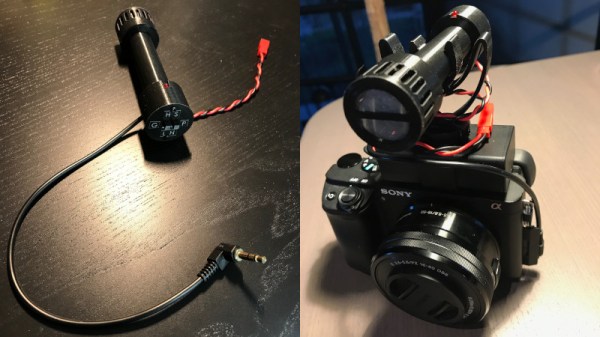
Building A Custom Camera Mic

Most consumer-grade cameras these days come with adequate microphones built in. However, as with all hardware made down to a price point, there’s room for improvement. [M. Ploegmakers] decided to whip up a better microphone setup for his Sony A6300, with the Dumbbell Mic as the result.

The microphone is based around an electret condensor element, which provides good performance at a remarkably low price. This is then integrated with a preamp circuit to bring the audio up to the appropriate level for the camera to record along with the video. Switches on board set the gain level, as well as changing the mic to operate with or without phantom power, where available.  The electronics is wrapped up in a 3D-printed enclosure, designed to mount on top of the camera for use out in the field.

It took some experimentation, but now [M. Ploegmakers] has a custom mic rig that records straight into the camera, avoiding the need to splice audio and video back together in post. If your camera lacks an audio input, you might have to do a little more work to hack one in, though!