Using Additives For Better Performing Epoxy

Epoxy resins are an important material in many fields. Used on their own as an adhesive, used as a coating, or used in concert with fiber materials to make composites, their high strength and light weight makes them useful in many applications. [Tech Ingredients] decided to explore how combining basic epoxy resin with various additives can make it perform better in different roles.

The video primarily concerns itself with explaining different common additives to epoxy resin mixtures, and how they impact its performance. Adding wood flour is a great way to thicken epoxy, allowing it to form a bead when joining two surfaces. Microbeads are great to add if you’re looking to create a sandable filler. Other additive like metal powders lend the mixture resistance to degradation from UV light, while adding dendritic copper creates a final product with high thermal conductivity.

The video does a great job of not only explaining the additives and their applications, but also shares a few handy tips on best workshop practices. Things like triple-gloving and observing proper mixing order can make a big difference to your workflow and lead to better results.

We’ve seen practical applications of epoxy mixes before – with epoxy granite being a particularly popular material. Video after the break.

Continue reading “Using Additives For Better Performing Epoxy” →

Patterned Plywood Makes For Attractive Speakers

In the matter of audio, we’re well past the reign of the home hi-fi and the boombox. If you’re not listening on headphones or directly on your phone, you’ve got a brick-sized Bluetooth speaker pumping out the tunes. Still a fan of the old-school, [Amanda Ghassaei] built some bookshelf speakers with a hip aesthetic.

First, the speaker enclosures were designed in WinISD, a software package specifically made for the task. For given woofers and tweeters, it helps get the enclosure and port sizes in the correct range for good sound. Panels were then fabricated out of plywood to make the enclosures. The plywood was cut and reformed several times to make the panels, using the pattern from the multiple plies to create the zig-zag look. Audio wise, a class D amplifier takes in line-level signals, before pumping them out to a woofer and tweeter through a custom designed crossover network.

It’s a tidy build, and we’d love to experiment ourselves with the fancy patterned plywood technique. Getting your enclosure design right can make a big difference to sound quality, as we’ve seen before. Video after the break.

Continue reading “Patterned Plywood Makes For Attractive Speakers” →

3D Printed Parts Keep Respirators Operational During COVID-19 Epidemic

COVID-19 can seem like a paper tiger, when looking at bare mortality rates. The far greater problem is the increase in fatalities as health systems are stretched to the limit. With thousands of patients presenting all at once, hospitals quickly run out of beds and resources and suddenly, normally survivable conditions become life threatening. One Italian hospital found themselves in such a position, running out of valves for a critical respirator device needed to save their patients. Supplies were running out – but additive manufacturing was able to save the day.

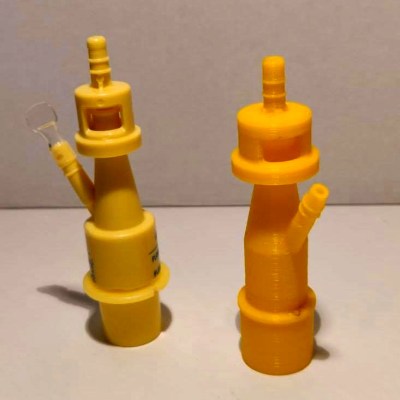
The original part, left, with its 3D-printed replacement.

While the article uses the term “reanimation device”, it’s clear we’re talking about respirators here, necessary to keep patients alive during respiratory distress. The valve in question is a plastic part, one which likely needs to be changed over when the device is used with each individual patient to provide a sterile flow of air. After the alarm was raised by Nunzia Vallini, a local journalist, a ring around of the 3D printing community led to a machine being sent down to the hospital and the parts being reproduced. Once proven to work, things were stepped up, with another company stepping in to produce the parts in quantity with a high-quality laser fusion printer.

It’s a great example of 3D printers being used to produce actual useful parts, and of the community coming together to do vital lifesaving work. We’ve seen the technology come in clutch in the medical field before, too. Stay safe out there, and live to hack another day.

Thanks to [Jarno Burger], [LuigiBrotha], and [Michael Hartmann] for the tips!

LED Shirt Does It With Tulle

Given that we are living in what most of humanity would now call “the future”, we really ought to start acting like it. We’re doing okay on the electric cars, but sartorially we’ve got some ground to make up. Helping with this effort is [Amy Goodchild], who put together a fancy LED shirt for all occasions.

The basis of the shirt is an ESP8266 running the FastLED library, hooked up to strings of WS2812B LEDs. It’s a great combination for doing quick and simple colorful animations without a lot of fuss. The LED strips are then fastened to the shirt by sewing them on, with heatshrink added to the strips to give the thread something to attach to. Tulle fabric is used as a diffuser, hiding the strips when they’re off and providing a more pleasant glowing effect. Everything is controlled from a small box, fitted with an arcade button and 7-segment display.

It’s a fun piece that’s readily achievable for the novice maker, and a great way to learn about LEDs and sewing. We’ve seen other similar builds before, such as this glowing LED skirt. Video after the break.

Continue reading “LED Shirt Does It With Tulle” →

Build Your Own Mouse For High Performance

For the dedicated gamer or hardcore computer user, there’s plenty of options for high-end input peripherals. We’ve seen plenty of makers build their own bespoke keyboards, too. Less commonly seen are custom mice, but [gipetto TranquilTempest] has crafted just such a device to suit their tastes.

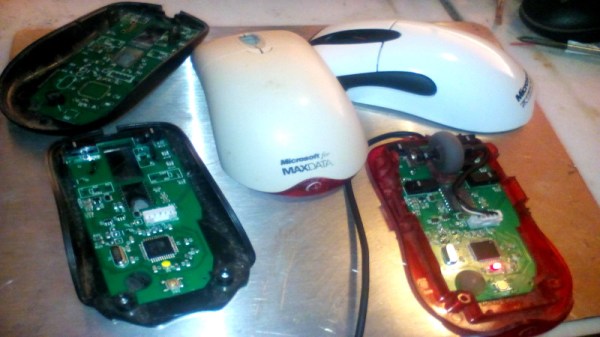
The mouse is based on the PMW3360 sensor, prized for its 250 inch per second speed and 50g acceleration capability. Buttons are read by an ATMEGA32U4 which handles hardware debouncing for improved control. Anyone that’s accidentally double-clicked all their villagers in AOE II can appreciate this feature. There’s also specialised code to read the wheel encoder from [Ben Buxton] which helps avoids backscrolling.

The PCB was ordered from JLCPCB using their assembly service, which comes in handy for makers who want to build advanced designs without messing around with reflow. It’s designed to fit inside Microsoft mouse shells popular in years past – like the Wheel Mouse Optical and the Intellimouse 1.3.

Building your own mouse from the ground up is a great way to get yourself an input device that perfectly serves your needs. We’ve seen others work in the field, with custom trackballs and breakout boards for sensors. If you’ve got your own cutting edge build, be sure to let us know!

Vocal Effects On The Arduino Uno

When one thinks of audio processing, the mind doesn’t usually leap to an 8-bit micro. Despite this, if you’re looking for some glitchy fun, it’s more than possible, as [Amanda Ghassaei] demonstrates with the Arduino Uno in this 2012 throwback project.

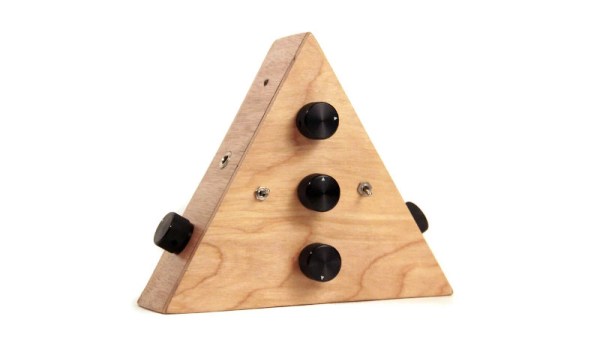
The build is designed for vocal effects, based on the idea of granular synthesis. This is where audio samples are chopped up into small chunks, called “grains”, and manipulated in various ways to make fun sounds. Controls on the box allow the nature of the sound created to be modified by the user.

[Amanda]’s project serves as a great example of what it takes to run audio processing on the Arduino Uno. There’s a guide to using the on-board ADC as a microphone input, as well as the construction of a resistor ladder DAC for output. As a neccessity, this also requires discussion of how to write directly to the ATMEGA’s IO ports, rather than using the slower digitalWrite() function typically used in Arduino projects. There’s plenty of value here for anyone learning to do audio on a microcontroller platform.

Overall, it’s a fun project that serves as a good primer for those keen to dive into digital sound processing. Of course, those looking to kick things up a gear would do well to check out the Teensy Audio Library, too. Video after the break.

Continue reading “Vocal Effects On The Arduino Uno” →

There Really Was A Sewing Machine Controlled By A Game Boy

These days, high-quality displays and powerful microcontrollers are cheap and plentiful. That wasn’t the case a couple of decades ago, and so engineers sometimes had to get creative. The result of this is products like the Jaguar nu.yell sewing machine, as covered by [Kelsey Lewin].

The later nuotto model was capable of more advanced embroidery patterns. A Mario character cartridge was sold, while a later Kirby edition was scrapped before release.

The Japanese market product eschewed the typical mechanical controls of the era, to instead interface with a Nintendo Game Boy. The sewing machine would hook up to the handheld console via the Link Port, while the user ran a special cartridge containing the control software. This would allow the user to select different stitch types, or embroider letters. Very much a product of its time, the nu yell mimics the then-cutting edge industrial design of the first-generation Apple iMac. The technology was later licensed to Singer, who brought it to the US under the name IZEK. Sales were poor, and the later Jaguar nuotto didn’t get a similar rebranding stateside.

Back in the late 90s, the Game Boy was likely an attractive package to engineers. Packing a Z80 processor, buttons, and a screen, it could act as a simple human interface in lieu of designing one from the ground up.  Aprilia even used them to diagnose motorbike ECUs, and we’ve seen Game Boy parts used in medical hardware from the era, too. Video after the break.

Continue reading “There Really Was A Sewing Machine Controlled By A Game Boy” →