Cordless Drill Sprouts Wings And Takes Flight

Brushless motors and lithium batteries were a revolution for remote control aircraft. No longer would nitro engines rule the roost, as flying became far cheaper and more accessible almost overnight. The same technology has also found its way into power tools, leading to [Peter Sripol] deciding to build a powerdrill into a flying aircraft in this video, embedded below.

An unmodified DeWalt drill is the heart of the build, serving as the propulsion unit of the craft. A servo is used to actuate the drill’s trigger to serve as the throttle. As power drills are geared down significantly compared to a typical hobby brushless motor, it was necessary to use a much larger prop than would be usual. This was custom machined out of wood with the help of [William Osman], and despite some mishaps, came out (mostly) in one piece. The airframe consists of foam wings with poplar spars, and an aluminium extrusion serves as the tail boom. A few 3D printed parts then tie everything together.

Despite the weight of the drill, the hacked-together craft is able to fly quite easily. The large wings and propeller help to make up for the shortcomings of the powertrain. Unfortunately, there wasn’t quite enough surplus lift to carry a payload of smartphones to capture in-flight footage, but overall the project could be considered a resounding success.

We’ve seen [Peter]’s work before, too – sometimes even putting himself in the pilots seat! Video after the break.

Continue reading “Cordless Drill Sprouts Wings And Takes Flight” →
A DIY Bench-Sized Milling Machine

Hanging around the machining community online, you’d be more than familiar with clapped out Bridgeport mills, which are practically a meme at this point. But mills come in all shapes and sizes, from the stout old iron from the days of yore, to smaller, compact builds. [Honus] decided to build the latter, and shared the details of the project.

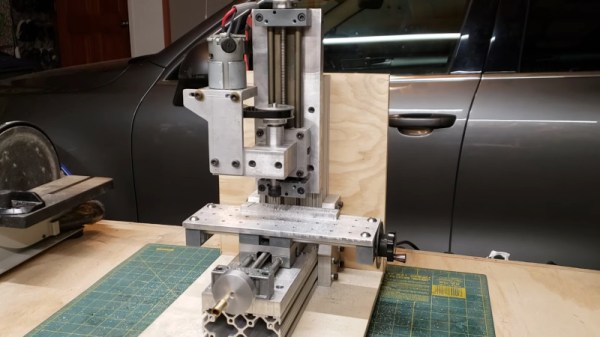
The aim of [Honus’s] build is to create a small benchtop mill, capable of handling the smaller tasks. The frame of the mill is built out of 80/20 extrusion, with plenty of aluminium plate to go along with it. Igus linear slides handle the X, Y and Z axes. An old brushed Makita drill motor serves as the spindle drive, controlled by an old R/C speed controller hooked up to an Arduino. [Honus] then fabbed up various bits and pieces as neccessary to bring it all together.

The mill is neat and tidy, and looks to do a good job machining aluminium. We imagine it should prove highly useful in [Honus’s] workshop. If you’re contemplating getting yourself some desk-sized tools, perhaps consider an engraver as well! Video after the break.

Continue reading “A DIY Bench-Sized Milling Machine” →

Hacking Pixmob Bands And Finding A Toolchain

The Pixmob band is an LED wrist strap, of the type often used at big concerts or other public events. Many have tinkered with the device, but as of yet, nobody was running custom code. It wouldn’t be easy, but [JinGen Lim] got down to work.

The wristbands are given out to concertgoers to create synchronized light shows in the crowd.

A teardown of a 2016 device revealed it consisted of an RGB LED, an IR sensor, a small EEPROM and a coin cell, which were all common parts. Unfortunately, the ABOV MC81F4204 microcontroller was a little more obscure. It’s a part that’s quite hard to find, and uses a proprietary programmer and an ancient IDE.

Searches online proved fruitless, and a working programmer remained outside [JinGen]’s grasp. Undeterred, he decided to simply walk into the company’s Korean headquarters and ask for help. As the part was end-of-life, they were unable to supply a programming device, but happily provided documentation for the chip that wasn’t publicly available. With this in hand, it was possible for [JinGen] to build his own programmer instead.

Booting up a copy of the ABOV IDE, with his newly-built programmer in hand, it was relatively easy to get the chip running custom code. Going the extra mile, [JinGen] even hacked the Arduino IDE to be partially compatible with the platform! A silicon error in the MC81F4204 design bricks the chips after only a few flash rewrites, so its never going to be the most useful platform, but it works nonetheless.

The Pixmob hardware has continued to evolve, and it’s unlikely modern units still use the same chip. Despite this, it’s a great example of what can be achieved by a little sleuthing and asking the right people the right questions. Others have attempted to hack similar products before, found at Disneyland and Coldplay concerts. You won’t catch this author at either, but if you’ve hacked something similar, be sure to reach out on the tip line!

This Dry-Ice Powered Fog Machine Is Perfect For Halloween

The leaves are turning brown, and the spookier season is upon us. If you’re currently working up plans for a top-notch Halloween party, you would do well to consider building a fog machine like this unit from [DIY Machines]!

This fog machine is based around dry ice, so you’ll need to source that from an external supplier. The machine consists of a closed container filled with hot water, inside which is a movable bucket filled with dry ice. By lowering the dry ice into the water, fog is produced.

An Arduino is used to control the bucket, allowing the amount of fog produced to be controlled with a smartphone app. There are also controllable LEDs built in to give the fog a suitably eerie glow. The build relies on a series of 3D printed parts for the mechanism, and features several different nozzle designs for achieving different effects, such as a rising geyser or a thick low-lying fog.

The basic concepts are simple and it’s a build anyone could knock out in a weekend with a 3D printer and an Amazon account. It’s a great way to add to the ambience of Halloween, but of course, that’s not all fog can do. Video after the break.

Continue reading “This Dry-Ice Powered Fog Machine Is Perfect For Halloween” →

Shapeshifter – An Open Source Drum Machine

With microcontrollers growing ever more powerful each new generation, things that were mere pipedreams before are now readily possible. The Shapeshifter drum machine is a perfect example.

Shapeshifter’s design is open-source, with everything available on Github for the curious musical tinkerers out there. The device is built around a PCB with only through-hole components, making assembly easy for even the least experienced enthusiasts out there. A Teensy 3.6 is then slotted into the socket on the board, providing 180MHz of grunt to run the show. It’s an excellent choice, as the Teensy platform has a huge range of libraries which make it simple to work with audio.

Being open-source, not only is it a cinch to make your own, but there’s plenty of room to remix the design to your personal tastes. There’s even a breadboarding area and the capability to add an expansion card for even more possibilities. Some users have even gone so far as to add displays and filter mods to really open things up.

We love a good drum machine at Hackaday, from the Amstrad-based to pocket-sized wonders. If you’ve got a build of your own, be sure to drop it in the tips line.

Tearing Down IKEA’S Sonos Speaker

There’s little better way to learn about a piece of electronics than by tearing it down. Taking a peek under the hood can reveal all manner of things about a device’s design, manufacturing, and origins. [This Does Not Compute] does a great job of doing just that, digging into the guts of IKEA’s Symfonisk speaker.

Symfonisk is a WiFi-enabled speaker, working with the Sonos ecosystem. Tearing down the device reveals some similarities to IKEA’s earlier Eneby speaker, with both devices sharing similar speaker drivers, apparently sourced from GGEC. However, upon digging deeper, it’s revealed that the Symfonisk has more in common with a speaker from another manufacturer entirely.

The video does a great job of not only investigating the manufacturing origins of the device, but breaking down the way it all works. This shows how the speaker relies on an Atheros WiFi-only chipset, thus explaining the lack of Bluetooth functionality, as well as discussing things like the neat solutions for cable management. Interestingly, the speaker uses a two-channel DAC and Class-D amplifier, but only operates in mono. Instead, the two channels are instead used to separately drive the tweeter and woofer, allowing EQ to be done in software on the main CPU, negating the need for analog crossover electronics.

It’s a teardown that would serve as a great primer for anyone considering building a piece of consumer electronics, but particularly those involved in the hi-fi space. To see how it was done way back when, perhaps try this 8-track teardown instead. Video after the break.

Continue reading “Tearing Down IKEA’S Sonos Speaker” →

Portrait Painter Turns G-Code Into Artworks

Portrait painting is, by and large, a human endeavour. But, like any and all skills, there are machines ready and willing to take a crack at it. [Jose Salatino] has built just such a machine, and the results are impressive.

Samples of the artwork created by [Jose’s] portrait painter.
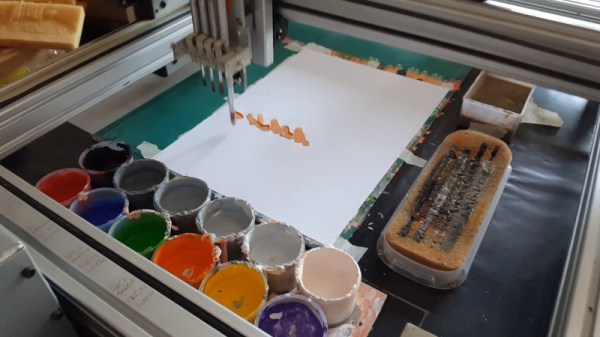
[Jose’s] portrait painter relies on a Cartesian CNC setup, with an X-Y gantry fitted with a retractable brush carrier. The carrier holds four brushes, allowing the device to paint with different sized strokes as per the artistic requirements. An algorithm is used to turn images into a series of brushstrokes, which are then turned into G-code to drive the system. Colors are mixed just like a human painter would, with the brush dipping into a series of paint pots. Using the hue-saturation-brightness (HSB) color system makes this easy.

While it’s much slower than your average printer, the goal here isn’t to create photorealistic images, but to create something with artistic appeal. The artworks painted by the ‘bot have a remarkable likeness to oil paintings by human artists, thanks to using similar techniques. We’re sure [Jose’s] experience as an oil painter helped out here, too.

We’ve seen other ‘bots produce custom artworks before, too. Video after the break.

Continue reading “Portrait Painter Turns G-Code Into Artworks” →