When we talk about HDTV, we’re typically talking about any one of a number of standards from when television made the paradigm switch from analog to digital transmission. At the dawn of the new millenium, high-definition TV was a step-change for the medium, perhaps the biggest leap forward since color transmissions began in the middle of the 20th century.
However, a higher-resolution television format did indeed exist well before the TV world went digital. Over in Japan, television engineers had developed an analog HD format that promised quality far beyond regular old NTSC and PAL transmissions. All this, decades before flat screens and digital TV were ever seen in consumer households!
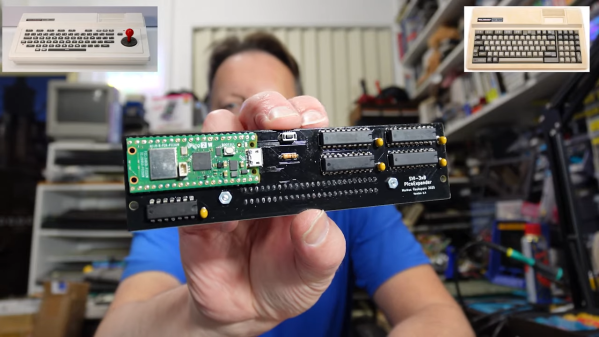
Spectravideo is not exactly the most well-known microcomputer company, but they were nevertheless somewhat active in the US market from 1981 to 1988. Their computers still have a fanbase of users and modders. Now, as demonstrated by [electricadventures], you can actually upgrade your ancient Spectravideo machine with some modern hardware.
The upgrade in question is the SVI-3×8 PicoExpander from [fitch]. It’s based on a Raspberry Pi Pico 2W, and is built to work with the Spectravideo 318 and 328 machines. If you’re running a 328, it will offer a full 96kB of additional RAM, while if you’re running a 318, it will add 144 kB more RAM and effectively push the device up to 328 spec. It’s also capable of emulating a pair of disk drives or a cassette drive, with saving and loading images possible over Wi-Fi.
It’s worth noting, though, that the PicoExpander pushes the Pico 2W well beyond design limits, overclocking it to 300 MHz (versus the original 150 MHz clock speed). The makers note it is “bleeding edge” hardware and that it may not last as long as the Spectravideo machines themselves.
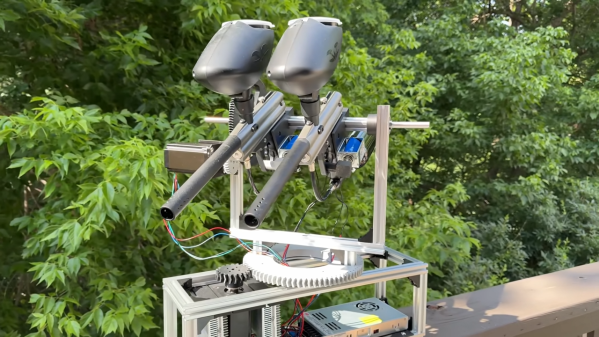
Video games, movies, and modern militaries are all full of robotic gun turrets that allow for remotely-controlled carnage. [Paul Junkin] decided to build his own, albeit in a less-destructive paint-hurling fashion.
The turret sits upon a lazy susan bearing mounted atop a aluminium extrusion frame. A large gear is mounted to the bearing allowing the turret to pan when driven by a stepper motor. A pair of pillow block bearings hold a horizontal shaft which mounts the two paint markers, which again is controlled by another stepper motor to move in the tilt axis. An ESP32 microcontroller is responsible for running the show, panning and tilting the platform by commanding the large stepper motors. Firing the paintball markers is achieved with solenoids mounted to the triggers, which cycle fast enough to make the semi-auto markers fire in a way that almost feels like full-auto. Commanding the turret is via an Xbox One controller; communicating with the ESP32 over Bluetooth using the BluePad32 library.
It’s worth noting you shouldn’t shoot paintballs at unsuspecting individuals, since they can do extreme amounts of damage to those not wearing the proper protection. We’ve featured a great many other sentry guns over the years, too, like this impressive Portal-themed build. Video after the break.
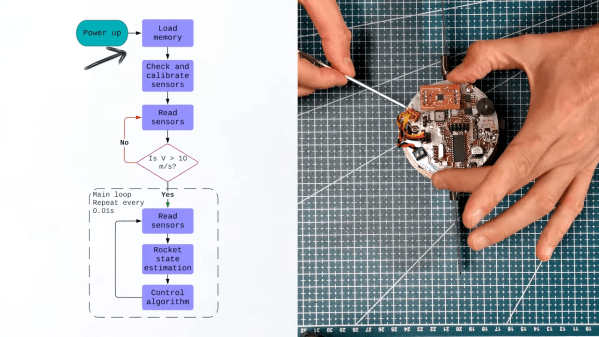
The vast majority of model rockets go vaguely up and float vaguely downwards without a lot of control. However, [newaysfactory] built a few rockets that were altogether more precise in their flight, thanks to his efforts to master active roll control.
[newaysfactory] started this work a long time ago, well before Arduinos, ESP32s, and other highly capable microcontroller platforms were on the market. In an era when you had to very much roll your own gear from the ground up, he whipped up a rocket control system based around a Microchip PIC18F2553. He paired it with a L3G4200D gyro, an MPXH6115A barometer, and an MMA2202KEG accelerometer, chosen for its ability to provide useful readings under high G acceleration. He then explains how these sensor outputs were knitted together to keep a rocket flying straight and true under active control.
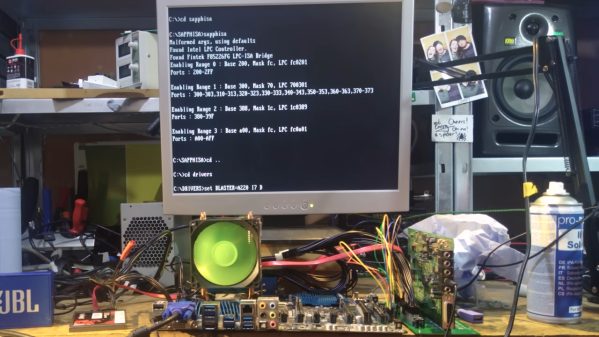
Believe it or not, some post-2010 PC hardware can still do ISA, it’s just that the slots aren’t broken out or populated on consumer hardware. However, if you know where to look, you can hack in an ISA hookup to get your old hardware going. [TheRasteri] achieves this on motherboards that have the LPC bus accessible, with the use of a custom PCB featuring the Fintek F85226 LPC-to-ISA bridge. This allows installing old ISA cards into a much more modern PC, with [TheRasteri] noting that DMA is fully functional with this setup—important for some applications. Testing thus far has involved a Socket 755 motherboard and a Socket 1155 motherboard, and [TheRasteri] believes this technique could work on newer hardware too as long as legacy BIOS or CSM is available.
It’s edge case stuff, as few of us are trying to run Hercules graphics cards on Windows 11 machines or anything like that. But if you’re a legacy hardware nut, and you want to see what can be done, you might like to check out [TheRasteri’s] work over on Github. Video after the break.
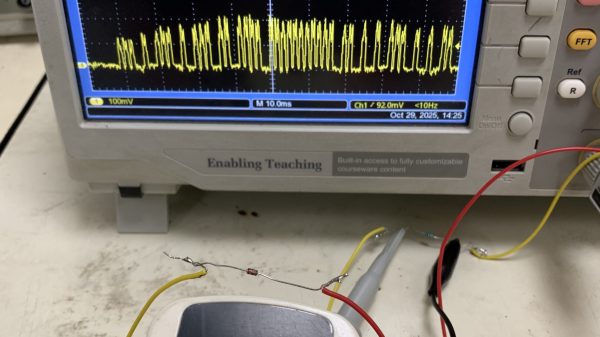
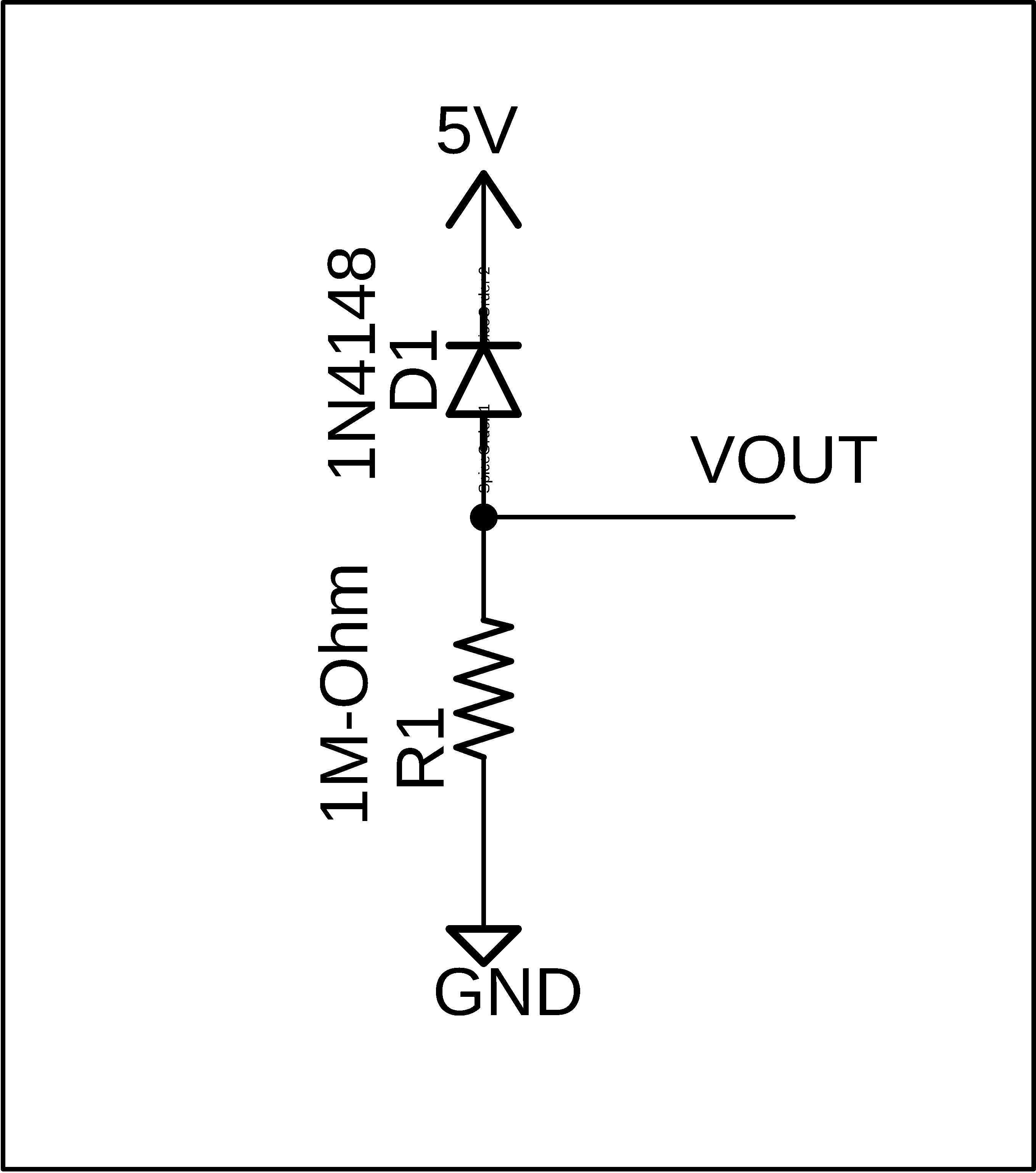
The trick is to treat the diode just like you would a proper IR photodiode. The part should be reverse biased with a resistor inline, and the signal taken from the anode side. Point an IR remote at your little diode and you’ll readily see the modulated signal pop up on a scope, clear as day.
The phenomenon is discussed at length over on Stack Exchange. Indeed, it’s a simple fact that most semiconductor devices are subject to some sort of photoelectric effect or another. It’s just that we stick the majority of them in opaque black packages so it never comes up in practice. In reality, things like photodiodes and phototransistors aren’t especially different from the regular parts—they’re just put in transparent packages and engineered and calibrated to give predictable responses when used in such a way.
Is this the way you’d go if your project needed an IR detector? Probably not—you’d be better served buying the specific parts you need from the outset. But, if you find yourself in a pinch, and you really need to detect some IR signals and all you’ve got on hand is glass-package signal diodes? Yeah, you can probably get it to work.
While this trick is well known to many oldheads, it’s often a lightbulb moment for many up-and-coming engineers and makers to realize this. Glass-packaged diodes aren’t the only light-sensitive parts out there, either. As we’ve explored previously, certain revisions of Raspberry Pi would reboot if exposed to a camera flash, while you can even use regular old LEDs as sensors if you’re so inclined. If you’ve got your own secret knowledge about how to repurpose regular components in weird ways, don’t hesitate to notify the tipsline!
If you’re a musician and you want a reverb effect, there are lots of ways to go about it. You can use software plugins, all kinds of rack-mount effects, or pedals. Or, as [David] has done, you could go with a lamp.
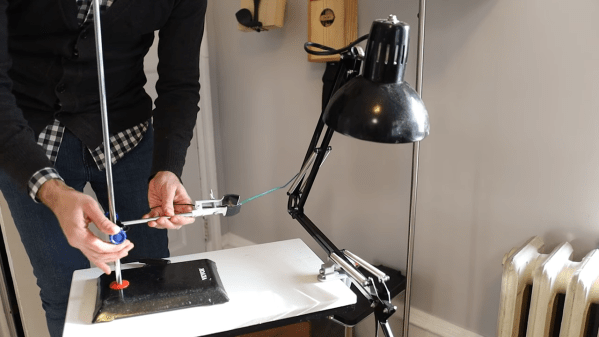
[David’s] build is straightforward enough in concept—he just chose a relatively unconventional item to use as a reverb tank. The lamp might seem like an odd choice, but it actually does a decent job at resonating because of its metal construction and the multiple springs that tension the structure. [David] turns the lamp into a reverb by fitting it with a Vidsonix Ghost audio transducer to put sound into the structure—picture the magnetic driver of a loudspeaker without the cone fitted, and you get the idea. Piezo elements were then used as contact mics to pick up reverberations from the lamp itself. Everything was assembled with a bunch of lab stands that give the build a rather nice aesthetic. The reverb time isn’t particularly long, but the sound is hauntingly beautiful.