Bringing Swift To The Apple II

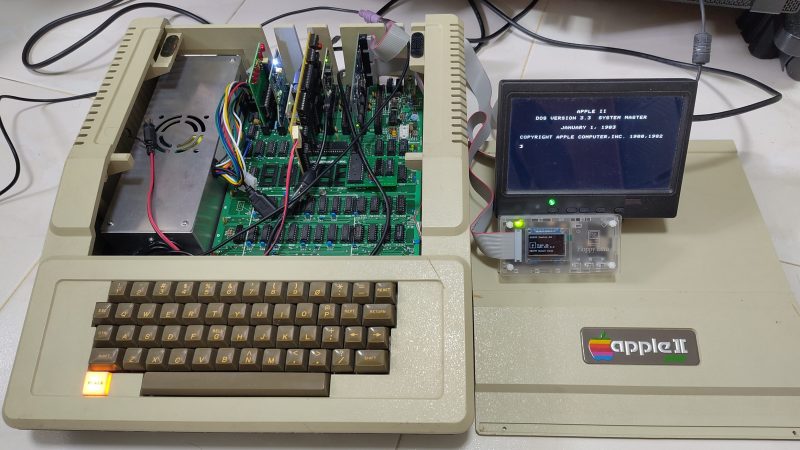
Swift is a relatively modern program language, appearing in 2014 as a replacement for Objective-C. Since then, it’s become a popular solution for programming apps across Apple platforms. That led [Yeo Kheng Meng] to a simple yet fun idea—porting Swift to the oldest Apple platform of all.

Yes, [Yeo] managed to build a development environment for Swift that targets the Apple II platform. Not just one machine, either—everything from the original Apple II up to the IIe and a little beyond. Now, the Apple II is very different from modern Macs and iPhones and the like, having debuted in 1977 with a 1 MHz 6502 CPU and a minuscule 4 KB of RAM. But that doesn’t mean you can’t use a modern language to develop for it!

[Yeo] does a great job of explaining how it all works, and how Claude Code and GPT 5.5 Codex were used to help piece things together. The compiler is set up to spit out bytecode that’s executed by a virtual machine running on the 6502. The target was to allow the setup to work on a standard 1977 Apple II from the factory, which would allow it to then run on subsequent models without issue. However, there is a small note— [Yeo]’s implementation requires the RAM to have been upgraded to 48 KB.

We love seeing modern stuff ported to the Apple II. This Portal port was a particular highlight.
Continue reading “Bringing Swift To The Apple II”

Cramming A Mini-ITX Gaming PC Into A 3D Printed Steam Machine Sized Case

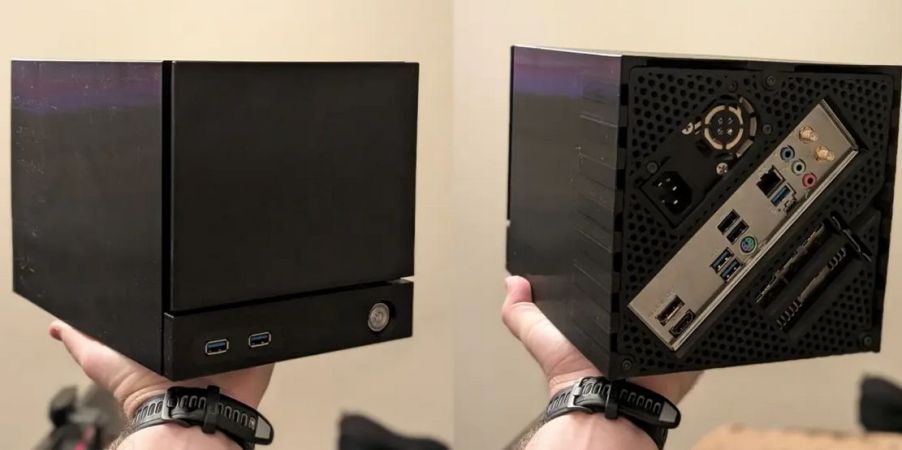
The recently released Valve Steam Machine is somewhat awkward in that it uses a custom, non-standard PCB and non-standard power supply. This fact apparently has irked some people who decided that it makes perfect sense to try and cram a Mini-ITX board, Small Form Factor (SFF) PSU and full-sized discrete GPU into an enclosure of the same size. Cue the SFF Mini-ITX Steam Machine Case project by [3DCatt] over at Printables.

This is apparently a project done in cooperation with AMD’s [Jacob Terkelsen], who showed off the 3D printed case stuffed full with the aforementioned parts, which includes a GeForce RTX 5060 GPU. Of note is that the Valve Steam Machine uses a different cooling configuration as it has both the CPU and GPU on the same PCB. These share the same massive heatsink, as can be seen in e.g. the [Gamers Nexus] teardown video.

For this angular imitation machine it would have been nice to use a blower-style GPU, to exhaust the hot air rather than dump it all into the case. This is also an issue that was raised by [Jacob], with more ventilation added to mitigate the issue. What the overall performance will be compared to regular compact Mini-ITX cases remains to be seen, but if you really want to live the Steam Machine life and have some parts kicking around along with a 3D printer, it might be worth a shot.

Requiem For Long Wave, As The BBC Goes Silent

Something happened this morning which will have been unnoticed by many, but which for a certain breed of radio enthusiast marks the end of an era. The BBC stopped broadcasting Radio 4 on their 198 kHz Long Wave frequency, ending over a century of transmission in the band. For now the transmitter carries a recorded message telling listeners that the service has ended, but it’s expected that this will soon be turned off.

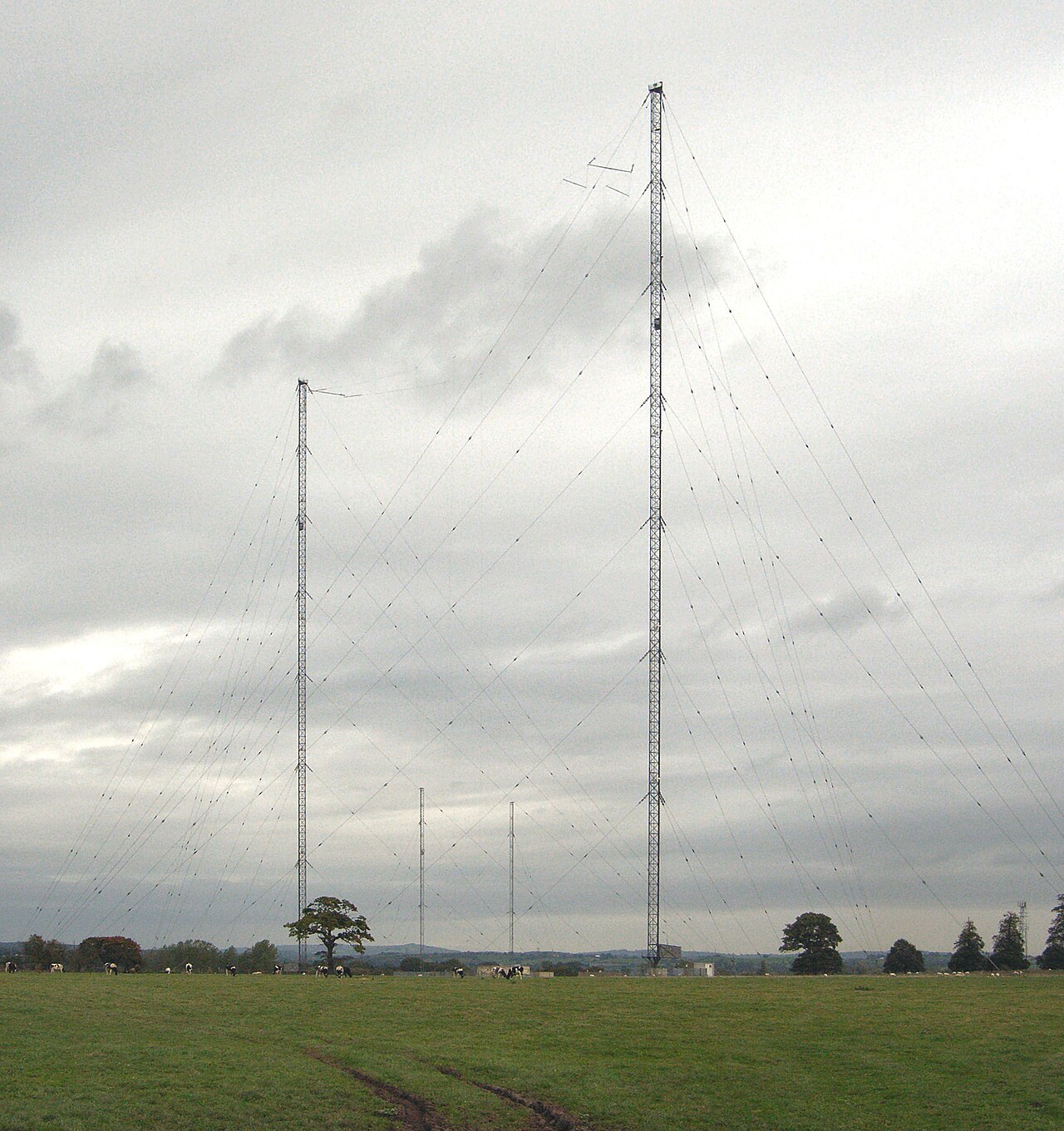
A pair of very large transmitting masts against a cloudy grey sky.
The main 198kHz BBC transmitter, at Droitwich. Bob Nienhuis, Public domain.

American readers may be unfamiliar with Long Wave as it’s a band not allocated in their region. Covering 153 to 279 kHz, it’s a relic from the earliest days of high-power broadcasting in the 1920s, used because of the enormous distances that could be covered with its lower frequencies. The main long wave transmitter for the BBC is at Droitwich, and its demise comes because there are no more spares for its high-power transmitter tubes. It joins many Medium Wave, or AM, as it is commonly known, stations in leaving the airwaves, as increased interference from switch mode electronics and the availability of higher quality alternatives took away their listeners. It’s fair to say that there will be few whose lives are inconvenienced by the switch-off in 2026, but it’s worth taking a moment to remember.

The first BBC Long Wave transmissions in the mid-1920s were on a 1600 metre wavelength, or 187.5 kHz. A series of international agreements saw them move to 193 kHz, and then 200 KHz or 1500 metres in 1934. They stayed on that frequency until another shift down 2 KHz to 198 kHz in 1988. They were atomic-controlled, and thus usable as a frequency standard. The programming started with station names redolent of their era, first the BBC National Service, then the Light Programme you’ll see on the dial in the header image, and finally the more modern-sounding Radio 4. A famous BBC programme tied to Long Wave is the Shipping Forecast, a weather bulletin for deep-sea fishermen which became cult listening on land and now features on FM and digital services too, and there’s even a probably-apocryphal tale that British nuclear submarine captains would once use its presence or absence to judge whether nuclear war had occurred.

In an Oxfordshire farmhouse not far short of fifty years ago, a young child who would later become a Hackaday writer heard a radio show like nothing before, which made an impression that continues to this day. The show was one of the earliest airings of the original Hitchhikers Guide To The Galaxy radio series, through a 1970s ITT radio tuned to BBC Radio 4 on (then) 200 kHz Long Wave. So long, Droitwich, and thanks for all the fish.

Hacking Routers Like It’s 2008

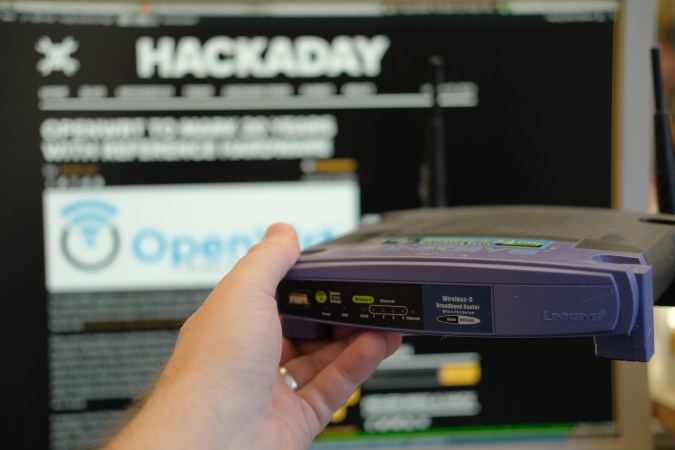
How long have we been hacking routers? To some of you who’ve been in the Hackaday audience for a while, the answer is “nearly forever”. In the early 2000s, they were one of the few consumer gadgets that had the trifecta of hackability: WiFi and networking built in, a user-friendly Linux operating system, and a few spare GPIOs that could control from the OS. Back when the Linksys WRT54GL was the king of the hill, we saw some pretty absurd hacks.

Take this example robot from October 2008. Link-rot hasn’t been kind to the original project, but from what we can tell, it used the GPIOs to drive servo motors hacked for continuous rotation, and features the equally anachronistic CD-ROM wheels. Where would you even get those today?

But the OS that this 18-year-old hack uses is still around: OpenWRT Linux. Although it still takes its name from the lovable purple router of old, it hasn’t supported that particular model in over a decade because of growing memory requirements. But it’s still the go-to distro for any modern router hacks, and it provides a lot more general-purpose Linux than you might expect on otherwise constrained platforms. As Tom pointed out in the podcast, if you see a used router for cheap, see if it’s supported by OpenWRT, and if it is, buy it.

While the project that got us thinking about routers again, Al’s recent networking hack, basically uses the router as a souped-up router, that’s by no means a given. OpenWRT is a real Linux OS, and can make use of most peripherals that your router find has available. Networking? Of course. USB? No problem. If you find a serial port and some GPIOs, you’re most of the way to a Linux SBC, although very likely a headless one.

There are a lot of hacks we see go in and out of style, and we see software projects come and go. But here we tip our hat to the router hacks, and to the plucky Linux OS that’s been ported to them all. Long may it keep old devices out of the landfill!

Featured image: My old baby, about a year or so before something in the radio modem finally gave up the ghost.

A Quantum Magic 8-Ball

If you ever cracked open one of those Magic 8-Ball toys, you found little more than a polyhedron floating in some dark-colored fluid. It was a quasi-random way of asking the universe to answer crucial questions like “will Mom and Dad get a divorce?” and “does Bethany like me?” even if the results were seldom accurate (sorry about your parents, kid). If you want a more reliably random 8-ball that is not even slightly more truthful, you might like this recent build from [David Noel Ng].

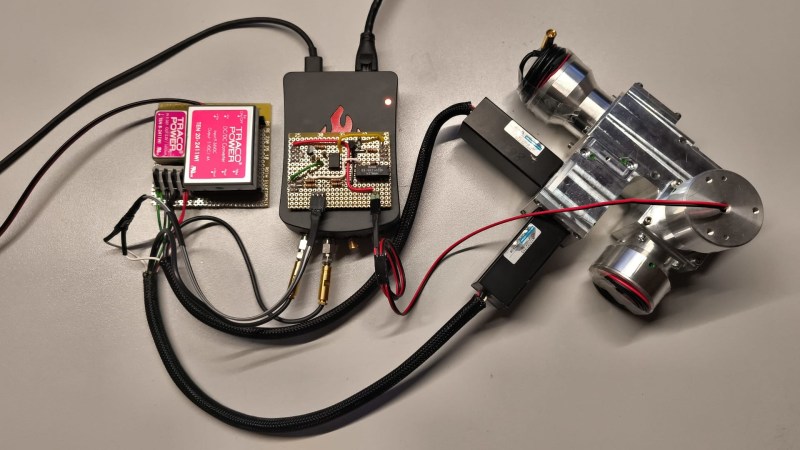
The concept is simple enough — leverage quantum effects that provide truly random results to seed run a random number generator that determines the outcome of a software magic 8-ball. [David] tried a few ways to build something along these lines, and eventually settled on a setup that he felt suited the task at hand.

In the final rig, a light source spits out photons, and is attenuated to the point where effectively only one photon is running through the light path at a time. Each photon passes through a beam splitter, and either passes through the mirror and hits photomultiplier A, or bounces off and hits photomultiplier B. This creates a truly random yes/no result for every photon that passes through. [David] does a great job of explaining the low-level physics at play, as well as the supporting electronics and code that turns this into a usable magic 8-ball that actually answers questions.

We’ve seen other magic 8-ball builds before, too. Few come with quite the same tactile wonder created by the original toy, but they nonetheless do the job of answering questions that are too frivolous to take to a tarot reader or local divining bog witch. If you’re whipping up your own way to deduce the wills of the fates, don’t hesitate to let us know on the tipsline.

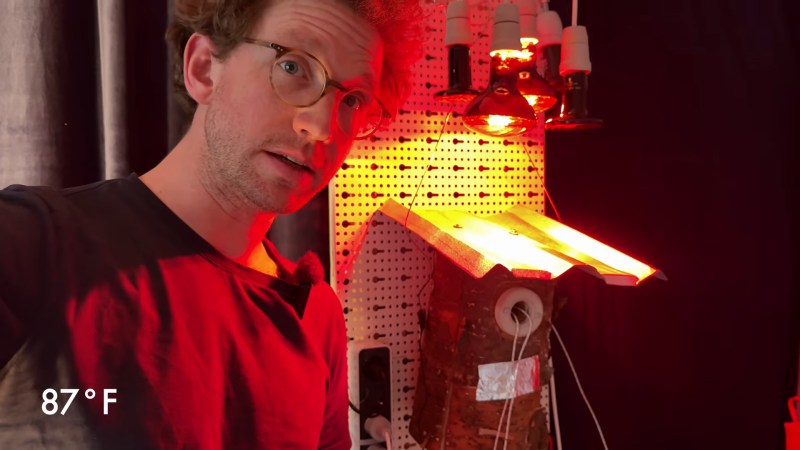
A white man in a dark t-shirt and glasses stands next to a pegboard. On the pegboard is a cylindrical wooden bird house with a small piece of metal roof attached to the top. A set of heat lamps are suspended above and give the image a reddish-orange glow. 87˚F is in white text in the lower left corner.

Do Metal Roofs Turn A Bird House Into An Oven?

Birdhouses can be a great way to help out nesting birds in your area, but they can be a bit intensive to make. As part of a 500 birdhouse marathon, [Of Human and Nature] decided to test whether a metal roof would be safe or turn the birdhouse into an oven.

Most DIY birdhouses are made of wood to encourage cavity nesting species that would naturally find a hole in a tree to use the house. Unfortunately, an unprotected chunk of wood will deteriorate much faster than a whole tree full of holes might. A metal roof reduces the exposure to the elements, but does it make the box too hot?

[Of Human and Nature] heeded concerns from commenters and actually tested his hypothesis with a simple set of thermocouples, a heat lamp, and an assembled birdhouse. While the metal roof was held at 70˚C for four hours, the inside of the house stayed in the mid 20˚C range thanks to the separation between the roof and the actual box which allows air to flow between the two.

Maybe a metal roof could help you house your homing pigeons as well? If you want to spread the mesh with your birdhouse instead, how about a solar panel roof with a LoRa node?

Continue reading “Do Metal Roofs Turn A Bird House Into An Oven?”

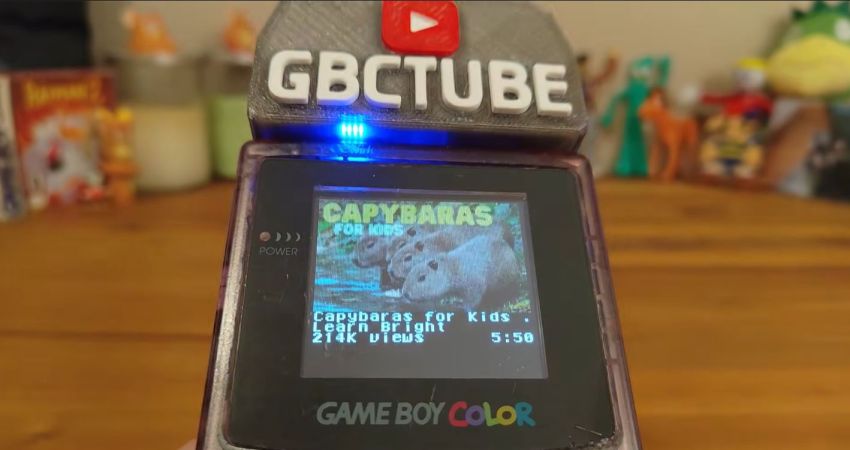
Watch YouTube On A Game Boy Color With A Special Cartridge

There’s no questioning [Throaty Mumbo]’s uncanny skill at answering questions that nobody ever asked, such as whether it’s possible to watch YouTube videos on a Nintendo Game Boy Color handheld gaming system.



Of course the answer here is a resounding ‘sorta’, loosely defined by what you mean with ‘watch’ and ‘video’ exactly. For the impatient there’s the GitHub project page with the project summary, along with a detailed video containing hijinks and a playback demo on real Game Boy Color hardware with the cobbled-together GBCTube cartridge.

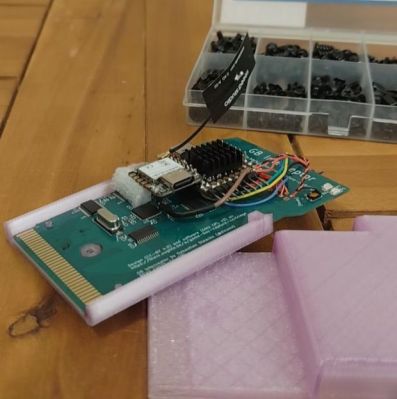
The nice thing about these cartridge-based gaming systems is that you get direct access to the system’s hardware via the cartridge bus, with for systems like the GBC a basic cartridge PCB readily available if you’re feeling that prototyping itch.

Such a cartridge breakout board for the GBC was thus used as the core of this project, with an ESP32-C6 acting solely as Wi-Fi bridge for the RP2350B MCU which handles basic player firmware and bridging duty between the GBC and the streamed video data from the host PC. It’s the latter does the heavy lifting of wrangling the YouTube experience into something that sort of works on the GBC’s amazing, very vibrant, backlight-free 160×144 resolution color LCD.

With the cartridge inserted you can search for a video title on the GBC, select a video which is then downloaded with yt-dlp on the host PC and prepared for streaming. Audio is handled by the RP2350B to free up CPU cycles on the GBC, for which a separate speaker is slapped into the cartridge for high-fidelity mostly-synced audio.

Perhaps the most fascinating question that one is left with is whether a more powerful Espressif MCU like e.g. the ESP32-S31 could combine all these tasks into a single package. Not because there’s a particular reason to do so, but more out of sheer morbid curiosity, perhaps.

Continue reading “Watch YouTube On A Game Boy Color With A Special Cartridge”