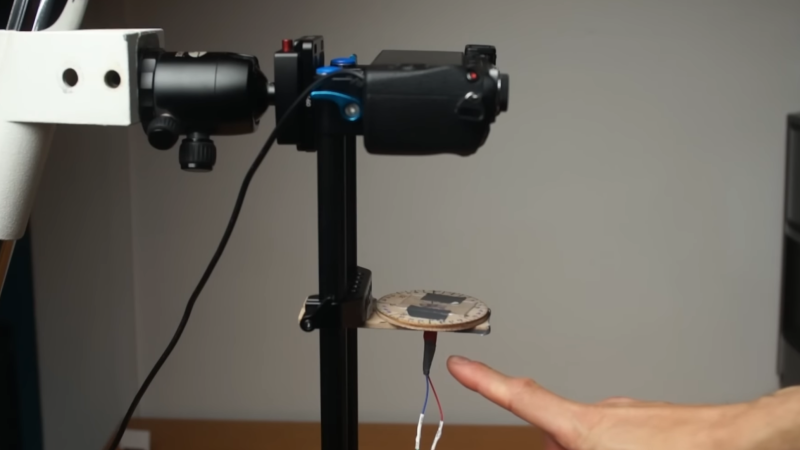
A mirrorless camera is mounted on a stand, facing downwards toward a rotating microscope stage made of wood. A pair of wires come down from the stage, and a man's hand is pointing to the stage.

Building A Microscope Without Lenses

It’s relatively easy to understand how optical microscopes work at low magnifications: one lens magnifies an image, the next magnifies the already-magnified image, and so on until it reaches the eye or sensor. At high magnifications, however, that model starts to fail when the feature size of the specimen nears the optical system’s diffraction limit. In a recent video, [xoreaxeax] built a simple microscope, then designed another microscope to overcome the diffraction limit without lenses or mirrors (the video is in German, but with automatic English subtitles).

The first part of the video goes over how lenses work and how they can be combined to magnify images. The first microscope was made out of camera lenses, and could resolve onion cells. The shorter the focal length of the objective lens, the stronger the magnification is, and a spherical lens gives the shortest focal length. [xoreaxeax] therefore made one by melting a bit of soda-lime glass with a torch. The picture it gave was indistinct, but highly magnified. Continue reading “Building A Microscope Without Lenses”
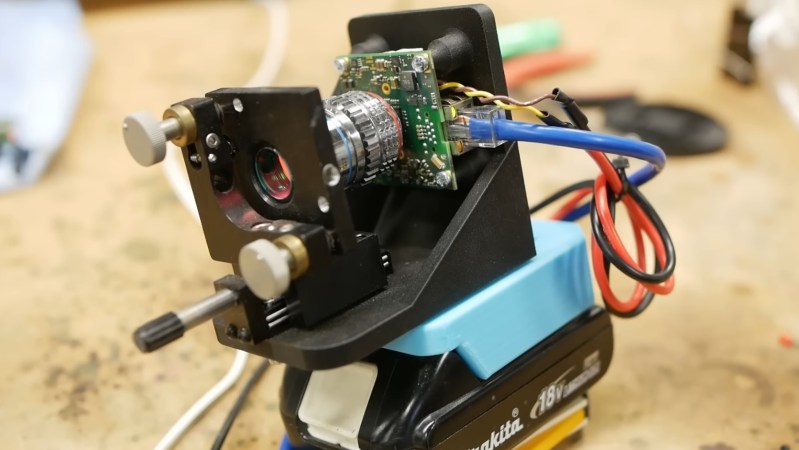
A photo of the camera.

F/0.38 Camera Lens Made With Oil Immersion Microscope Objective

Over on YouTube [Applied Science] shows us how to make an f/0.38 camera lens using an oil immersion microscope objective.

The f-number of a lens indicates how well it will perform in low-light. To calculate the f-number you divide the focal length by the diameter of the aperture. A common f-number is f/1.4 which is generally considered “fast”.

We are told the fastest commercial lens ever used had f/0.7 and was used by Stanley Kubrick to shoot the film Barry Lyndon which was recorded only with candle light.

A microscope objective is a crucial lens that gathers and magnifies light to form an image. It plays a key role in determining the quality and clarity of the final magnified image produced by a microscope.

Continue reading “F/0.38 Camera Lens Made With Oil Immersion Microscope Objective”

Give Your Microscope Polarized $5 Shades To Fight Glare

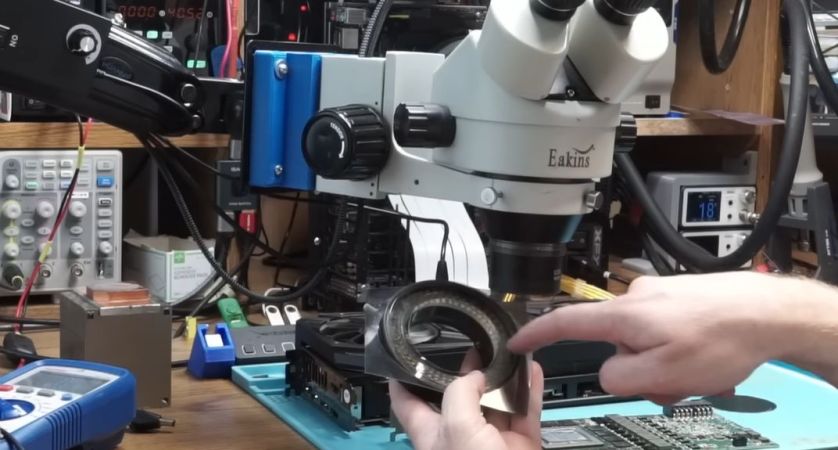
Who doesn’t know the problem of glare when trying to ogle a PCB underneath a microscope of some description? Even with a ring light, you find yourself struggling to make out fine detail such as laser-etched markings in ICs, since the scattered light turns everything into a hazy mess. That’s where a simple sheet of linear polarizer film can do wonders, as demonstrated by [northwestrepair] in a recent video.

Simply get one of these ubiquitous films from your favorite purveyor of goods, or from a junked LCD screen or similar, and grab a pair of scissors or cutting implements. The basic idea is to put this linear polarizer film on both the light source as well as on your microscope’s lens(es), so that manipulating the orientation of either to align the polarization will make the glare vanish.

This is somewhat similar to the use of polarizing sunshades, only here you also produce specifically the polarized light that will be let through, giving you excellent control over what you see. As demonstrated in the video, simply rotating the ring light with the polarizer attached gives wildly different results, ranging from glare-central to a darkened-but-clear picture view of an IC’s markings.

How to adapt this method to your particular microscope is left as your daily arts and crafts exercise. You may also want to tweak your lighting setup to alter the angle and intensity, as there’s rarely a single silver bullet for the ideal setup.

Just the thing for that shiny new microscope under the Christmas tree. Don’t have a ring light? Build one.

Continue reading “Give Your Microscope Polarized $5 Shades To Fight Glare”

How A Failed Video Format Spawned A New Kind Of Microscope

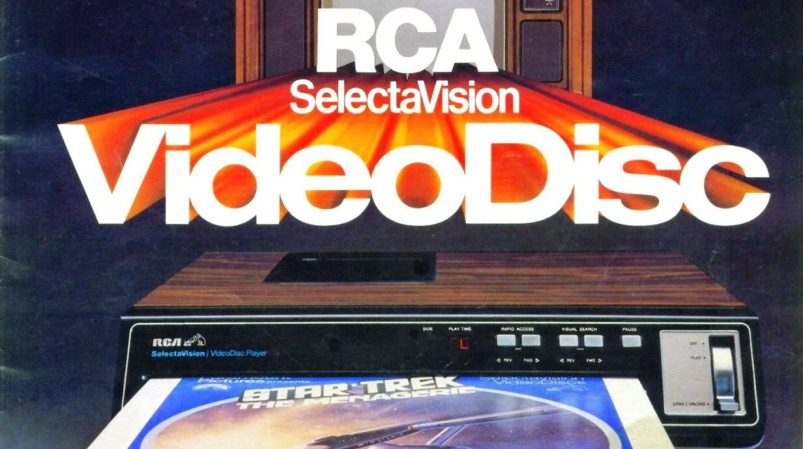
The video cassette tape was really the first successful home video format; discs just couldn’t compete back in the early days. That’s not to say nobody tried, however, with RCA’s VideoDisc a valiant effort that ultimately fell flat on its face. However, the forgotten format did have one benefit, in that it led to the development of an entirely new kind of microscope, as explained by IEEE Spectrum.

The full story is well worth the read; the short version is that it all comes down to capacitance. RCA’s VideoDisc format was unique in that it didn’t use reflective surfaces or magnetic states to represent data. Instead, the data was effectively stored as capacitance changes. As a conductive stylus rode through an undulating groove in a carbon-impregnated PVC disc, the capacitance between the stylus and the disc changed. This capacitance was effectively placed into a resonant circuit, where it would alter the frequency over time, delivering an FM signal that could be decoded into video and audio by the VideoDisc player.

The VideoDisc had a capacitance sensor that could detect such fine changes in capacitance, that it led to the development of the Scanning Capacitance Microscope (SCM). The same techniques used to read and inspect VideoDiscs for quality control could be put to good use in the field of semiconductors. The sensors were able to be used to detect tiny changes in capacitance from dopants in a semiconductor sample, and the SCM soon became an important tool in the industry.

It’s perhaps a more inspiring discovery than when cheeky troublemakers figured out you could use BluRay diodes to pop balloons. Still fun, though. An advertisement for the RCA VideoDisc is your video after the break.

Continue reading “How A Failed Video Format Spawned A New Kind Of Microscope”

Why Cheap Digital Microscopes Are Pretty Terrible

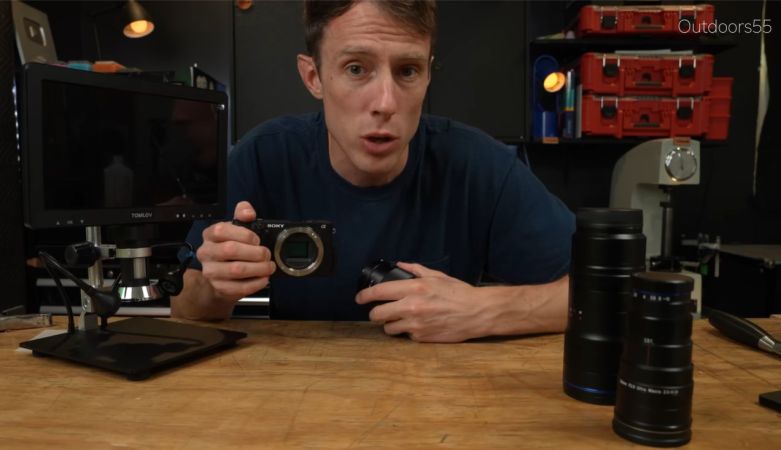
The depth of field you get with a cheap Tomlov DM9 digital microscope. Pictured is the tip of a ballpoint. (Credit: Outdoors55, YouTube)

We have all seen those cheap digital microscopes, whether in USB format or with its own screen, all of them promising super-clear images of everything from butterfly wings to electronics at amazing magnification levels. In response to this, we have to paraphrase The Simpsons: in this Universe, we obey the laws of physics. This applies doubly so for image sensors and optics, which is where fundamental physics can only be dodged so far by heavy post-processing. In a recent video, the [Outdoors55] YouTube channel goes over these exact details, comparing a Tomlov DM9 digital microscope from Amazon to a quality macro lens on an APS-C format Sony Alpha a6400.

First of all, the magnification levels listed are effectively meaningless, as you are comparing a very tiny image sensor to something like an APS-C sensor, which itself is smaller than a full-frame sensor (i.e., 35 mm). As demonstrated in the video, the much larger sensor already gives you the ability to see many more details even before cranking the optical zoom levels up to something like 5 times, never mind the 1,500x claimed for the DM9.

On the optics side, the lack of significant depth of field is problematic. Although the workarounds suggested in the video work, such as focus stacking and diffusing the light projected onto the subject, it is essential to be aware of the limitations of these microscopes. That said, since we’re comparing a $150 digital microscope with a $1,500  Sony digital camera with macro lens, there’s some leeway here to say that the former will be ‘good enough’ for many tasks, but so might a simple jeweler’s loupe for even less.

There are some reasonable hobby-grade USB microscopes. There are also some hard-to-use toys.

Continue reading “Why Cheap Digital Microscopes Are Pretty Terrible”

The green CRT display of a scanning-electron microscope is shown, displaying small particles.

DIY Calibration Target For Electron Microscopes

It’s a problem that few of us will ever face, but if you ever have to calibrate your scanning electron microscope, you’ll need a resolution target with a high contrast under an electron beam. This requires an extremely small pattern of alternating high and low-density materials, which [ProjectsInFlight] created in his latest video by depositing gold nanoparticles on a silicon slide.

[ProjectsInFlight]’s scanning electron microscope came from a lab that discarded it as nonfunctional, and as we’ve seen before, he’s since been getting it back into working condition. When it was new, it could magnify 200,000 times and resolve features of 5.5 nm, and a resolution target with a range of feature sizes would indicate how high a magnification the microscope could still reach. [ProjectsInFlight] could also use the target to make before-and-after comparisons for his repairs, and to properly adjust the electron beam.

Since it’s easy to get very flat silicon wafers, [ProjectsInFlight] settled on these as the low-density portion of the target, and deposited a range of sizes of gold nanoparticles onto them as the high-density portion. To make the nanoparticles, he started by dissolving a small sample of gold in aqua regia to make chloroauric acid, then reduced this back to gold nanoparticles using sodium citrate. This gave particles in the 50-100 nanometer range, but [ProjectsInFlight] also needed some larger particles. This proved troublesome for a while, until he learned that he needed to cool the reaction temperature solution to near freezing before making the nanoparticles.

Using these particles, [ProjectsInFlight] was able to tune the astigmatism settings on the microscope’s electron beam so that it could clearly resolve the larger particles, and just barely see the smaller particles – quite an achievement considering that they’re under 100 nanometers across!

Electron microscopes are still a pretty rare build, but not unheard-of. If you ever find one that’s broken, it could be a worthwhile investment.

Continue reading “DIY Calibration Target For Electron Microscopes”

Building The Simplest Atomic Force Microscope

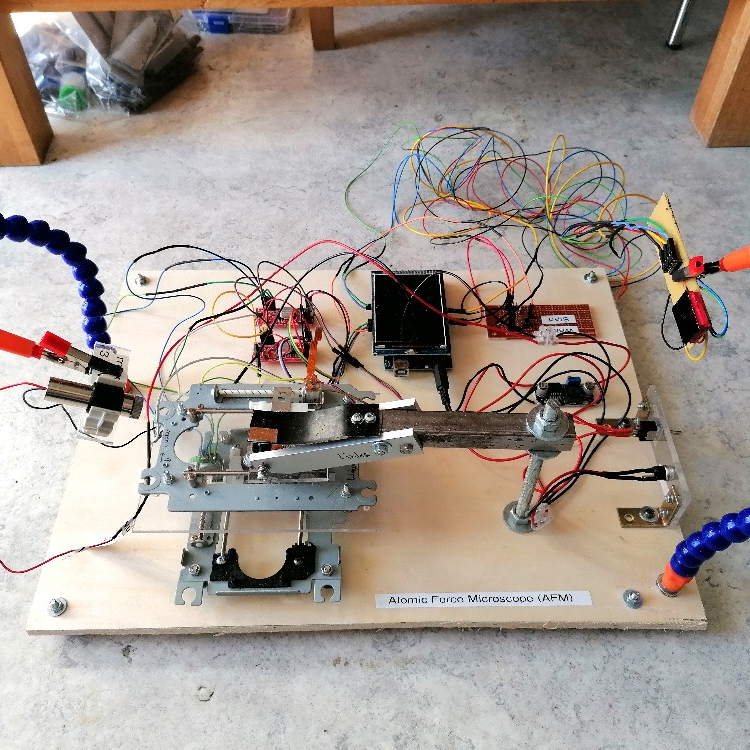
Doing it yourself may not get you the most precise lab equipment in the world, but it gets you a hands-on appreciation of the techniques that just can’t be beat. Today’s example of this adage: [Stoppi] built an atomic force microscope out of mostly junk parts and got pretty good results, considering. (Original is in German; read it translated here.)

The traditional AFM setup uses a piezo micromotor to raise and lower the sample into a very, very fine point. When this point deflects, it reads the height from the piezo setup and a motor stage moves on to the next point. Resolution is essentially limited by how fine a point you can make and how precisely you can read from the motion stages. Here, [stoppi]’s motion stage follows the traditional hacker avenue of twin DVD sleds, but instead of a piezo motor, he bounces a laser off of a mirror on top of the point and reads the deflection with a line sensor. It’s a clever and much simpler solution.

A lot of the learnings here are in the machine build. Custom nichrome and tungsten tips are abandoned in favor of a presumably steel compass tip. The first-draft spring ended up wobbling in the X and Y directions, rather than just moving in the desired Z, so that mechanism got reinforced with aluminum blocks. And finally, the line sensors were easily swamped by the laser’s brightness, so neutral density filters were added to the project.

The result? A nice side effect of the laser-bouncing-off-of-mirror setup is that the minimum resolvable height can be increased simply by moving the line sensors further and further away from the sample, multiplying the deflection by the baseline. Across his kitchen, [stoppi] is easily able to resolve the 35-um height of a PCB’s copper pour. Not bad for junk bin parts, a point from a crafts store, and a line sensor.

If you want to know how far you can push a home AFM microscope project, check out [Dan Berard]’s absolutely classic hack. And once you have microscope images of every individual atom in the house, you’ll, of course, want to print them out.