Hackaday Prize 2022: A Sun-Chasing Robot

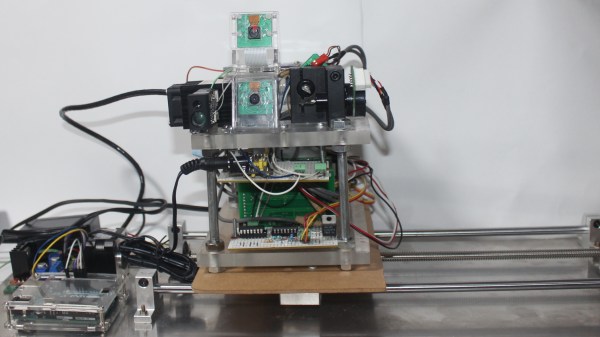
There’s plenty of power to be had from the sun, but you need to be out of the shade to receive it. [Dennis] built a robot by the name of Sun Chaser that has the smarts to go where the sun is shining.

Sun Chaser is essentially a robotic solar panel, tasked with filling up its batteries as much as possible. It can then be used as a power supply for campsites or other remote areas, and used to charge devices as required.

A Raspberry Pi runs the show, paired with a Squid motor controller to run the drive system. Sun Chaser has a motorized solar panel onboard which can track the sun for maximum output, with the aid of six photoresistors to guide the positioning. A camera is used to image the area around Sun Chaser, too, and processing is used to identify sunny regions which will provide the most energy.

Even outside of its useful applications, the idea of having a robot that can run around and keep itself juiced up is a fun one. Solar power gives a robot a greater sense of autonomy, after all. This author has experimented in this field to great enjoyment, too. Video after the break.

Continue reading “Hackaday Prize 2022: A Sun-Chasing Robot”

Backup Camera, Digital Dash, Road Assist… In 1969?

If your friend told you their car had a backup camera, a digital dashboard, climate control, could scan for radio stations, and even helped stay on the road, you wouldn’t think much about it. Unless the year was 1969. The car — the Hurricane by Australian automaker Holden — was never a production vehicle. But it was way beyond the state of the art in 1969 and isn’t too dated, even today.  The concept car was actually found in 1988 and restored by 2011. Honestly, it still looks great.

The car looks amazing and was meant to be a research vehicle and — probably — nice eye candy for the car shows. Seating two passengers with a mid-mounted 253 cubic inch V8, it featured many things we take for granted now: a backup camera, temperature control, and a  (somewhat) digital dashboard, for example. There was a system to help it stay in lane, but that required magnets in the road — it was 1969, after all.

The fiberglass body was unique and had a canopy instead of doors. The power seats lifted up when the canopy came up and went down for driving. The passenger compartment was a steel cage. The vehicle featured headrests, a foam-lined fuel tank, and a fire warning system. Two of the brakes were even oil-cooled.

Continue reading “Backup Camera, Digital Dash, Road Assist… In 1969?”

Water Level Sensor Does Not Use Water Level Sensor

When interfacing with the real world, there are all kinds of sensors available which will readily communicate with your microcontroller of choice. Moisture, pH, humidity, temperature, location, light, and essentially every other physical phenomenon are readily measured with a matching sensor. But if you don’t have the exact sensor you need, it’s sometimes possible to use one sensor as a proxy for another.

[Brian Wyld] needed a way to monitor the level of a remote body of water but couldn’t use a pressure or surface-level sensor, so he used a sensor typically intended for geolocation instead. This particular unit, an STM-type device with a built-in accelerometer, is attached to a rotating arm with a float at one end. As the arm pivots, the microcontroller reports its position and some software converts the change in position to a water level. It’s also paired with a LoRa radio, allowing it to operate off-grid.

Whether there is a design requirement to use an esoteric sensor to measure something more common, or a personal hardware limitation brought about by a shallow parts drawer, there’s often a workaround like this one that can accomplish the job. Whatever the situation, we do appreciate hacking sensors into other types of sensors just as much as anything else.

We Can’t Switch To Electric Cars Until We Get More Copper

Reducing emissions from human activity requires a great deal of effort in many different sectors. When it comes to land transport, the idea is generally to eliminate vehicles powered by combustion engines and replace them with electric vehicles instead. At a glance, the job is simple enough. We know how to build EVs, and the technology is getting to the point where they’re capable of replacing traditional vehicles in many applications.

Of course, the reality is not so simple. To understand the problem of converting transportation to electric drive en masse, you have to take a look at the big numbers. Focus in on the metrics of copper, and you’ll find the story is a concerning one. 

Continue reading “We Can’t Switch To Electric Cars Until We Get More Copper”

Building A Glowing Demon Core Lamp

The so-called Demon Core was a cursed object, a 6.2 kilogram mass of plutonium intended to be installed in a nuclear weapon. Instead, slapdash experimental techniques saw it feature in several tragic nuclear accidents and cause multiple fatalities. Now, you can build yourself a lamp themed after this evil dense sphere.

A later recreation of the infamous “Slotin Accident” that occurred with the Demon Core. Credit: Public Domain, Los Alamos National Laboratory

Creator [skelly] has designed the lamp to replicate the Slotin incident, where the spherical Demon Core was placed inside two half-spheres of beryllium which acted as neutron reflectors to allow it to approach criticality. Thus, the core is printed as a small sphere which is thin enough to let light escape, mimicking the release of radiation that doomed Louis Slotin. The outer spheres are then printed in silvery PLA to replicate the beryllium half-spheres. It’s all assembled atop a stand mimicking those used in the Los Alamos National Laboratory in the 1940s.

To mimic the Core’s deadly blue glow, the build uses cheap LED modules sourced from Dollar Tree lights. With the addition of a current limiting resistor, they can easily be run off USB power in a safe manner.

The Demon Core has become a meme in recent times, perhaps as a new generation believes themselves smart enough not to tinker with 6.2 kilograms of plutonium and a screwdriver. That’s not to say there aren’t still dangerous nuclear experiments going on, even the DIY kind. Be careful out there!

Electromagnetic Field Drops 2022 Talk Videos

Earlier this year we made the journey to a field in the West of England for the Electromagnetic Field hacker camp. It was the usual few days of fun in the open air, but due to a few technical difficulties we were unable to point you to any of the talks. We’re happy to note that now the dust has settled they are uploading talks, and there are a decent number up on YouTube with more to come.

Paging through the talks uploaded so far, and there’s plenty to get your teeth into. We’ll start with a couple that should be viewed as a pair,  [Robin Wilson] on UK railway signalling, and [Anthony Williams] giving us a crash course in railway safety, and then while we’re on a railway theme continue to [Hugh Wells] on hacking the train ticket system. Those first two amply demonstrate the best in our community, in that here are professionals sharing knowledge with us we’d never hear without working in that field.

Another esoteric talk that’s typical of a hacker camp schedule and which should be of interest to anyone who has wrestled with time synchronization comes from [John Dalziel], who gives us a brief history of time zones and daylight saving time. A talk that had me riveted during a train journey though came from [Cybergibbons], who describes penetration testing at a cruise ship scale.

These are just a few of the ones uploaded thus far, and as this is being written there are more appearing. So keep checking and you’ll see some really good ones. Meanwhile, have a read of our report from the event.

Simple Hacks To Make LEGO Train Track Out Of Other Pieces

LEGO trains are fun to play with, but as with any model train, you so seldom have enough track to fulfill your greatest desires. YouTuber [brick_on_the_tracks] has come up with some creative ideas of his own to make track compatible with Lego trains using other techniques.

TRAINED LEGO PROFESSIONALS! DO NOT ATTEMPT IN REAL LIFE!

The most straightforward is to use the LEGO fence piece, first released in 1967. They can be laid in two rows, four studs apart, and they’ll serve as perfectly functional train track. It’s a 100% legal building technique as per the official LEGO rules, too. Official track pieces can be linked up by placing them on a 1-stud-high booster. [brick_on_the_tracks] argues that it’s up to nine times cheaper than using official track, but it depends on how you’re building your layout, and you need to take into account the need for a base plate.

On the sillier side of things, it’s actually possible to use mini-figures as track, too. Again, it’s a 100% legal technique, though the trains don’t run as smoothly compared to the fence track. It’s very amusing, though, and could be a fun addition to a build you’re taking to a local LEGO convention.

If you’re really strapped for cash though, you can go as far as using cardboard. It’s not legal in the LEGO world, and it’s pretty basic, but you could literally make up a layout using nothing but a craft knife and pizza boxes. We’ve actually featured other LEGO train hacks before, like this neat automatic decoupler design.

Continue reading “Simple Hacks To Make LEGO Train Track Out Of Other Pieces”