Star Wars Themed Laser Badge: All That Is Missing Is The Pew Pew Sound Effect

In the quest to advance the art of the electronic badge, the boundaries of what is possible to manufacture in small quantities are continually tested. Full-colour PCBs, injection moulding, custom keyboards, and other wow factor techniques have all been tried, leading to some extremely impressive creations. With all this innovation then it’s sometimes easy to forget that clever design and a really good idea can produce an exceptional badge with far more mundane materials.

The 10th InCTF cybersecurity contest held at Amrita, Kerala, India, had a Star Wars themed badge designed by Team bi0s for the event. It takes the form of a Millennium Falcon-shaped PCB, with a NodeMCU ESP8266 board mounted on it, a shift register, small OLED display, and the usual array of buttons and LEDs. The fun doesn’t stop there though, because it also packs a light-dependent resistor and a laser pointer diode that forms part of one of its games. Power for this ensemble comes courtesy of a set of AA cells on its underside.

They took a novel approach to the badge’s firmware, with a range of different firmwares for different functions instead of all functions contained in one. These could be loaded through means of a web-based OTA updater. Aside from a firmware for serial exploits there was an Asteroids game, a Conway’s Game Of Life, and for us the star of the show: a Millennium Cannon laser-tag game using that laser. With this, attendees could “shoot” others’ LDRs, with three “hits” putting their opponent’s badge out of action for a couple of minutes.

Unusually this badge is a through-hole design as a soldering teaching aid, but its aesthetics do not suffer for that. We like its design and we especially like the laser game, we look forward to whatever next Team bi0s produce in the way of badges.

This isn’t the first badge packing a laser we’ve seen, at last year’s Def Con there was a laser synth badge. No laser tag battles though.

Werewolf Ears With A Sense For Danger

When walking down a dark street, it’s common to get a sense that one is being followed. It pays to check, of course, but what if we could get better data than simply a vague feeling from the unknown? [caitlinsdad] built a project that can do just that, with a cute pair of ears to boot.

The werewolf ears claim to be ISO Standard, though we’re yet to see the relevant documents to bear that out. Regardless, they use an Adafruit Gemma M0 microcontroller to run the show, hooked up to an infrared proximity sensor to detect movement. When triggered, the Gemma responds to the signal by twitching the wolf ears attached to a headband, alerting the wearer that someone is closing in.

Built and calibrated properly, this could be a useful invention for those who regularly find themselves followed by those skulking on the sidewalk and for whom moving to another neighbourhood is a more expensive option. We’ve seen other responsive wearables, too. Video after the break.

Continue reading “Werewolf Ears With A Sense For Danger”

All Band Radio Uses Arduino And Si4730

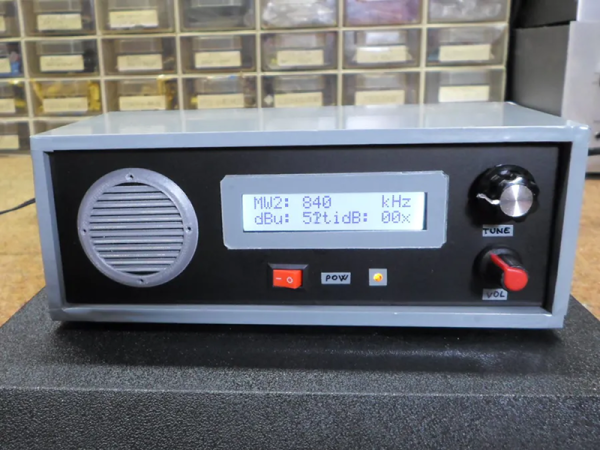
It is getting harder and harder to tell homemade projects from commercial ones. A good case in point is [Mirko’s] all band radio which you can see in the video below the break. On the outside, it has a good looking case. On the inside, it uses a Si4730 radio which has excellent performance that would be hard to get with discrete components.

The chip contains two RF strips with AGC, built-in converters to go from analog to digital and back and also has a DSP onboard. The chip will do FM 64 to 108 MHz and can demodulate AM signals ranging from 153 kHz to 279 kHz, 520 kHz to 1.71 MHz, and 2.3 MHz to 26.1 MHz. It can even read RDS and RBDS for station information. The output can be digital (in several formats) or analog.

Continue reading “All Band Radio Uses Arduino And Si4730”

Laser Tachometer Knows How Fast You Were Spinning Back There

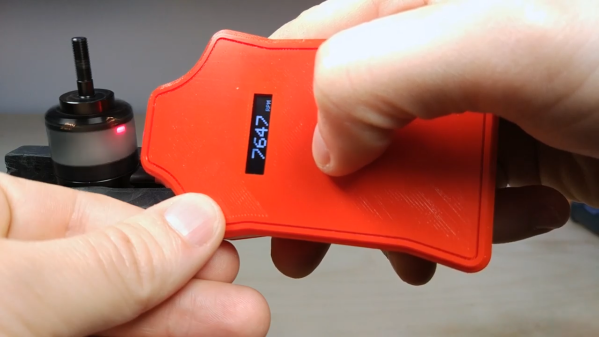
Does your drill go as fast as the manufacturer says it will? Well, you’d need a tachometer to figure that out. They’re not that expensive to buy, but as [Elite Worm] shows, they’re not that expensive to make, either — about $10 total if you get your parts from the right places. Lucky for you, he has links to everything.

Really, the links are just the tip of the iceberg here as far as the gifts that [Elite Worm] bestows upon those who choose to undertake this project. The build video (after the break, as usual; our favor to you) is fantastic, and would be perfect for a beginner because of the entrancing speed at which he builds it. The video is straight up relaxing to watch, whether you want to build one or not.

It’s a fairly simple circuit — just push the momentary switch, and the laser diode and sensor pair count the revolutions over one second. The Arduino Nano multiplies this number by 60 and displays the RPM on the OLED screen. What we absolutely love about this build is the care that taken in designing the case. There’s a designated spot for each component, and the ones without their own special holder are kept in place with printed crossbar pieces. [Elite Worm] says this has a higher refresh rate than his store-bought tacho, and we say it looks way cooler, too.

Still don’t want to make one yourself? Well, okay. Before you buy one, try using your phone to calculate RPM.

Continue reading “Laser Tachometer Knows How Fast You Were Spinning Back There”

Pneumatic Glove For Therapy And Experimentation

Many projects have aimed to replicate the function of the human hand, creating robotic structures that mimic real anatomy. Fewer have attempted to work with human hands directly. SoftGlove is a project by [france.bonde] that uses pneumatics to do just that.

The glove works by using a silicone pneumatic actuator for each digit on the human hand, attached to a glove. These are created with 3D printed molds, into which EcoFlex silicone is poured. A FlowIO device is used to run the pneumatics, which combines a microcontroller with penumatic hardware to pump air in and out of the actuators.

The goal of the project is to use a companion unit, in which a glove with flex sensors is used to make the SoftGlove mimic its movements. This would allow SoftGlove to move the fingers of a person with damaged muscle control, potentially aiding the muscles and nerves to recover when used in a therapeutic setting.

It’s exciting to see typical maker technologies used in a context to create better outcomes for patients, and we’re excited to see where this project leads next. It also has potential applications for robotic actuators, too. Programmable Air is another exciting project working in this space, too. And of course, if you’ve got a hot pneumatics project you’re cooking up in the garage, be sure to let us know!

Nuclear Fusion Power Without Regular Tokamaks Or Stellarators

When it comes to nuclear fusion, the most well-known reactor type today is no doubt the tokamak, due to its relatively straight-forward concept of plasma containment. That’s not to say that there aren’t other ways to accomplish nuclear fusion in a way that could conceivably be used in a commercial power plant in the near future.

As we covered previously, another fairly well-known type of fusion reactor is the stellarator, which much like the tokamak, has been around since the 1950s. There are other reactor types from that era, like the Z-pinch, but they seem to have all fallen into obscurity. That is not to say that research on Z-pinch reactors has ceased, or that other reactor concepts — some involving massive lasers — haven’t been investigated or even built since then.

In this article we’ll take a look at a range of nuclear fusion reactor types that definitely deserve a bit more time in the limelight.

Continue reading “Nuclear Fusion Power Without Regular Tokamaks Or Stellarators”