ESP8266 Upgrade Gives IKEA LEDs UDP Superpowers

It can be difficult to resist the impulse buy. You see something interesting, the price is right, and even though you know you should do your research first, you end up putting it in your cart anyway. That’s how [Tobias Girstmair] ended up being the not-so proud owner of a LEDBERG RGB LED strip from IKEA, and what eventually pushed him to replace wimpy original controller with an ESP8266.

So what was the problem with the original controller? If you can believe it, it was incapable of producing white light. When IKEA says an LED is multi-color, they apparently mean it’s only multi-color. A quick check of the reviews online seem to indicate that the white version is sold as a different SKU that apparently looks the same externally and has confused more than a few purchasers.

Rather than having to pick one or the other, [Tobias] decided he would replace the original controller with an ESP-03, hoping that would give him granular enough control over the LEDs to coax a suitably white light out of them. He didn’t want to completely start from scratch, so one of the first decisions he made was to reuse the existing PCB and MOSFETs. Some handy test points on the PCB allowed him to hook the digital pins of the ESP right to the red, blue, and green LED channels.

Then it was just a matter of coming up with the software. To keep things simple, [Tobias] decided to create a “dumb” controller that simply sets the LED color and intensity according to commands it receives over a simplified UDP protocol. Anything beyond that, such as randomized colors or special effects, is done with scripts that run on his computer and fire off the appropriate UDP commands. This also means he can manually control his newly upgraded LEDBERG strips from basically anything that can generate UDP packets, such as an application on his Android phone.

It might not be the most robust implementation we’ve ever seen, but all things considered, it looks as though this modification could be a pretty good way to get some cheap network controlled RGB lighting in your life.

Depotting An Ancient Car Computer

Carburettors were king for decades, until the onward march of technology brought electronic fuel injection to the fore. During their final years, a handful of automakers experimented with computer control of the humble carb, trying to squeeze out every last bit of efficiency and reduce pollution as much as possible. [NeXT] happened to own a vehicle fitted with AMC’s Computerized Engine Control system, and decided to see what made it tick.

This was easier said than done due to choices made by Ford, who manufactured the engine computer for AMC. Unlike modern ECUs which usually feature a metal case fitted with rubber gaskets, the CEC computer was potted in epoxy. [NeXT] was able to de-pot the circuit board by placing it in a stock pot of boiling water, and then slowly peeling the epoxy away.

With the potting removed, it was possible to begin reverse engineering the board. The main microcontroller is an Intel 8049, of the MCS-48 family. The board uses through-hole technology, and only features a handful of other small ICs.

It’s always interesting to look back at forgotten technologies and see how things were done in decades past. [NeXT] hopes to keep working on the project, intending to dump the ROM from the CEC module and build a replacement computer with an Arduino. It’s possible to build your own ECU from scratch, so we’re looking forward to seeing [NeXT]’s AMC Eagle running on modern silicon real soon.

PiFX, The Pi-Powered Pedal Board

Since the beginnings of the Raspberry Pi, [Tibbbbz] has wanted to build a DIY guitar effects board and amp simulator. A device like this, and similar ones sold by Boss and Kemper, put a bunch of processing power inside a metal enclosure with some footswitches and a pair of quarter inch jacks for input and output. Mash some buttons and wicked toanz come out the other end. Now this is actually possible with a Pi, and it’ll sound great too.

Because this is an audio application, latency is critical. It doesn’t really matter if you have 200 milliseconds of latency when scrolling through your Facebook feed, but for real-time audio processing anything over five milliseconds is disorienting and nearly unusable. [Tibbbbz] is using a standard, off-the-shelf USB audio adapter that gets the latency down to about that level. A Raspberry Pi is never going to have latency as low as a handful of transistors in a analog effects pedal, but it’s close enough.

For the audio system, it’s all about JACK audio: a wonderful frontend for the Linux audio system. The actual pedal emulation is happening with Guitarix. For the hardware part of this build, there’s actually not that much going on here apart from a USB sound card and a touch screen display. The footswitches are the most interesting as they’re wired up as buttons in a repurposed USB keyboard controller board. This repurposing of a USB keyboard is rather interesting, because it vastly simplifies the entire build. All of this is wrapped up in a wedge-shaped walnut pedalboard that’s sturdy enough to live on the stage at least part of the time. You can check out the demos here.

Retrocomputing For The Masses Hack Chat

Join us on Wednesday 29 May 2019 at noon Pacific for the Retrocomputing for the Masses Hack Chat!

Of the early crop of personal computers that made their way to market before IBM and Apple came to dominate it, few machines achieved the iconic status that the Sinclair ZX80 did.

Perhaps it was its unusual and appealing design style, or maybe it had more to do with its affordability. Regardless, [Sir Clive]’s little machine sold north of 100,000 units and earned a place in both computing history and the hearts of early adopters.

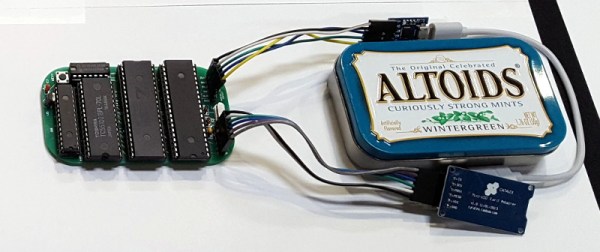
Spencer Owen is one who still holds a torch for the ZX80, so much so that in 2013, he hatched a seemingly wacky idea to make his own. A breadboard prototype of the Z80 machine slowly came to life over Christmas 2013, one thing led to another, and the “RC2014” was born.

The RC2014 proved popular enough to sell on Tindie, and Spencer is now following his dream as a retrocomputing mogul and working on RC2014 full time. He’ll be joining us to discuss the RC2014, how it came to be, and how selling computing nostalgia can be more than just a dream.

join-hack-chatOur Hack Chats are live community events in the Hackaday.io Hack Chat group messaging. This week we’ll be sitting down on Wednesday May 29 at 12:00 PM Pacific time. If time zones have got you down, we have a handy time zone converter.

Click that speech bubble to the right, and you’ll be taken directly to the Hack Chat group on Hackaday.io. You don’t have to wait until Wednesday; join whenever you want and you can see what the community is talking about.


Retrotechtacular: Making Chains

We take the everyday materials of engineering for granted, as ubiquitous components rather than as complex items in their own right. Sure, we know that an integrated circuit represents the pinnacle of a hundred years’ development in the field of electronics, but to us it’s simply a black box with some wires. Even with more basic materials it’s easy to forget the work that goes into their manufacture, as for example with the two videos below the break. They both take a look from a very different angle at the creation of the same product: metal chain. However, the approaches couldn’t be more different as the two examples are separated by about a century and with vastly different techniques and material.

The first film follows the manufacture of the chain and anchor that would have been found on a ship around the turn of the twentieth century. One of the text frames mentions Netherton Works, allowing us to identify it as being filmed at N. Hingley & Sons, a specialist anchor and chain manufacturer based in the area to the west of the English city of Birmingham known as the Black Country. It’s a window on a manufacturing world that has entirely disappeared, as large gangs of men do almost every task in the process by hand, with very few automated steps. There is scant regard for health and safety in handling the huge pieces of red-hot metal, and the material in question is not the steel we’d be used to today but wrought iron. The skill required to perform some of the steps such as forge-welding large anchor parts under a steam hammer is very significant, and the film alone can not convey it. More recent videos of similar scenes in Chinese factories do a better job.

The other video is contemporary, a How It’s Made look at chain manufacture. Here the chains involved are much smaller, everything is done by automated machinery, and once we have got over marveling at the intricacy of the process we can see that there is far more emphasis on the metallurgy. The wire is hard drawn before the chain is formed, and then hardened and annealed in a continuous process by a pair of induction heaters and water baths. I’m trying really hard to avoid a minor rant about the propensity of mass-market entertainment such as this for glossing over parts of the process. A keen eye notices that each link has become welded but we are not shown the machine that performs the task.

Most of us will never have the chance of a peek into a chain factory, so the medium of YouTube industrial films and videos is compulsive viewing. These two views of what is essentially the same process could not be more different, however it would be wrong to assume that one has replaced the other. There would have been mechanised production of small chains when the first film was made, and large chains will still be made today with fewer workers and from arc-welded steel rather than wrought iron. Plants like the Hingley one in Netherton may have closed in the 1980s, but there is still a demand for chains and anchors.

Continue reading “Retrotechtacular: Making Chains”

The Augmented Reality Breadboard Of The Future

You’d be hard pressed to find a carpenter who didn’t own a hammer, or a painter that didn’t have a couple of brushes kicking around. Some tools are simply so fundamental to their respective craft that their ownership is essentially a given. The same could be said of the breadboard: if you’re working with electronics on the hobby or even professional level, you’ve certainly spent a decent amount of time poking components and wires into one of these quintessential prototyping tools.

There’s little danger that the breadboard will loose its relevance going forward, but if [Andrea Bianchi] and her team have anything to say about it, it might learn some impressive new tricks. Developed at the Korean Advanced Institute of Science and Technology, VirtualComponent uses augmented reality and some very clever electronics to transform the classic breadboard into a powerful mixed-reality tool for testing and simulating circuits. It’s not going to replace the $3 breadboard you’ve got hiding at the bottom of your tool bag, but one day it might be standard equipment in electronics classrooms.

The short version is that VirtualComponent is essentially a dynamic breadboard. Holes in the same row are still electrically linked like in the classic breadboard, but with two AD75019 cross-point switch arrays and an Arduino in the base, it has the ability to virtually “plug in” components at arbitrary locations as selected by the user. So rather than having to physically insert a resistor, the user can simply tell the software to connect a resistor between two selected holes and the cross-point array will do the rest.

What’s more, many of those components can be either simulated or at least augmented in software. For example, by using AD5241 digital potentiometers, VirtualComponent can adjust the value of the virtual resistor. To provide variable capacitance, a similar trick can be pulled off using an array of real capacitors and a ADG715 digital switch to connect them together; essentially automating what the classic “Decade Box” does. In the demonstration video after the break, this capability is extended all the way out to connecting a virtual function generator to the circuit.

The whole system is controlled by way of an Android tablet suspended over the breadboard. Using the tablet’s camera, the software provides an augmented reality view of both the physical and virtual components of the circuit. With a few taps the user can add or edit their virtual hardware and immediately see how it changes the behavior of the physical circuit on the bench.

People have been trying to improve the breadboard for years, but so far it seems like nothing has really stuck around. Given how complex VirtualComponent is, they’ll likely have an even harder time gaining traction. That said, we can’t help but be excited about the potential augmented reality has for hardware development.

Continue reading “The Augmented Reality Breadboard Of The Future”

Vintage Fairchild IC Proves Tough To Decap

You’d think that something called “white fuming nitric acid” would be more than corrosive enough to dissolve just about anything. Heck, it’s rocket fuel – OK, rocket fuel oxidizer – and even so it still it wasn’t enough to pop the top on this vintage Fairchild μL914 integrated circuit, at least not without special measures.

As [John McMaster], part of the team that analyzed the classic dual 2-input NOR gate RTL chip from the 1960s, explains it, decapping modern chips is a straightforward if noxious process. Generally a divot is milled into the epoxy, providing both a reservoir for the WFNA and a roughened surface for it to attack. But the Fairchild chip, chosen for dissection for the Maker Faire Bay Area last week specifically because the features on the die are enormous by modern standards, was housed in an eight-lead TO-99 case with epoxy that proved nigh invulnerable to WFNA. [John] tried every chemical and mechanical trick in the book, going so far as to ablate epoxy with a Nd:YAG laser. He eventually got the die exposed, only to discover that it was covered with silicone rather than the silicon dioxide passivation layer of modern chips. Silicone can be tough stuff to remove, and [John] resorted to using lighter fluid as a solvent and a brush with a single bristle to clean up the die.

We applaud the effort that this took, which only proves that decapping is more art than science sometimes. And the results were fabulous; as Hackaday editor-in-chief [Mike Szczys] notes, the decapping led to his first real “a-ha moment” about how chips really work.

Continue reading “Vintage Fairchild IC Proves Tough To Decap”